Mayor Bloomberg defunded New York libraries at a time of increasing public use, population growth and increased city wealth, shrinking our library system to create real estate deals for wealthy real estate developers at a time of cutbacks in education and escalating disparitiesin opportunity. It’s an unjust and shortsighted plan that will ultimately hurt New York City’s economy and competitiveness.
It should NOT be adopted by those we have now elected to pursue better policies.
Showing posts with label Brooklyn Public Library Trustees. Show all posts
Showing posts with label Brooklyn Public Library Trustees. Show all posts
The date, May 22nd, finally came and the Brooklyn Brooklyn Public Library held it’s 2019 annual gala at the Barclays basketball arena, of all places, honoring the nets basketball team and the Barclay’s arena itself.
. . . “Of all places” has several implications. A weird place to hold the gala? Yes, but weirder if you know that BPL president Linda Johnson has shacked up (in a Brooklyn Bridge Park apartment) with real estate developer and mega-subsidy collector Bruce Ratner who created the arena as part of the ill-famed Atlantic Yards eminent domain project. And that weirdness grows more ominous when you realize all the connections that exist between the real estate industry, Mr. Ratner’s Forest City Ratner development company in particular, and the sale and shrinkage of libraries, the elimination of books and the deprofessionalization of librarians.
That weird ominousness continues when you consider how the BPL now likes to focus on “partnering” its public, supposedly democratic commons with private corporate interests such as the Nets and the Prokhorov/Ratner arena. That, in fact was something that the BPL’s press release made a point about.
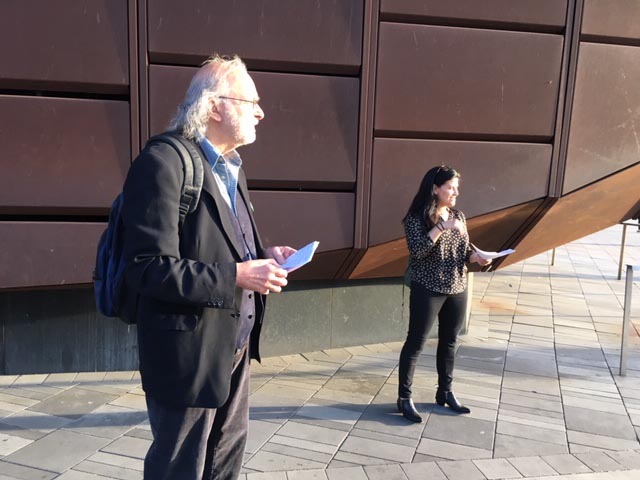
Sometimes you just gotta be there- Citizens Defending Libraries was outside the gala leafleting with a message as gala attendees arrived.
Our message which we chanted was “Put a stake in faux philanthropy: Take less and don’t sell our libraries!” We also sang our library don't sell our libraries song written for us by Judy Gorman. We displayed this visual:
Admittedly, our chant about eliminating “faux philanthropy” and “taking less” instead of selling libraries was borrowing from the spirit of Anand Giridharadas, author of “The Elite Charade of Changing the World” (we've writtenabout him before), who has said that“giving has become the wingman of taking. Generosity has become the wingman of injustice. Changing the world has become the wingman of rigging the system.”
Upon hearing our chant one of the developers entering the arena came over to joke with us: “How about if I want to buy a library?” David Kramer, whose Hudson Companies is replacing the downtown Heights central destination library with a luxury tower in a shrink-and-sink real estate deal, was one of the attendees. Although often quipful himself, Kramer was not the fellow who offered this clever quip.
This is the flyer we handed out to those entering plus to some passersby:
Here is the text.
Spending Public Library Money To Partner and Party With Private Real Estate Interests Destroying Our Libraries?
NYC Public Libraries Are Mostly Public Tax Dollar Funded– And The BPL Is Partnering & Partying With Private Interests, Honoring Real Estates Interests Dismantling Libraries?
Our libraries should be a civic commons for public discourse and learning. Instead, the mantra afoot with our library officials is to “partner” with, advertise, and undeservedly burnish commercial corporate brands and the reputations of companies unraveling our democracy, companies involved in privatizing our public assets and turning our libraries into real estate deals that eliminate the books, librarians and libraries the public has invested in.
NY Times columnist Jim Dwyer wrote that NYC libraries “have more users than major professional sports, performing arts, museums, gardens and zoos - combined,” but the city diverted its funds instead into subsidies for the very controversial private Ratner/Prokhorov “Barclays” arena with:
at least $464 million to build new baseball stadiums . . and $156 million for the Barclays Center. That's $620 million for just those three sports arenas - a sum more than one-third greater than the $453 million that the city committed for capital improvements to the its 206 branch libraries and four research centers, which serve roughly seven times as many people a year as attend baseball games. ( . . the teams are getting an additional $680 million in subsidies spread over 40 years.)
Our presidential-candidate mayor underfunds libraries as an excuse to sell them while the BPL holds a gala to honor the Barclays Center and the Brooklyn Nets, brought to us by subsidy-collection meister Bruce Ratner? It’s insane and absurd: BPL president Linda Johnson said turning libraries into real estate deals was her biggest priority. Topping the list: Two libraries next to Ratner property, including Brooklyn’s second biggest library. Ms. Johnson is now literally shacked up with Bruce Ratner. The dots to be connected are myriad. See:
Sign our petition on the web: Citizens Defending Libraries
* * *
Note that the two Citizens Defending Libraries posts above contain a ton of information about the almost unbelievable number of dots that connect when it some to library real estate sales, Linda Johnson, her shackmate Bruce Ratner, Forest City Ratner and the Brooklyn Bridge Park Corporation board similarly pushing for development there.
Nearly 500 supporters gathered at Barclays Center last night to raise funds for Brooklyn Public Library (BPL) and to recognize Brooklyn’s leaders in business, sports and literature. “In addition to raising funds for our collections and services, the gala provides Brooklyn Public Library the opportunity to recognize organizations and individuals emblematic of Brooklyn’s innovative and creative spirit,” said Linda E. Johnson, Brooklyn Public Library President and CEO. “The Barclays Center and Brooklyn Nets have inspired the borough with the power of sports, and in the process supported the Library and local community-based organizations. We are delighted to honor all of their accomplishments.” * * * * BSE CEO Brett Yormark—who oversees the business enterprise that manages and controls the Brooklyn Nets, Barclays Center and other sports and entertainment venues—accepted the award on behalf of the Barclays Center. In his remarks, he announced a special initiative to provide two free tickets to a Barclays Center event to every child who completes Brooklyn Public Library’s summer reading challenge. “We are honored to be recognized by the Brooklyn Public Library, one of our borough’s pre-eminent cultural institutions,” said Yormark. “Hosting the Gala aligns perfectly with Barclays Center’s mission of bolstering other key Brooklyn organizations and we are proud to continue that support by partnering on the summer reading challenge.” Opened in 2012, Barclays Center hosts an extensive variety of events, including the Brooklyn Nets, premier concerts, major professional boxing cards, top college basketball, family shows and the New York Islanders. The Nets relocated from New Jersey upon the opening of the arena, and have reached the postseason four times since moving to the borough. In all of its community efforts, BSE Global aims to inspire lives through the spirit and the power of sports and entertainment. * * * Furthermore, the Brooklyn Nets and Barclays Center have partnered with Brooklyn Public Library on a number of literacy initiatives including Team Up To Read, a program to support children ages 5 to 9 as they work to become strong readers. * * * * Special guests included Brooklyn Borough President Eric L. Adams . . . * * * * Baratunde Thurston, a trustee of Brooklyn Public Library and Emmy-nominated futurist comedian, writer and cultural critic, served as host for the evening. Thurston helped re-launch The Daily Show with Trevor Noah. . .
(An aside: Does it seem that the Daily Show has gotten increasing flat and corporate in its messages recently?)
As for the "nearly 500 supporters," that's also what the BPL told the police, but our own count was far below that. We had an idea of the number based on the number of flyers we handed out to those who arrived plus a good sense of the high proportion of people taking them. Maybe nearly "nearly 500" is the number of people for whom tickets had been bought, rather than people who actually showed up?
It was amazing how many of the people who showed up didn't know about the library sales or dismantlement. One of the attendees walked over to specifically thank us for handing out the flyer. At least of the police officers on duty for the even was also very thankful to learn about much that he said he didn't know.
There seems to have been virtually no coverage of the gala. The BPL, itself, put up pictures here:
Join the crowd?
On the right it's Bruce Ratner
Ratner girlfriend BPL president Linda Johnson, glad to have her arms around two local politicians who want to become mayor, City Councilman Corey Johnson on left, and Brooklyn Borough President Eric Adams on right. Borough President Adams has been a regular attending BPL galas.
Early September 2015: Borough President Adams ponders over 2000+ signed and individualized petitions opposing the sale of the second biggest library in Brooklyn that were collected by Citizens Defending Libraries in August. The petitions impressed him, and he surprised the real estate industry by refusing to approve the deal selling the library that had been brought to him. After the City Planning Commission and the City Council ignored his opposition, Borough President Adams eventually fell in line behind everyone else giving a last approval of the shrink-and-sink sale that converted the library site to a luxury tower project.
Here is a link to must read from National Notice how on issue after major issue, a robust system of NYC libraries being an excellent example, elected officials, succumbing to the influence of money are not giving the public what it wants and could easily have (plus how the corporate press is complicit):
It's unsurprising that the library, like the Brooklyn Academy of Music and the Brooklyn Museum and the Brooklyn Children's Museum [which itself is involved with a BPL library real estate deal] and the Brooklyn Historical Society, would enmesh itself with a major company. Still, it remains unfortunate that such nonprofit institutions, which are supposed to act in the public interest, ally themselves with big-money sponsors whose interests are not necessarily in sync. * * * I don't think--I don't like to think--that the need to keep warm relations with potential sponsors affects Brooklyn Public Library programming decisions or materials selection. Let's see. The library, during the height of the project controversy (and before Johnson's time), faced charges of censorship for culling certain politically charged pieces of art when re-mounting an art exhibit called Footprints. (It was unwise caution, but I thought other omissions were even more meaningful.)
About library real estate deals (which have been in the works since about 2004 or earlier, at first mostly in secret) Mr. Oder said:
The devil is in the deal, and the details: clearly the New York Public Library's Donnell Library deal in Manhattan was a disaster. I'm reserving judgment on the Brooklyn Public Library's Brooklyn Heights Branch.
As comments to Mr. Oder’s article Citizens Defending Libraries co-founder Michael D. D. White wrote:
One might reserve judgement about the sale of the central downtown Heights library, a central destination library that was the second biggest in Brooklyn and hope that it will be a good deal for library patrons in the end, but that hope must factor in what we know now: It will no longer be a Business Library. It will no longer be a Career Library. It will no longer be an Education Library. It will no longer be a federal depository library. It was all of these things until recently. It will be approximately 40% the previous size. The proportion of space the public visits will be pushed underground: Previously there was almost 38,000 square feet of space above ground (plus two underground stories kept books at the ready). The new library will have just 15,000 square feet above ground. [More of the comment at the site.]
A few days after the gala, BPL trustee (also Brooklyn Bridge Park Corporation board member) Hank Gutman, dressed for tennis out side the Brooklyn Casino on Montague Street, ran into CDL co-founder Michael D. D. White. Gutman attended the gala, while White was outside with other leafleting library defenders. Gutman told White that White should have come to gala and `why not contribute to the library to do so.' He asked White why White wasn't busy donating to the library-- But that sort of missed the basic point of the flyer that was handed out that evening, that we the taxpayers do pay for our libraries, that "NYC Public Libraries Are Mostly Public Tax Dollar Funded," and that when taxpayer money is diverted into huge subsidies for projects like the private Barclays arena and then the BPL is induced to use our publicly funded libraries to advertise that private arena, it's not charity, and our public tax dollars are being stolen to support private interests.
There is now available a brand new Project Censored Radio Show radio interview with CDL co-founder Michael D. D. White that provides, in one-half hour, a superb up-to-date comprehensive overview about what is going on with respect to the dismantlement of NYC libraries and issues related thereto.
The photo of Bruce and Linda that creeps in here is from a recent BPL gala
Sometimes to report truly relevant news, even about the real estate deal sales that plunder our libraries, you have to sound a little bit like a gossip column. . . .
Guess who’s dating whom on the sly? Guess who just got divorced? What two darlings spotlighted in the annals of library sell-off deals are shacking up in a love nest the location of which you might find startling and hard to fathom?
A couple of days ago reporting by the Real Deal highlighted three “memorable” residential sales that just “popped up in records.” The number one deal highlighted was a couple’s purchase of one of the luxury condo apartments in the much litigated over and promenade-view-impairing Pierhouse development in Brooklyn Bridge Park at 130 Furman Street. . .
And who was the “couple”?: it was Bruce Ratner and Brooklyn Public Library President Linda Johnson.
To wit, here is what the Real Deal reported:
1.) Forest City Ratner co-founder Bruce Ratner along with Linda Johnson snapped up a condominium along the Brooklyn waterfront. The couple paid $4.7 million for the two-bedroom pad at 130 Furman Street. Ratner split from Dr. Pamela Lipkin, a plastic surgeon, who at one point during the couple’s divorce had alleged Ratner was trying to evict her from her clinic at 128 East 62nd Street.
We generally like to be well wishers when couples unite, but what a confluence of the unsavory this is. Where do we start in making the connections; there are so many connectable dots in play:
• Bruce Ratner is, after all, the Bruce Ratner “developer” of Forest City Ratner, who, as in the case of the Atlantic Yards Project (now going by the alias “Pacific Park”- Park?), has specialized in subsidy collection and preferential no-bid handouts from government. When BPL president Linda Johnson first announced the sale of Brooklyn public libraries, saying that the BPL wanted to sell the most valuable libraries first, the two libraries at the top of her list for sale first were both adjacent to Forest City Ratner property. See: What Could We Expect Forest City Ratner Would Do With Two Library Sites On Sale For The Sake Of Creating Real Estate Deals? and A Ratner in the Stacks: Library To Sell Forest City-Adjacent Branches, by Stephen Jacob Smith, February 5, 2013.
• BPL’ spokesperson Josh Nachowitz said that the BPL would not rule out the possibility that it would sell to Ratner one of those BPL libraries prioritized for first sale, the second biggest library in Brooklyn, the central destination Business, Career and Education Brooklyn Heights federal depository library in downtown Brooklyn. Ultimately, under the circumstances, doing so would have been very bad optics. The Heights library was not, in fact sold to Ratner. Nevertheless, the deal was structured in such a way that Ratner became the gatekeeper controlling whether the transaction could proceed. See: Forest City Ratner As The Development Gatekeeper (And Profit taker) Getting The Benefit As Brooklyn Heights Public Library Is Sold.
• BPL president Johnson and Ratner will settle into the Pierhouse amongst company they know well and have significant connections to. In September 2015 it was considered a scandal when it was discovered that Hank Gutman (Henry B. Gutman) and David Offensend had both purchased condo apartments in the Brooklyn Bridge Park Pierhouse condominium. Both Gutman and Offensend were board members of the board of the Brooklyn Bridge Park Corporation (BBPC) that had to approve the Pierhouse development, something that then required the Conflicts of Interest Board to rule on whether this was a conflict (a ruling that it is not, is only a ruling by a politically connected COIB). The Brooklyn Bridge Park Corporation has pushed for development in Brooklyn Bridge Park. It has a lot of probably not so coincidental overlap with the board of the BPL where the trustees have pushed to turn libraries into real estate development. Two of those overlaps are Mr. Gutman and Mr. Offensend themselves. Mr. Gutman who is also on the BPL board has been one of those pushing for library sales. Mr. Offensend’s wife, Janet Offensend, was also on the BPL board for a critical period of time where she spearheaded adoption of the BPL strategic real estate plan to sell BPL libraries. That included hiring consultant Karen Backus from Forest City Ratner and overseeing the creation and submission of the Backus recommendations). Janet Offensend’s work as a trustee closely mirrors the work that David Offensend, her husband, was concurrently doing as he set NYC public libraries up for sale when he was Chief Operating Officer of the New York Public Library (NYPL). Thus, two of the first library sales by the NYPL and BPL respectively, the shrink-and-sink deal of the Donnell Library and the shrink-and-sink deal of the Brooklyn Heights Library (with Ratner as gatekeeper) mirrored each other closely
• With David Offensend being involved in the approval of both transactions, Starwood Development wound up being involved both as a developer of the challenged Pierhouse development in Brooklyn Bridge Park and the luxury development that replaced the Donnell Library sold by the NYPL.
• The reason that the Pierhouse development was legally challenged, that community residents were so angry with the Brooklyn Bridge Park Corporation and its board, and with Brooklyn Bridge Park Corporation board members Gutman and Offensend getting condo apartments from the developer (even if the COIB declared there was no conflict of interest) was because of the shenanigans involved when the Brooklyn Bridge Park Corporation (pushing for more development all the time anyway) allowed the Pierhouse development to violate representations and promises made to the community: The Pierhouse development surprised the community by being built extra tall, and obliterated views from the Brooklyn Heights promenade that were supposed to have been protected. The Brooklyn Bridge Park Corporation tried shuffling off some of the blame to the Pierhouse development architects and including the way that those architects had done their numbers while interpreting some obscure rules the architects chose to apply in making the Pierhouse taller.
• Johnson and Ratner’s familiarity with Marvel Architects, the architects of their new digs also relates to libraries. Marvel Architects, headed by Jonathan Marvel, in addition with being accused of running funny numbers to make Pierhouse taller is also the architect for the luxury tower replacing the Brooklyn Heights Business, Career and Education Library, plus is acting as advisor to Ms. Johnson and the BPL on design issues related to selling that library. Marvel, as advisor to the BPL and Ms. Johnson came up with some very suspicious numbers respecting book counts and bookshelf capacity as the BPL tried to mount and press arguments to ensure that the library was sold for development. See: It’s Marvelous To Have Books!- Indeed, But Architect Jonathan Marvel Designs a Library Seemingly Oblivious To The Tradition of Finding Books In The Library.
• At this point, would it be superfluous to add that one of the first so-called “public/private partnerhsips” that BPL president has recommended for the BPL to be pursuing manifested itself in the form of the BPL partnering to promote to local school children Ratner’s Nets at his Atlantic Yards “Barclays” arena?
Back to gossip our column Hedda Hopper voice: We have a page up with more about the BPL trustees and the BPL’s senior officers including well worth reviewing bio of Linda Johnson, Ms. Johnson started at the BPL in July 2010. At her first meeting with the BPL board Ms. Johnson told the board how the BPL's real estate plans were her priority and not long thereafter reminded the BPL to remember that their goal was to lock the next mayor (whoever was successor to Bloomberg) into the real estate plans that were secretly underway.
Prior relationship: Linda Johnson with billionaire Leonard Lauder.
Often noted is that until December 2013 Johnson was dating another very wealthy man from a big company, Leonard Lauder, with plans to marry that were broken off just before the scheduled ceremony. The New York Post states that they had been dating since 2012. The Times says they were engaged in 2013. (The relationship reportedly began after Lauder’s first wife Evelyn died in 2011.) Leonard Lauder's very politically active brother Ron Lauder, also a famously wealthy billionaire was involved in clearing the prohibitions that allowed Bloomberg to get his third term.
The Pierhouse development offers extraordinary views of the New York’s harbor and the lower Manhattan skyline. What allows it to manage it to do so involves, to an extent, the interposition by which the Pierhouse is grabbing views that were previously available from the Brooklyn Heights promenade and no longer are. That raises an overall question about who gets the benefit when public assets are usurped for private benefit . .
Above: Luxury NY Harbor and Manhattan skyline views offered, respectively by Pierhouse where Bruce and Linda bought a condo and by the luxury tower replacing Brooklyn's second biggest library that they were involved in selling off.
The luxury tower now replacing the downtown Heights Business, Career and Education Library that will now dominate the sky of historic Brooklyn Heights is, similarly to the Pierhouse, advertising stunning views. Those views likewise include sweeping views of the harbor and the downtown Manhattan skyline. And, as that luxury tower looks down on the much shorter federal courthouse across that way (that, with some success, was challenged for being too tall) it is worthwhile to remember that the spectacular views offered to residents of that tower are based on what the public sacrificed. We mean by that not only the surrender of the skies of over historic Brooklyn Heights, but the sacrifice of a major library that was recently thoroughly renovated and upgraded to be state-of-the-art and one of the best in the BPL system.
If you are benefitting from the views in either of these developments you are unlikely to have second thoughts about any diminishment of the public realm by which those views may have been achieved. However, like Bruce and Linda, you may have to keep buying new apartments, whatever has just been built, to stay ahead, and keep you back turned on the losses the public realm is suffering. . . But the option of continually buying new apartments affording the latest edition of a good view may be something that only those who remain wealthy will be able to afford– That's true; Isn’t it? . .
. . . In that case, if you are benefitting from these newly marketed views, you might indeed actually have second thoughts about the diminishment of the public realm that made it all possible. That’s because, like Bruce and Linda, your ongoing participation in that diminishment is vital your staying one step ahead on the treadmill.
(BTW: For those who may be confused seeing recent pictures of Mr. Ratner, he has recently shed a great deal of weight.)
“Rearranging deck chairs on the Titanic”: That’s a certain snide metaphor most of us are familiar with–
The quip doesn’t have exact application to the December 11, 2018 meeting of the Brooklyn Public Library trustees, but what the trustees did at their close-of-the-year, seasonal holiday meeting does stand as a very apt, stark and not altogether different metaphor for things wrong at the BPL. They devoted their time to a presentation about rearranging furniture in shrunken library spaces like the one they were in. Their meeting occurred atop a library of empty library shelves, and, although the Trustees were theoretically in charge, nobody in the meeting seemed to notice or care that the library book shelves in the building below them were empty.
Blithely, the trustees were in happy holiday spirit. And the holiday gifting that was going on?: To put the final ribboned bow of symbolism on this event, each library trustee was given a copy of a book about the neglectful destruction of libraries.
At their close-of-the-year, December 11, 2018 trustees meeting the board of Brooklyn Public Library treated themselves to a special showcasing of what we have refereed to as their “Murphy Library” concept, the idea that if spaces in libraries are flexible enough in the ways certain people are conceiving, that libraries don’t need to be large at all; they can be tiny. In other words, the size of a library is virtually just a state of mind— To quote Hamlet: “I could be bounded in a nutshell and count myself a king of infinite space.”* And there is a corollary concept that the BPL trustees and their cohorts advance along with the concept that with sufficient flexibility, space of almost any size can be enough library space: That corollary is that just about anyspace, anytime, can be library space.
(* On the other hand, Hamlet experiences the entirety of Denmark to be a prison, knowing what he knows of the crimes afoot and knowing that “the time is out of joint.” NYPL librarians were told to discard "extra" copies of Hamlet, even if there might be demand for them, in order to keep their shelves half empty.)
An Overview of The Fussing Over Library Space
Before, we get to the details of the December 11th “Making Space” presentation to the trustees, which we will in a moment, it is worthwhile to consider an overview.
The fussy energy that library administration officials and others are putting into their “Making Space” initiatives could, at first blush, be regarded as a valiant effort to squeeze the most out of library resources, communicating to onlookers that library spaces are intensely valued by these people . . . That’s until you realize that these same people, the same coalition of economic forces (the Revson Foundation, The Center For an Urban Future, the BPL trustees themselves) are at the same time working hard to justify the selling off of libraries, turning them into real estate deals like the shrink-and-sink Donnell Library sale (creating, as a priority, a luxury tower where you can now go for $1,500 ice cream sundaes) and the similar -shrink-and-sink sale of the Business, Career and Education Brooklyn Heights Library with the concurrent elimination of books and librarians. . . (We are eliminating the city’s largest science museum!) When that is considered these perky “Making Space” optimisms look much more like an effort to justify the shrinking of libraries by proving that there is no need or benefit fulfilled when libraries spaces are larger.
The zest for `flexibility’ that these “Making Space” initiatives show may seem to demonstrate commendable creativity and inventiveness in envisioning how library spaces can be used. . . But that is until you realize that these same people are the ones that over and over again suggest that existing libraries must be rushed into the hand of real state developers who will tear them down because, the vision and insight of library administrators failing them, they just don’t see how the spaces of those, often larger, libraries can still be flexibly or valuably used by the public. This same lack of competence, creativity and this propensity to abject despair also crops up when these people can’t believe how libraries they want to give to real estate developers could ever be kept in good repair.
The presentation of the “Making Space” initiatives involve an almost absurd delectation of, a preoccupation with, the value of repeatedly reconfiguring the arrangement of space, as if the arrangement and configuration of space matters. Indeed, as just noted, these same library administration officials will argue that they want to sell libraries because of their poor configurations as with NYPL COO (and Senator Schumer wife) Iris Weinshall in 2017 stressing that a reason to sell the Inwood library was so that it could be reconfigured or BPL president Linda Johnson saying the same things about the central destination, downtown Brooklyn Heights Library she wanted to shrink. But then, at the developer meetings where these libraries are being sold off, the developers are told that the development proposals they submit will not get extra credit for good configuration of “replacement” library space. In the case of the redevelopment of the former Business, Career and Education Brooklyn Heights Library, the horse-shoe shape of the smaller, more underground “replacement” library was clearly just an afterthought to the developer being able to first cream off the top what was most valuable to him.
In the case of the Inwood Library and Downtown Brooklyn Heights Library, the library spaces being jettisoned were recently accomplished expansions that were praised. Likewise, the city’s largest science library, SIBL (the Science, Industry and Business Library at 34th street) that is being done away with is a recent expansion of space, configured with modern needs in mind, and was also praised even as the public invested heavily to produce it.
All these things considered, what might be the theoretically praiseworthy aspirations of the “Making Space” initiative look a lot more like just one more overturned walnut shell being pushed around the table in a much larger shell game of distractions.
Then there is the question how the “Making Space” initiatives focus cleverly to such a significant extent on re-imagining what has clearly been library space with broader and broader redefinitions where, particularly at the outer edges, the relationship of such uses to the essential mission of libraries becomes quite vague: Case in point?– making library space into karaoke space.
There is a desperate need for public spaces and public services of all sorts. That need is felt all the more acutely as the world around us is privatized and government services contract. There is nothing wrong and everything right with wanting more theater space and, for instance, museum space. Furthermore, the tradition of libraries also providing community and public assembly space already goes back. But throwing everything in the same pot creates an opportunity for muddling and can even create destructive competition where instead of being properly augmented, public resources that have already been made scarce get divided up into ever smaller fractions.
And that muddling can work against, instead of in favor of, those other groups getting thrown into the same pot with the libraries. For instance, in a consolidating shrinkage, the BPL is giving up its Brower Park Library space. Although that library, the “smallest library” in the BPL system, desperately needed to be enlarged (and could have been enlarged) the “replacement” library will be no bigger, perhaps smaller, and will take over and shrink space in the Brooklyn Children’s Museum that not long ago needed to be enlarged at public expense.
When what is “library” space keeps getting redefined to include other increasingly broad alternative uses, it draws in other constituencies to claim the space. One experiment, of the BPL and NYPL officials in this regard was to privatize and shrink library space by turning library space over to the private Spaceworks corporation (actually set up for that purpose), which would then charge for artists to use the space. Thus the BPL gave away the second floor on top of its Williamsburg Library and was marching next toward a similar substantial shrinkage of the Red Hook Library. Spaceworks proclaimed that one of it's central purposes was to take over library space because it was “underutilized.”
At the same time, this kind of muddling is potentially a distraction and deflection from the loss of books and core library services. Plus, finally, somewhere along the line, the constituency for defending libraries is likely to get confusingly diffuse.
If you are going to dismantle libraries it is a useful start to first dismantle the concept of what “a library” is: If any space of any size used for virtually anything can be “a library,” and if virtually any space anywhere, anytime can be considered “a library,” then it is almost as if, nothing in particular is a library and everything is a library. In other words there is nothing that is not “a library.” If you are confused enough about what a library actually is, how do you defend them?
Probably those of us who are not entranced and excited by “Making Space” initiatives presentations are supposed to be viewed as old, behind-the-times fuddy-duddies unwilling to pay homage to the marvelous future that’s unfolding. . .
. . . That’s as if we are not supposed to notice that as the BPL trustees were in exuberant holiday spirit enjoying this presentation they were sitting atop a library full of empty bookshelves.
The “Making Space” Initiatives Presentation
The “Brooklyn Public Library’s Making Space” initiative is a“Featured Project” of The Revson Foundation, a “pilot” project to deal with the “major challenge,” of library administration officials “finding spaces that can accommodate the diverse variety of programs.” The presentation to the trustees on december 11th was by David Giles. Mr. Giles came to the BPL as staff after working for the Center For an Urban Future (CUF) doing work funded by the Revson Foundation, where he advocated for sales that turned libraries into real estate deals. That included writing op-eds CUF got published in newspapers favoring library sales. Giles is on the BPL’s strategy staff. “Strategy” is the rubric under which library administration officials generally put their libraries-as-real-estate venture activities.
Giles explained that his presentation was a version of the presentation given for the AIA, American Institute of Architects, earlier in the year. It reflects the design work of SITU Studio, an Architectural Design and furniture fabrication company which is lucky enough to be located in the subsidized Brooklyn Navy Yards. SITU Studio has branded its “Re-Envisioning Branch Libraries” as “L+.” The “+” branding is a nice PR touch, an example of what has become the fairly standard Owellian tactic these days of reverse naming things: It counters the fact that the project focuses on making use of inadequate, small and insufficient spaces. Making certain the “+” branding doesn’t go unnoticed or unremarked upon SITU Studio’s used the “+” design as a motif for door handles and sprinkled it around liberally for other of its furniture design accents.
Giles explained to the trustees that the project:
was meant to sort of re-envision The library community room as a more dynamic education and collaboration space. And it was meant to address the gap between the types of services and programs that we put on as a 21st century library, uhm and the various buildings that we’ve inherited over the last 120 years or so. [i.e. “old.”]
Giles said these old `inherited' buildings included approximately 18 Carnegie era libraries buildings built at the beginning of the last century (the BPL previously caused the Brooklyn Paper to carry an article about how they ought to be sold), about 15 mid-century buildings, and about 20 so-called “Lindsay box buildings” from the 1960s and 70s. He described the Carnegie era libraries as being “highly controlled spaces” from the “prime shush period” with lots of space for private work. (The Flatbush Library in which the presentation was occurring is`Carnegie era,’ the sixth Carnegie, which opened in Brooklyn in 1905,)
The mid-century libraries were “fairly large, two stories” with “lots of spaces for shelving and seating, even, and in some instances, auditoriums and stages for public events.” The Lindsay Boxes were referred to as stripped down to “a kind of franchise model” avoiding “accouterments” to “spaces” that “are sort of devoted mainly to shelving.”
In January of 2013 Mr. Giles authored a report issued by the Center For and Urban Future with figures we quickly picked up on because those figures argued well against the sell off of libraries and the elimination of books: “[Libraries] have experienced a 40 percent spike in the number of people attending programs and a 59 percent increase in circulation over the past decade.” Mr. Giles didn’t offer a new figure to replace their previously cited “59 percent increase in circulation” figure that we used against them when we disagreed about whether libraries should be sold, but in saying that program attendance was now putting “an incredible strain on our buildings” Giles had a now boosted figure for program attendance saying that “in just the last five years” there was another 20% increase, making program attendance “more like a 59%, 60% increase” over the previous 18 years. . . . If those numbers don’t quite jibe (and they don’t seem to), it could be because some of those figures are for New York City libraries generally, while others may be for just the BPL’s Brooklyn libraries.
Giles explained that the BPL library programs were hosting cultural celebrations and cultural programs: theatrical performances; and townhall type discussions, media classes, and programs for teens and adults, tell-a-stories and televisits. And he said that, doing an audit, the BPL decided it was hosting 70,000 or so public programs during the year throughout all its libraries.
Giles explained (starting to refer, as he talked, to what was in the community room where the trustees sat):
As a part of this project, Situ studios, along with our librarians, and strategy office did a complete audit of the 70,000 or so public programs that are happening in the library across the year. And they categorized these in terms of program types, and took a sort of deep dive in terms of the functional requirements and spatial demands they made, uhm, and sort of systematized these programs, not only in terms of theme and program type, but in terms of furniture requirements and functions. . . . And then they started developing what they are calling `building blocks' to support these various program demands. And, two things they wanted to do here, they wanted to create furniture pieces that were incredibly movable, easily rearranged into new constellations, and fairly cheap to produce and manufacture. So you can see here these quite sturdy metal frames can be used, uhm and, you know, produced in different ways to support different purposes. Here we have a mobile media cabinet, which has, actually, outlets installed inside. It holds a game console and television, but that same frame can be repurposed, not by the library staff, but by the manufacturers as a sort of hanging coat hanging unit. We have different storage units, different sizes. The storage units can double as seats. All of the services are writable, so people can write on these, use them as white boards. We have mobile walls that serve as whiteboards, And also pin up boards on the other side. They help divide up the room as well.
Here are some other mobile walls and signs. . . .
So, translating, if you will, the idea of all this “fairly cheap” rolling box furniture, is that it is sort of like a theater set, where black clad figures that the audience is supposed to ignore swoop in during scene changes effecting rearrangements that when the audience and actors assist with their imagination suggest entirely different places, indoors, outdoors, maybe even on different continents, palaces or hovels . . .
. . . Will the BPL be engaging black clad stage assistants to swoop in between the library space users? We imagined turnover time when all the “mobile walls” that have served so ingeniously “as whiteboards” have to be wiped down (make sure you get all the sides) so the next group of users have a clean slate for how they will `conjure’ the room. We were tempted to try out these BPL whiteboards by writing, “Don’t sell or shrink our libraries” on them and see how fast the trustees would react, but nowhere in the room were there any whiteboard writing implements to be seen.
It's "curtains" for the old fashioned library user of days past!
Giles explained how the room could also be divided (as if into more than one room) for “two different programs simultaneously.” Pointing to the ceiling Giles explained that heavy curtains hung on tracks there could pulled around as enveloping privacy walls. BPL president Linda Johnson delightedly told the trustees that curtains hanging almost to the floor were designed to be “soundproof” (indeed, like the “Get Smart” television series “cone of silence”?). And if you don’t like hanging curtain walls evocative of Ninotchka’s satirical vision of Soviet era Russian poverty, there were also rolling walls.
Giles said “You can hang a lot of different things from the ceiling grid: you can hang theater lights, speakers, projectors, and furniture, OK?”
Looking a little bit like a vacuum cleaner nozzle, an electric cord dangling above our heads ready to be dragged down for use by a right-height individual
Included among the things “hanging” from the ceiling grid were dangling electrical cords looking a little like vacuum cleaner nozzles for right-height human beings to reach up and grab
Giles explained:
Uhm, One big need was power. This room had two outlets. And with the conduit’s and the ceiling grid we were able to add 24 that’s in here for different programs. You can see the extendable cords hanging from the ceiling for maker programs.
Wow! Gosh golly. Library administration officials and the other library sale promoting organizations they have been working with have cited the lack of electrical outlets of as one of their favorite capital infrastructure shortcomings when describing libraries, but running electric lines or cords is one of the easiest, cheapest things to do, especially when you don’t bury them in the walls when prioritizing aesthetic goals.
One of those electrical nozzles when it's a little closer to nose height
Giles explained that he and his designers had hopes of somehow arranging the constellation of furniture to “create a natural stage” for karaoke and talent shows at the library (part of the “very different public service model and . . diverse variety of programs” Giles was telling the trustees could be so ingeniously handled by strained resources with such flexible repurposing of library space). Giles said that while “it was a nice idea” they had “backed off” of it “because of insurance.”
Then Giles demonstrated the room’s addressable LED “smart lights” and if you want to know when he became most gleeful it was probably as he was talking about “value engineering” and showing off how the lights that hung like children’s party balloons between the grid for hanging curtains, electric cords and furniture (or other lights) could change colors or be multiple colors at the same time. The lighting was going to be good for karaoke and talent shows.
We have a short little video that captured the moment (click through to Youtube for best viewing):
Giles said that at first he worried that spending on the lights would be an excessively expensive part of the project, but if you are following these things, you probably know that, along with other computer type things, LEDs tricked up with integrated computer features are getting pretty cheap these days. What did you put on you Chanucha bush this year? Giles said the LED lights were “aspirational.”
Fun fact about lighting: One of the defining characteristics of Film Noir is its lighting emphasized dramatic areas of dark shadow contrasted with bright light shining on key objects. Yes it was partly inherited from early German Expressionist cinema, but one reason it was adopted as part of the look of the genre was that the films of Film Noir tended to be B films and the use of the bare minimum of lighting (already costing virtually nothing), was a way to stretch low budgets to get dramatic effects without investing anything for sets. . . Just saying.
Giles put up slide after slide to show all the “configurations” into which a flexible room could theoretically be rearranged: typical classroom configuration, team cooking classes, job readiness classes, English as a Second Language classes, citizenship test classes, classes on for health insurance enrollment assistance, homework assistance, “maker space” configurations, storytime configuration, movie nights, and of course karaoke and talent shows.
At one point, Giles stopped to admire an image of the divided community room with people filling it and exclaimed that the image was “sort of like a Renaissance painting; I love this picture.”
David Gile's "Renaissance painting," (a Rembrandt?)
At the outset, the trustees were told that the guinea pig libraries for the program experimentation were the Flatbush Library they were in and the smaller Clinton Hill Library’s space. The Clinton Hill Library has been talked about in connection with a future library sale, but now probably only in conjunction with an upzoning of the area like with the Inwood Library.
At the conclusion of the presentation, Linda Johnson said the community room they were in was “a prototype, the kind of thing we would like to do with other libraries throughout the system.”
Situ Studio partner Brad Samuels said in another "Making Space" presentation video you can watch on video*
That mass production is essentially what Situ Studio partner Brad Samuels said in another presentation video you can watch on video*, that the approach representing a “paradigm shift” is designed to be “replicable” and “implemented anywhere in the city.” In fact, Mr. Samuels, saying that future of the libraries was “not monumental” and that the future of the libraries “is distributed,” talked in that presentation about how the same approach was also intended to convert other than existing library space into such flexible `L+ library space’ by throwing these L+ “kits of parts” into “community retail space” such as “persistently vacant store fronts.” Samuels cited, for example how a “cooking class could benefit” if it took place in abandoned restaurant space that still had working sinks.
(* We have our own video of an event we did with Rev. Billy where at about 10:36 we reviewed, with some parody, the L+ ideas for using tiny library spaces.)
These thoughts about minimal investment library “outposts” that pop up into existence easily by, say, taking over a closed restaurant or another space a landlord is finding hard to rent out, are thoughts that are interesting to sit with a bit, if you consider that the people paying the piper with NYC public library money are people now tending to think of libraries as pieces on a real estate chess board. These are people who also seem to have no compunction about popping them back out of existence when disappearing acts would convenience a deal being put together– “Outpost libraries” could be rent paying placeholders as time is bided.
This idea that `poof,’ an unused restaurant now becomes `library space,’ that library space can be anywhere, anytime, is based partly on the notion that library space can be anything. It is also based, as Mr. Samuels referred to in his presentation, on the idea that libraries don’t need to have books on the premises when there is instead a “floating collection” of books theoretically (not at the libraries themselves). That “floating collection” qualifies every space to be a library. Mr. Samuels credited Christian Zabriski and Lauren Comito of Urban Librarians Unite (who have argued for all the library real estate sale deals proposed so far) with helping him construct his vision for the libraries. Mr. Samuels said that the existing space now in libraries needed to “catch up” with this vision.
The Empty Shelves of the Flatbush Library
The BPL trustees were happy with Mr. Giles’ presentation. Not one of them seemed aware or commented that they had noticed that the bookshelves in the library downstairs below them were, as they met, largely empty. You could actually see this looking through the atrium windows of the community room in which they sat. And we have close up photographs that show the situation. (Would this be a good time to mention that only a few weeks ago we posted information about how to recognize someone who can be the diagnosed as a "communal narcissist"?)
From this vantage you can see through the windows the BPL trustees having an executive discussion meeting at their December 11th meeting, and at the same time empty bookshelves below.
When we went to the mezzanine to take photographs, some arriving library users were just ahead got upstairs seconds before us and we heard them immediately exclaim about the empty shelves we were about to witness ourselves: “They ain’t got jack!”
The goal of these disappointed book seekers was apparently books related to education and to study for college preparation. . .
The Flatbush Library serves a largely Caribbean community. It seems like the Caribbean is rich in history and culture. Are there no books and materials about it? If there are, they are not filing this library.
Some of the same bookshelves could also be seen to be empty in the summer of 2017 when the Brooklyner ran an article (with photos) that the BPL had “announced a drastic cut in their summer hours” for the Flatbush Library“due to a broken air conditioning system.”
Some commenters expressed concern that this reduced schedule signaled the beginning of the end, citing the demolished Brooklyn Heights Branch. “They did the same thing at the Brooklyn Heights branch a couple of years ago, before they sold it to a developer,” writes another commenter. “The air conditioner can be repaired, the city just doesn’t want to pay for it.”
Who knows what was going on in 2017 (we also don’t have a date for when the community room work was gearing up), but, as Citizens Defending Libraries has frequently written and testified, air conditioning in city libraries seems to suspiciously break and balk at being repaired over and over again when library administrators want to sell or shrink libraries: The Donnell Library, the Brooklyn Heights Library, the 42nd Street Central Reference Library, the Red Hook Library, the Sunset Park Library, the Pacific Branch Library, etc.
Feeling Good About Themselves BPL Trustees Give Themselves a Popular Book About Library Destruction
Putting a ribbon and bow on it: The ribbon and bow wrapped red books in front of each of the BPL trustees as a holiday present is a critically acclaimed current bestseller about library destruction.
And that book about the neglectful destruction of libraries that each of the BPL library trustees was given as a holiday season present? It’s “The Library Book,” a critically acclaimed current bestseller by Susan Orlean about the hugely destructive fire in the Los Angeles Library in 1986 when more than a million books were lost or destroyed. It happened because of the neglect by those officially in charge. The LA Public Library was rife with fire safety violations and many experts had warned of the worst before the fire happened.
Ed D’Angelo, a recently retired BPL librarian, who has written his own book about what is destroying our libraries generally (based in part on what he personally saw first hand and reacted to) wrote us that the Susan Orlean book is “an enjoyable read” by “a great writer” who “knows how to tell a good story” and did a lot of research. But he complains that the book is a “`feel good’ book about public libraries.” He says that the book “lacks a critical edge,” and that Orlean “doesn't take the next step and subject all the information she's gathered to critical analysis,” that she “doesn't step back and question” what she has described.
D’Angelo said “You're supposed to walk away from reading the book feel warm and fuzzy about public libraries. . . But critical analysis doesn't sell books or make library bureaucrats feel warm and fuzzy.”
D’Angelo said that the conclusion that Orlean could have drawn, but failed to was that those in charge in Los Angeles were a “a poor custodian of books” and that “the fire merely dramatized their negligence.” D’Angelo opined that the fact that all the trustees of the BPL were given a copy of The Library Book as a holiday gift this year “doesn't reflect well on the book!!”