Why Is New York City Planning to Sell and Shrink Its Libraries?

Defend our libraries, don't defund them. . . . . fund 'em, don't plunder 'em

Mayor Bloomberg defunded New York libraries at a time of increasing public use, population growth and increased city wealth, shrinking our library system to create real estate deals for wealthy real estate developers at a time of cutbacks in education and escalating disparities in opportunity. It’s an unjust and shortsighted plan that will ultimately hurt New York City’s economy and competitiveness.

It should NOT be adopted by those we have now elected to pursue better policies.

Showing posts with label 99%. Show all posts

Tuesday, September 25, 2018

Authors Anand Giridharadas, Eric Klinenberg, Kristen Ghodsee, and Activist Blair Imani, On Panel at Brooklyn Book Festival Discuss, `How To Change The World’ (With Libraries and Social Infrastructure!) Plus Who NOT To Trust— When In Jumps Untrustworthy, Library-Selling Councilman Brad Lander!!

Brooklyn Book Festival "How Do We Change the World?" panel. Left to right, after moderator (and fellow author) Jessica Bruder: panelist authors Kristen Ghodsee, Eric Klinenberg, Blair Imani, and Anand Giridharadas
Sure you want to charge out and get started `changing the world’: You’re revved up because it sure seems the world could use a lot of changing these days!  But it is amazing how twisted things can get right at the outset and how insanely easy it is to trip up in trying to choose your allies. . .

Starting off the morning Sunday (it was the 16th) at the Brooklyn Book Festival was a panel of authors (two of whom we have written about already, Anand Giridharadas (Winners Take All: The Elite Charade of Changing the World) and Eric Klinenberg (Palaces for the People: How To Build a More Equal and United Society*) and two of whom we have not yet written about, gender and communism scholar Kristen Ghodsee, (Why Women Have Better Sex Under Socialism: And Other Arguments for Economic Independence) and activist Blair Imani (Modern HERstory: Stories of Women and Nonbinary People Rewriting History).
(* Mr. Klinenberg has both a British title for his book for U.K. release, “Palaces for the People: How To Build a More Equal and United Society,” and a United States Title, “Palaces for the People: How Social Infrastructure Can Help Fight Inequality, Polarization, and the Decline of Civic Life.”)
The panel's topic was: "How Do We Change the World?"

We wrote about Mr. Klinenberg because he wrote an op-ed derived from his new book about the importance of libraries as an example of how critically libraries represent the need for us to conserve and build our social infrastructure.  His op-ed sounded extraordinarily like it was cribbed directly from the web pages of Citizens Defending Libraries, including his assertion that one reason libraries are besieged these days is because those in power see them as “out of sync with the market logic that dominates our world” plus his rallying cry that libraries need “defending” because they are ties to our freedom and equality.

See: Eric Klinenberg in NY Times Op-ed calls for Defending Libraries Promoing His New Book- "Palaces for the People: How Social Infrastructure Can Help Fight Inequality, Polarization, and the Decline of Civic Life"

We wrote about Mr. Giridharadas because of his warning about who not to trust and more specifically his book’s admonitions that when the wealthy, all the “new philanthropists” who come out (to once again use Mr. Klinenberg’s phrase) infected by their “market logic that dominates our world” we should, indeed, stop to look their gift horses in the mouth— because the gifts they are presenting are likely to be more harmful than beneficial.

See: There’s Much You Should Not Trust When The Wealthy Give- Anand Giridharadas’ “Winners Take All- The Elite Charade of Changing the World” and David Callahan’s “The Givers: Wealth, Power and Philanthropy in a New Gilded Age”

The panel discussion was in the Brooklyn Borough Hall Courtroom, the very same space where multiple “hearings” have been held about the sale of Brooklyn Libraries to turn those libraries into real estate deals, such as the shrink-and-sink sale that got rid of Brooklyn’s second biggest library, what was the Business, Career and Education Federal Depository Library, the central destination Brooklyn Heights Library in Downtown Brooklyn.   . .   BTW: The luxury condos in the tower replacing that library are just now coming to market.  See: As Condo Apartments Set Brooklyn Heights Sales Records (You Heard About Matt Damon’s $16.645 Million Penthouse?) Central Library Sold To Build (Now About To be Marketed) Luxury Condos Nets Mere Pittance.

Thus it was highly ironic in multiple ways that, before the panel even had a chance to commence, who should jump in but library-selling Brad Lander who previously grabbed the spotlight at so many of such hearings leading those who  champion and push for the selling of libraries in deals that will impoverish the public.  (For instance, see him in several clips here: Will Steve Levin Save the Brooklyn Heights Library?)
Brad Lander presenting himself as a progressive activist at the Brooklyn Book Festival's "How to Change The World."  The lectern is the same one where so many people have testified opposing the NYC library sales Mr. Lander promotes when he testifies.
Lander did a breathless double-time spiel associating himself with the `politics’ of ‘activism.’  Like every other knave these days who dresses up in fauxmanteau progressivism, Lander ventured forward in his “bonding” with the audience, starting with an all too usual and easy `I am anti-Trump pot-shot.’   Here are the Landerisms the audience had to sit through before the panel they came to hear got to talk:
I am so exited to come and listen to this panel- I don’t know about you, but I feel like my normal day is something like, you open Twitter and you’re like `Oh my god, what did Trump do today? . . .Who is going to be harmed by it?’  Then you see all this incredible activism taking place.  You think: `Wow!; people are really rising up in creative and new ways, and maybe there is a new world we could build that reflects people’s full selves!’ . . . What would it take to actually bring the change that we need?  I feel like we are in a moment when people have woken up for the need for really big change.  The question of how to bring it remains really, really challenging, so people are focused on just how big the inequalities are economically, but across so many lines of difference as well.  What would it look like to have real equality, real representation in our world, the climate crisis, weakness in our democracy.  But each of those challenges also presents a challenge for the kind of activism that we need to make that change, those very lines of division that general hopelessness about our institutions, they present those challenges: How are we going to make those changes? . . .
This is the same city councilman whom the library selling BPL president Linda Johnson and the library selling Jimmy Van Bramer both proclaimed to be  "very clever."

It gets worse, as we will come back to, during the Q&A that wrapped up the panel discussion, Mr. Klinenberg told the audience that those seeking to change the world (including apparently people wanting to defend and build libraries) should seek out Lander to help them, because they were not going to be able to do it alone.

In the same room, at the same lectern where Brad Lander pitched himself as a (library supporting?) activist, many members of the public testified against library sales Lander was promoting.
We were prepared, in fact we were on the very edge of our seat, trying to get called upon during the Q&A.  We wanted to ask a question about the degree of care with which we need to select our allies for activist change.  We were eager to ask this given the example of Mr. Lander’s usurpation of the opening moments with his self-promoting appeal, and also because of many cautions from Mr. Giridharadas during the session telling us to beware of how the wealthy use their money and foundations.  Giridharadas told us the wealthy try to always to be in the driver’s seat steering, or “changing change” so that change will never take off in a direction offensive to what they have in mind respecting continuing their self-enrichment; over and over again their goal is to just soften the abrasive edges of their self enrichment by appearing to be on the side of the public  — Ah well, we did not get called upon and therefore did not get to ask our question about how to decide who to trust before it was all over.

Here are some highlights of the discussion preceding the Q&A that pertain most interestingly to libraries:
    •    Mr. Klinenberg told the audience that “a week ago, I did an op-ed about libraries, public institutions, which for me are extraordinary a source of inspiration and are in neighborhoods that we live in . . . a place that deserves our resources, our attention, our love. . .”  (We should note that Mr. Klinenberg should have a certain amount of credibility dating a ways back- We previously wrote how Jane Jacobs, in her last book, admired Mr. Klinenberg’s work as a graduate student done a number of years ago.)
Anand Giridharadas

    •    Mr. Giridharadas sounded the alarm not to trust appearances or announced good intentions when the wealthy deploy their philanthropy.  His words sounded sharper than we’ve heard them before (we wrote more about this before):
       •    “We live in a day where the elites seem to really want to help, and yet this is by any reading of the numbers this is the most predatory elite we’ve had in America in one hundred years.  I became interested in how billionaires are helping us while screwing us at the same time. . . . Is the help what upholds their hoarding?”
       •    “When rich people . . . come into the space of changing the world, they never sit in the back row of changing the world; they sit in the front row.  They always get on the board of directors of changing the world.  The wind up as the COO or CEO or something with a `C’ of changing the world, and they change change.  They defang change; they tend to define change in ways that don’t threaten winners.”
       •    He said we get a “light facsimile of change that is the kind of change Mark Zukerberg can get on board with.”
       •    We shouldn’t be looking at these “sugar daddies” to fix inequality and “outsource change.”
       •    He said, “I don’t think that we should be turning first to the `woke’ billionaires to fix this.  My goal is to remind people that we built things like this [the grand court room and Brooklyn Borough hall building we were in] again, and we don’t need permission slips from the powerful to make changes.”
       •    He said we have to clear the brush of a lot of widely believed bullshit and terminology that needs to be dismantled:
          •    “Win-Win”- Neoliberal bullshit.
          •    “Thought Leaders” are thinkers that don’t threaten power.  There are “thinkers” and then there are “thought leaders”- You don’t want to be a “thought leader,” bad thing to be.
          •    “Doing good by doing well, and doing well by . . .”  Again, not good, not real change.
          •    “Innovation”- Not the same as “progress.”  We got a lot of innovation in the last 30 or 40 years.  Unfortunately it just skipped about half of us.
          •    “Giving back”- Sounds nice?- Not the same as “taking less.”
        •    “There is a significant silent minority within the power institutions of our age that understand that they are sitting in temples of cruelty, that understand that they are part of system that’s indefensible.”
Kristen Ghodsee

   •    Kristen Ghodsee said,  “I am trying to think outside of the box of capitalism.  I am trying to push back: Why is it we always turn to the billionaires?  And why do we think of our social infrastructure as something that has to happen within a fundamentally private market where the prices of good and services are always informed by the caprices of supply and demand.”  She blamed “a particular form” of “unregulated neoliberalism capitalism” as the “source of all our problems,” devastating us with “the idea that everything has to have a price” and “even our most intimate experiences are increasingly commodified.”  (She also said she was “totally on board with” the practical benefit of building more libraries.)

   •    Klinenberg said he believed in turning toward the state for help, not billionaires.  We agree with him on this.  It’s one reason why it is so worrisome when the city cuts back on funding libraries with private partnerships and “new philanthropies” stepping up as the potential replacements.
Following the panel, there was this self-explanatory exchange with Mr. Klinenberg that starts with the following email from Citizens Defending Libraries co-founder Michael D. D. White:
Dear Mr. Klinenberg,

When we talked after the morning Brooklyn Book Festival panel and you signed my copy of your new book (inscribing it “solidarity”) I noted that during the Q&A when you were answering for the audience the question of `what to do to change the world’ you told them to `find Councilman Brad Lander’ and work with him; and I was clear with you about how Councilman Brad Lander has been in the forefront promoting turning New York libraries into real estate deals, their sale and shrinkage and elimination of books, (basically across the board) and including specifically, for example, the NYPL’s Central Library Plan and the shrink-and-sink sale of Brooklyn’s second biggest library, deals that benefit real estate developers, not the public.  The latter, the shrink-and-sink sale of Brooklyn’s second biggest library was modeled after the shrink-and-sink sale of the Donnell Library.  Those two shrink-and-sink schemes were conceived essentially at the same time.  I also see that, although you say that Citizens Defending Libraries and the Committee to Save the New York Public Library were unknown to you when you wrote your book, your book includes descriptions of both of those library sales we were so active in criticizing.

I have reviewed your Brooklyn Book Festival remarks when you told people who were seeking to change the world to `find Councilman Brad Lander’ because I intend to write about what you said, and it seems reasonable that people hearing how you phrased things and the context in which you were offering your advice, would probably conclude that you were instructing them that, rather than work alone (which you said would be unsuccessful), they should “find Brad Lander” because they could “believe” in him, should “support” him, that Lander is some who we can think of as helping to “build libraries,” and, finally, that Mr. Lander is someone who exists safely exterior to the trap of neoliberal thinking.

I’ll also remind you that just before the panel began its discussion, Councilman Lander jumped in to speak to the crowd and portray himself with some heavy duty rhetoric as a fellow political activist looking to make the same changes the audience of activists were wanting.

Accordingly, before I write about your instruction to “find Brad Lander,” I wanted to contact you and see if you wanted to retroactively supply some sort of caveat or warning that I can pass along from you, perhaps particularly to people seeking to defend libraries and our public assets and infrastructure, about Mr. Lander and what to expect from him. . . before they put themselves in Mr. Lander’s hands or let him lead them.  Would you like to do so?

Perhaps I should also mention that I have found the descriptions in your book about the Donnell and Brooklyn Heights Library sales. The flaws I find in them is the overall mildness of what you wrote and what is missing be virtue of what you elide in your descriptions.  I can take that up with you further a bit later.
Mr. Klinenberg responded:
Dear Mr White,
   
I respectfully ask that you do not misrepresent my statement. I told the audience that they cannot change the world by asking alone. I told them to speak to people like Mr Lander because he is an elected representative in our local democracy. That is clearly not the only way to change the world, and I said that as well. The way you’ve described it here is a gross simplification of my remarks.

I believe in solidarity. I’d like to see advocates for the city libraries work together more effectively. I know there are differences in strategy and in opinion about some matters, including how to finance the system. I take a position in the book. You can write Bantu it, of course. I simply ask that you represent it fairly.

Bets wishes,
Eric
Mr. Klinenberg did not take up the first or a subsequent invitation extended to him to join Citizens Defending Libraries in warning people about what Councilman Lander is up to in terms of the libraries.

— Another thing that Mr. Klinenberg could do in the interest of “solidarity” (and staying informed) would be to sign our Citizens Defending Libraries petition that the New York City’s administration should adequately fund our libraries,  not sell them as real estate deals. 
Mr. Klinenberg's book inscribed with "Solidarity," by him.
Here is exactly what Mr. Klinenberg said in answering the question about how to change the world.  It is up to you to decide its implications with respect to Mr. Lander who had orated entreatingly earlier.  To be fair, Mr. Klinenberg does not technically say exactly why it would be good to seek out this elected representative.

Mr. Klinenberg:
The question is how can I as an individual do something to change the world?  The answer is you can’t.  But if the question is how do we do something, then there is a world of possibilities, because these are major problems that we are fighting right now; it’s about the shape of the world.  The only way we do something is if we do something as a collective.  And that means that we export that collective out of the space of neoliberalism that has made us think of ourselves as individual actors who can change the world with our consumption.  So whatever it is that’s your passion, and in this room there are going to be a lot of passions (there are a lot of things that are fucked up and need to be changed), find the other people who share your passion, persuade people who don’t know what they are passionate about that this is a passion worth fighting for, take time out of your schedule to meet with those people and do something.  Find Brad Lander and other members of the local political infrastructure or the national political infrastructure; find the organizations that you can believe in and work with them and support them.  And I am not an opponent of social media, but we are not going to change the world by “liking” things; we are going to change the world by building libraries and day care centers, and safe places where people can spend time and enjoy each other’s companionship.  That’s the world we want to make together.
Perhaps you want to know what Mr. Klinenberg’s book said about the library sales that we think is misleadingly mild?

Below are the paragraphs he wrote. For balance and perspective we will intersperse them with our comments to indicate his shadings and what he left out of the story- 
Klinenberg: The current battle pits the library's executive leadership, which is anxious about the system's declining fortunes, against local patrons who fear they'll lose neighborhood branches and specialized services if the system consolidates.
[Our comment: Portraying the library's executive leadership (presumably the library boards interconnected with that “leadership”) as “anxious” (does that mean “caring”?) about the “declining fortunes” skips over possible characterization of the board and “leadership” as being real estate deal oriented and wealthy in the kind of way* that Mr. Giridharadas scrutinizes in his analysis.  It is also perhaps inconsistent with Klinenberg’s own endnote buried at the back of the book- for those who read endnotes- mentioning the NYPL’s Central Library Plan describing it as a “misguided, massively expensive, and ultimately ill-fated effort . . .led by elite trustees who, as one former library executive said, “only care about the 42nd Street Building” and “don’t care about the branches.”  For that quote, he refers to Scott Sherman’s book Patience and Fortitude- Power, Real Estate, and the Fight to Save a Public Library about the Central Library Plan which was derailed in part by the efforts of Committee to save the New York Public Library and Citizens Defending Libraries and by two lawsuits in which Citizens Defending Libraries was the first named plaintiff, but Mr. Klinenberg told us he’d heard of neither group when he wrote his book.
(* In fact, just a few pages before Klinenberg has a few sentences that make him sound perplexingly, but not exactly, similar to Giridharadas: “Like Zuckerberg, corporate leaders are always happy to experiment with projects that promote the common good while raising their market capitalism.  But there are limits to how much they can accomplish by giving while taking.  How much more wealth do they need to accumulate before they are ready to help?”  Both men’s books are promoted by Greenlight Bookstore.– Klinenberg next writes he finds the lack of support for libraries from the corporate tech world “puzzling,” but the minute you start wondering about that question there are plenty of answers available.  Amazingly, Klinenberg acts as if he comprehends so little that he cites as an exception to this stinginess, as an example of generosity, the transfer of money by Stephen A. Schwarzman to the NYPL on the understanding that the NYPL would proceed with the Central Library Plan selling major Manhattan libraries.) 
At this point in Klinenberg’s narrative, it would have been an excellent time for him to mention the Central Library Plan and how it involved the proposed sale of central destination libraries: Mid-Manhattan, New York’s biggest circulating library and SIBL, the Science Business and Industry Library (among other things the city’s biggest science library), and, as it was announced at the same time, the central destination arts and media Donnell Library.  It also involved the banishment of millions of books intended to be shelved at the 42nd Street Central Reference Library.  He could have mentioned these things here, but they go unmentioned in his book.—   Klinenberg does mention what he calls the current “renovation” of the Mid-Manhattan Library and money for it coming from the Stavros Niarchos Foundation, but only in a way that his readers would assume that it was unquestionably good, not questioning the shrinkage or book loss involved or the questionable expenditures of money.

“Consolidates,” the word used by Mr. Klinenberg, sounds relatively neutral, like a possible good thing, compared how we more fully we convey the threat of these “leadership” proposals describing them as “consolidating shrinkages.”]
Klinenberg (continued): They have good reason to fear. According to the Center for an Urban Future, the New York Public Library system has more than $1.5 billion in construction needs-just for repairs and maintenance on existing facilities. In Manhattan, the city sold land and air rights to the beloved Donnell Library, across from the Museum of Modern Art on Fifty-Third Street, in 2007, for $59 million, promising to open a new facility within the new luxury hotel and condo building there by 2011. It opened in summer 2016, and while some appreciated its twenty-first-century design, both users and critics complained that it felt soulless, more like an Apple Store than a community hub.
[Our comment: The “They have good reason to fear” formulation, splits the possible blame for that fear between the described underfunding of the libraries and the first mention of any sell offs of NYC libraries.  This doesn’t describe for Klinenberg’s readers our admonitions about efforts on the part of the library “leadership” to overstate and exaggerate repair figures (even while holding back available funds) and, as can been seen in part from the minutes of the BPL trustee meetings, an agreement with Bloomberg city administration officials to start building up those repair figures made just as they were also launching the library sell-off plans.  In his back of the book endnotes, Klinenberg says he is taking his figures from the testimony of Jonathan Bowles of the Revson funded Center For an Urban Future at the September 30, 2013 City Council hearing.  That hearing, at which Citizens Defending Libraries delivered copious opposing testimony, was the first city council hearing about selling libraries, and was set up and orchestrated by the City Council and Councilman Jimmy Van Bramer to justify selling libraries (including at that time the NYPL Central Library Plan) shortly after plans for selling libraries were eviscerated (including follow up in the newspapers) in at a June 27, 2013 state assembly hearing on the subject. Klinenberg doesn’t note that Bowles and the Center For an Urban Future have actually advocated the library sales that Klinenberg is only softy bemoaning in his text here.  (In our communication with Mr. Klinenberg we said that we wondered where he was getting his information.)

While “beloved Donnell Library” is the phrase we consistently use remembering its unforgivable sale, Klinenberg says that the library was sold “for $59 million,” without indicating, especially for non-New Yorkers not knowing real estate prices here, how much less this figure was than the huge central library’s actual value to the public.  He also does not note that this is a gross figure and that if he was paying attention to Scott Sherman’s book, what the NYPL netted after expenses for selling the valuable library was probably less than $23 million at best.  Also, maybe because he doesn’t know, Klinenberg does not say that the Donnell was sold off in what was for practical purposes a no-bid deal where one of the principal financial beneficiaries of the transaction was Jared Kushner, Donald Trump’s son-in-law.

Klinenberg says the NYPL promised to open “a new facility” in what was rebuilt.   What they really promised was that the Donnell Library would be rebuilt.  Ultimately, the NYPL was too embarrassed to call what was built a new “Donnell”: it became just a “53rd Street library,” jettisoning reference to the past.  They did not, at the time the sale was announced, tell the public about the huge luxury tower that was coming.  The NYPL just talked about an “11-story hotel” being built.

For Klinenberg to say that the criticism of the “new facility” was that it “felt soulless” is an extreme understatement.  What about the fact that library was smaller, just over a fourth the size?  That it was largely underground?  That books were largely eliminated, along with other facilities like that auditorium and media center as well?  That, to add insult to injury, the new facility was showing huge picture screen slides of fancy real estate developments and construction?  And how can Mr. Klinenberg be aware of any of this criticism at all without knowing that Citizens Defending Libraries and the Committee to save the Public Library were leading demonstrations about it, plus consolidating the published criticism that regularly quoted us?    As for the twenty-first-century design gibberish, that’s pure Center for and Urban Future PR speak, some of the “brush” and “widely believed bullshit and terminology” that needs to be cleared away in this context.

To point out that the library’s opening in 2016, after almost nine years, was later than promised is to miss the point that its opening lagged the opening of the luxury hotel, restaurants and condos by more than a year or what that, in turn, said about the NYPL’s priorities in making the library into a real estate deal.]        
Klinenberg (continued):  In Brooklyn, where estimates for repairing the borough's sixty branch buildings top $300 million, the public library board tried to sell the historic, heavily used Pacific Library branch in Boerum Hill to real estate developers, only to withdraw the offer because of fierce neighborhood protests. Soon after, the board voted to sell the land rights to the Brooklyn Heights Library for $52 million, so that another developer could build a thirty-six-story, mixed-use tower that, as in Manhattan, would include a new library, considerably smaller than the current one. Once again, neighbors protested, but this time for naught. The Brooklyn Borough Board approved the sale in early 2016.
[Our comment: Again, Klinenberg promotes the believability of the repair figure that “leadership” trotted out to sell libraries they were intentionally underfunding to have an excuse to sell these valuable assets.  Klinenberg notes the “fierce” opposition to the sale of the Pacific Library, but somehow again, by his account, never noticed our Citizens Defending Libraries leadership in the fight?   Once again, Klinenberg describes the sale of the central destination Business, Career, and Education Federal Depository Brooklyn Heights Library in downtown without noting that it was the second biggest library in Brooklyn, recently expanded and fully upgraded, or how much below its value it was sold for, for less than its tear down value of that of a vacant lot in what was criticized as pay-to-play deal for campaign contributions to the mayor.  He doesn’t lay it out for non-New Yorkers or indicate that, $52 million aside, the library sale will, just like Donnell, actually net far less than that gross figure he gives.  This time, Klinenberg does say that the new library will be “considerably smaller,” (about 40% of what it was), but he doesn’t note the loss of books, the discontinuation of the Business, Career, and Education plus Federal Depository functions banished from the site, and he doesn’t note that, again, like Donnell, the public will be pushed more underground.  Again, he notes the protests and, once again we must wonder how he professes to be unaware that we led them.  Mention of us would, of course, have the consequence of leading people into a more informed state of affairs.]     
Klinenberg (continued): The fiscal crisis in the New York Public Library has had more immediate consequences too. Between 2008 and 2013, New York City cut the library system's operating funds by $68 million, resulting in a 24 percent drop in staff hours. A century ago, most branch libraries were open seven days a week; today, most are closed on Sundays, which have always been popular days for immigrants, blue-collar workers, and families to visit. No other institution can fill the void.

[Our comment: There is no reason for the libraries to be underfunded, especially when they are a top public priority and cost relatively little to fund.  Mr. Klinenberg writes as if he does not recognize the games that are being played here, dangerous ones at that.  If underfunding of the libraries is allowed to work as an excuse to sell libraries then that underfunding will persist as long as the real estate industry and its allies still want libraries to be sold.]
If Mr. Klinenberg is writing so mildly, taking the edge off what he is telling the public every conceivable which way, should we be wondering why?

In the acknowledgments to his book, Mr. Klinenberg offers an origin story with respect to his writing of his book— It started with an approach to him to write about libraries— And that approach came from the Revson Foundation which has funded all sorts of initiatives in connection with promoting the sale of libraries (it has on its board Sharon L. Greenberger who lead the Brooklyn Public Library’s launch of its library sales, while Reynold Levy, another of its board members is president of the unaptly named Robinhood Foundation spearheading the Inwood Library sale)– emphasis is supplied:
I am also lucky to have met Julie Sandorf, president of the Charles H. Revson Foundation and fierce champion of public libraries.  In early 2016, Julie came to IPK [Institute for Public Knowledge- established in 2007 by the President and Provost of New York University] and pitched a small, collaborative project on the state of New York City’s branch libraries.  I raised the bid, and came back to the foundation with a proposal for what ultimately became a wide-ranging project on libraries, social infrastructure, and civic life.  Julie and her team have been all in ever since, and I thank them for their support.
We have asked Mr. Klinenberg about his funding from the Revson Foundation and how much it was.  He hasn’t informed us about that.  He did respond to another inquiry when we asked whether his writing about the library sales was reviewed by the Revson Foundation or the Center for an Urban Future (whose promotion of Library sales is funded by the Revson Foundation).  He told us he did not have the “Revson or CUF vet my writing.”

Mr. Giridharadas tells us to be wary of the foundations of the “new philanthropy,” because they are not what they seem, often wanting to soften the edges of greed to let it persist in its pursuits.  And he also describes foundations that veer off course from what would actually be helpful, because keeping the interests of the wealthy always in mind they set the wrong priorities. But until we have settled down with his book to read it through, we won’t know whether he has ventured to describe foundations such as the Revson Foundation, the Robinhood Foundation and the Center for and Urban Future (not to mention the oddly comprised boards of the libraries themselves), who apparently represent something worse, efforts to use the guise of charity to plunder public assets, case in point, turning libraries into real estate deals that benefit the real estate industry, but impoverish the public that relies on libraries.

Back of book blurbs
Mr. Klinenberg’s book is likely to get good readership.  He seems to have risen to a certain level of access that plugs him into the mainstream media.  He has appeared on Bill Maher.  The back of his book has endorsement blurbs from a number of recognized names: Jon Stewart (Citizens Defending Libraries would over to have had Mr. Stewart or John Oliver pay attention to our publicizing of the library sell-offs; hasn’t happened yet), Renzo Piano (who designed the New York Times building), sociologist Alie Hochschild (who credits Mr. Klinenberg with a “Jane Jacobs-eye”), Rebecca Solnit (of “mansplaining” fame) and “How Democracies Die” authors  Steven Levitsky and Daniel Ziblatt.  That may mean that Klinenberg’s story about what is happening with New York City library sales will tend to become more the official one than ours. . . Especially if our press releases are not picked up. . . .

 . . . We think it would be unfortunate if that proves to be the case.  Among other things, we think the information we provide is far better researched and is a far more neutral and careful expression of the facts and the concerns that face us.  And, we are careful about with whom we ally; we don’t take money from the Revson Foundation!

Monday, December 28, 2015

“An Open Letter Regarding the Brooklyn Heights Library Project”- Obfuscation From Councilman Steve Levin Concerning His Betrayal of The Community By Approving The Sale and Shrinkage of Our Library

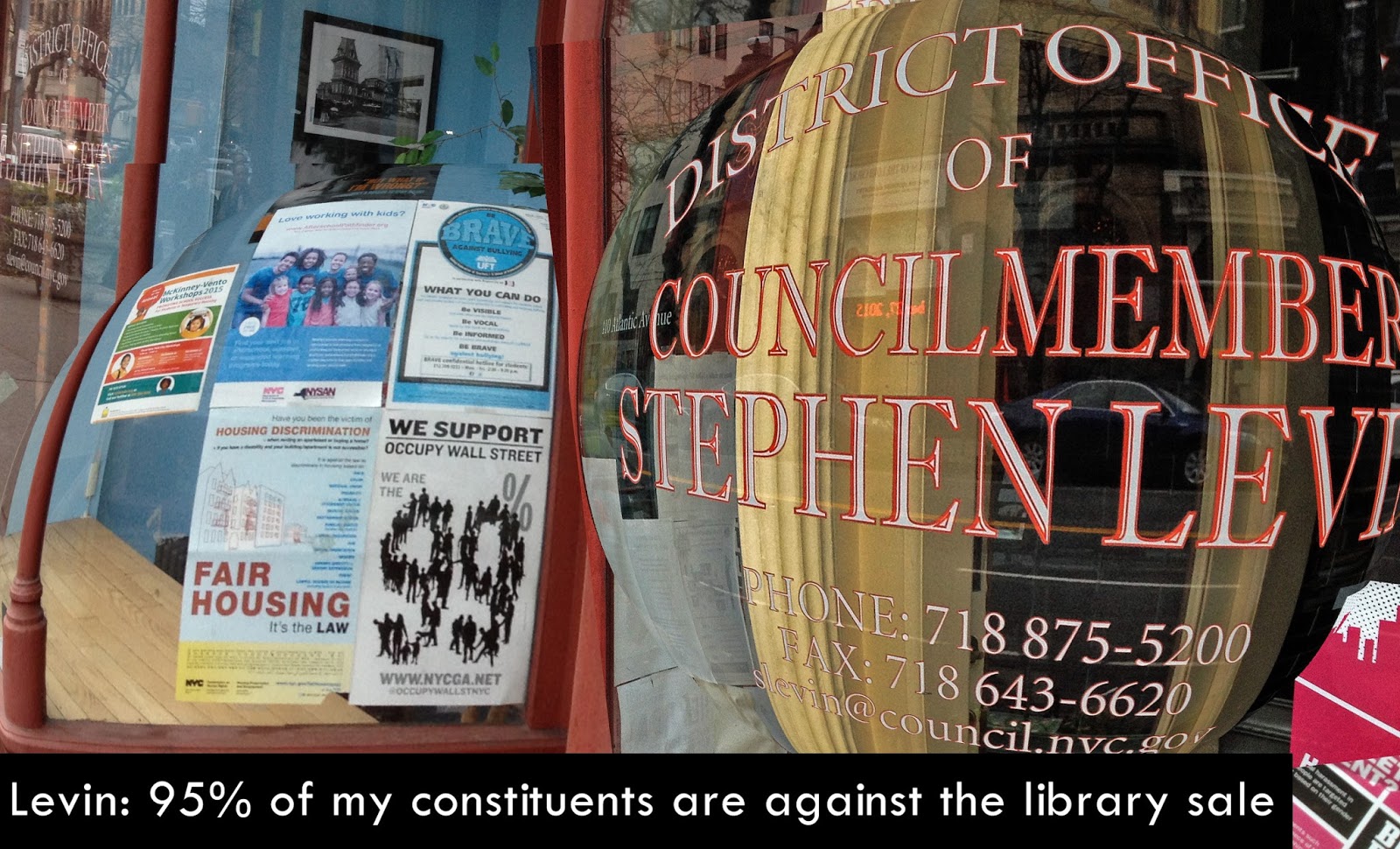
Levin said that 95% of his constituents were against the Brooklyn Heights Library sale and shrinkage.  Then he pushed it through with a backroom deal unveiled at the last minute.  Now, having a great deal of explaining he has produced a letter. . . . and he still has a great deal of explaining to do.
If the truly impressive word count, (3012 words) of his “An Open Letter Regarding the Brooklyn Heights Library Project” (below) is any indication, Councilman Steve Levin knows with excruciating certainty that he has a lot of explaining to do to his constituents about his approval of the sale and drastic shrinkage (down to just 42% of its current 63,000 square feet) of the Brooklyn Heights Library, the central destination library in Downtown Brooklyn . . .

. . . The problem is that Levin’s so-called explanations are entirely inadequate and he mightily hedges in terms of what he ought to be disclosing.

3012 words?: That’s about four times the length of your average New York Times Op-Ed column, and about five times the length of opinion columns you might find in the Daily News!  And this is an elected official writing to constituents on one subject.

Despite all those many words and the six separate subject headings of his opus that arrived in email in-boxes around Brooklyn the evening of December 28th, it is remarkable in what Stephen Levin does not address and outright evades in what he writes.

Levin does not mention or explain why he did not, as he promised Citizens Defending Libraries, demand and insist on transparency from the BPL about:
    1.    Information about the value of the existing library from the public’s perspective.  Instead he refers just once to his own theoretical curiosity about the “value of the project” (not of the library).  He asserts that he “asked about a half dozen very knowledgeable experts whether the public was in fact getting a reasonable deal on this property” apparently without one of those "experts" telling him that the library would cost $120+ million to replace.  Instead, Levin deflects from his obvious duty to consider this from the public’s perspective, saying that a “definitive answer” about the value “remained elusive” and then meandering off to discuss instead, from a developer’s perspective, (under the somewhat deceptive rubric of "Fair Market Value") whether ‘bids’ assured that the price for which the library was being sold was its full “tear-down” value, i.e. a price less than the price of a vacant lot.  It is not a vacant lot.  Levin deflects again from the value of the library by describing it as “built in 1961" (1962) without mentioning that this building, two full stories above ground and two half-floors below ground, was substantially enlarged and fully upgraded at considerable public expense and sacrifice in 1993.  It is one of most modern and best equipped libraries to support computer use in a  system where it is complained that average age of other libraries is sixty-five years old.

    2.    Information about the true and complete costs to the public of selling and shrinking this library as proposed.  Never in the entire length of his letter does Levin mention that what the public gets after selling and shrinking this library (to the extent that it gets anything at all) is only a “net amount” of money after factoring in all the associated expenditures necessary to sell the library and then recover only some of the ground lost after the public sells it.  Never does Levin in his justifications mention this or what the “net” figure is.  We urged him to help us to zero in on and ascertain the number.  After unkept promises, he failed to investigate.  BPL president Linda Johnson has told her board it will be appreciably less than $40 million, but Citizens Defending Libraries believes that the BPL’s math was self-serving to justify the transaction and the actual figure is far less even than that.  Levin never followed through to insist on finding out from the BPL what are all the costs of disruptions and what the public must forgo and bear to endure this transaction.  Instead, as you can see from Levin’s letter the Councilman acting like the developer's sale agent does the reverse, straining and going to great lengths to try to make the stated gross sales price for the library sound better by including the value of various things that still don’t get the public anywhere near back to where we were before a sale.  He includes on the “plus” side of his fudging equation things like there being a very tiny little interim library for the untold number of years during which construction will be underway where the library once stood.

    3.    Information about the “strategic real estate plan” that was formulated going back to 2007.  To date the BPL has released no iterations of this plan all of which would be valuably informative in many ways, including about similar plans for other libraries.  Similarly, Levin did not insist the BPL release the requested “Revson Study.”

    4.    The background communications between the BPL and the Department of Design and Construction based upon which representations about the acceptability and suitability of the air conditioning at the Brooklyn Heights Library were made to Levin’s predecessor in office, David Yassky, before any planned sale and shrinkage of the library.  Levin says that he realizes that BPL’s estimated figure for repair of the air conditioning system (which broke down, right on cue, six months before planned announcement of the proposed sale) “sounds extravagant.”  He then adopts a BPL talking point about government inefficiency being the reason for this.  He says that he “independently confirmed the cost of the HVAC repair” but does not reveal his actual lack of follow-up with the New York City Department of Design and Construction for specific documents we requested.  Information has also been requested and not furnished to the public about the air conditioning repair firm, Performance Mechanical Corporation, that the BPL engaged in an extended multi–year contract for its entire system not all that long before problems with the Brooklyn Heights Library’s and a number of other libraries' air conditioning systems started receiving attention.  Early analysis in this regard about the Brooklyn Heights Library (2007/2008) by Karen Backus and communications with respect thereto have also not been provided.

    5.    Information about the BPL’s communications with the city Landmarks department and commission about which libraries are historic and which libraries the BPL wanted pushed forward into real estate deals avoiding designation.

    6.    Information about the considerable amount the BPL is paying in connection with its promotion of its real estate plans for libraries.  It is troubling that in a time when there is a supposed scarcity of available funds for libraries BPL is spending a considerable amount of money on consultants and lobbyists for this purpose.  The information requested about this has not been furnished.  It is a matter about which the BPL needs to be forthcoming.  That includes monies paid to Booz & Co., Berlin Rosen, WSP Flack & Kurtz, K&K Property Solutions, Ed Tettemer and Mo (Maureen) Craig for branding and PR Advice.

    7.    Information about book counts: what they have been, what they are now and what they are intended to be in the future.  For instance, the BPL and the architect representing it, and the developer in this regard have not been able to state what the book shelf capacity of the entire Brooklyn Heights Library (we are not talking about supposed branch sub-component) has historically been, or what it is intended to be in the future.  In fact, it would have been relevant for Levin to have sought Information respecting the entire system.

    8.    Communications with Saint Ann's School respecting development rights and the Brooklyn Heights Library.  Levin’s letter misleadingly promotes the idea that sale of the library is mostly just cashing in on  "air rights" or “development rights, above the current building at 280 Cadman . . .   worth millions of dollars.”  (Implicitly a 'painless' one?- “a unique opportunity.”)  Levin doesn’t mention the extremely pertinent fact that half the city’s development rights were already transferred to Forest City Ratner in 1986 or that the reason the developer is still able to propose such a tall building under these circumstances is that Saint Ann’s School is the party that is actually painlessly cashing in on the sale of its “development rights, . . .   worth millions of dollars.”   The difference is that Saint Ann’s doesn’t have to tear down its own building or incur a loss to cash in.  Levin never forced disclosure of how much Saint Ann’s is benefitting or whether it will reap more net cash from transaction than the city would get from its  sale of the library.
The above constitutes a good starter list of what Levin should have insisted on as the essentials for basic transparency.

Had Levin forced transparency about these things, brought them into the light, the public and press would have gained what they are entitled to, a much better and far more fair understanding of the sacrifice and plunder the BPL proposes as it proceeds with its plan to sell and shrink this library as a first hand-off to the development community.  That would likely have killed the deal and it must now be asked whether, as it certainly appears, that is exactly the reason that Councilman Levin, privately aligning with the promoters of the sell-off, did not represent the community in these ways that it was his duty to do as an elected official.  At the very least, learning of all the practices BPL had secretly engaged in, how far its plans went back and who was involved (such as the connections between this proposed transaction and the 2007 announcement of the Donnell Library sale) would have engendered deep suspicions about the BPL’s good faith and intent.

Instead, in an effort to snatch his reputation from the free fall it deserves, Councilman Levin is compounding his sins by repeating in his treatise the suspect talking points and falsification of facts the BPL has been selling the public all along.

Remarkably, as long as Levin has made his letter he at no point ever suggests that even one tiny statement or representation by the BPL needs to be corrected or in any way qualified.  Instead, he signs on to all of them.
    1.    Levin adopts the BPL’s play-with-numbers shell games to understate the library’s size and obscure the shrinkage (down to just 42%) associated with the proposed replacement.  He borrows the BPL’s concept of selectively measuring just what it wants to define as public space.  In this regard he doesn’t ever mention the planned shift moving public space underground.  He doesn’t mention that the proposed new library will have just 15,000 square feet above ground.  Currently approximately 37,703 square feet, of the Brooklyn Heights Library (59%) is above ground, and none of the space underground is space that the public visits.  Not that the book storage space underground isn’t valuable or that it doesn't serve the public to having books at the ready.  Levin obfuscates manipulating with figures the way that the BPL plays with them asserting that the current library is has only “32,431 sq. ft. . .above ground, with 27,222 sq. ft. accessible to the public.”

    2.    Levin suggests that BPL’s cry of a capital crisis isn’t suspect and that it is a valid reason to sell and shrink libraries.  He ignores that New York City has a huge budget surplus with Crain’s recently reporting that the city Independent Budget Office estimates de Blasio will have an additional $1 billion above the $3.5 billion he stowed away unspent this year.  Libraries are an infinitesimal portion of the city’s budget.  How is it Levin promotes the notion we should sell them off for a minuscule fraction of their worth in a time of plenty and increasing use?  Levin also ignores the fact that, according to BPL minutes, the capital crisis is apparently by design with the deferral of capital repairs being planned concurrently with he proposed library sales.  On top of that, he also ignores evidence that the needs, like the air conditioning costs, are deliberately exaggerated.  Finally, Levin ignores the fact that there is no assurance that funds from a library sale, however big or small the net, (remember he didn’t want to talk about what the “net” was) will go back to libraries.  Even though Councilman Brad Lander pressing hard for library sales makes similar arguments that libraries should e sold, Lander has said flat out that you cannot obligate administrations or the City Council with respect to future budget expenditures, that its “unconstitutional” to seek to do so.

    3.    Levin adopts language in his letter that seems, like the BPL’s own, infected with a disdain for the value of the books that should be available to the public at a central destination library in Downtown Brooklyn like the Heights library. Such disdain for books is unsuitable to the BPL when its core mission should be books, not real estate.  It’s unfortunate to see a councilman sign on to this rather than protect the public, but after the City Council’s vote Levin admitted not paying attention to the question of the library’s capacity to meet these needs.
Much of what doesn’t comes out of the murk of Levin’s letter concerns the changes to the original sale and shrinkage proposal that were only unveiled at the very last minute as part of pushing the deal through.  Levin refers to them as “the improvements to this project that I announced” and they were no doubt intended to confuse the public and make him look good as he rammed through an exceptionally unsavory deal which he previously said 95% of his constituents opposed.

Levin says that he “went back and forth on whether to approve the proposal up until the final few days” but that he was also working “with the de Blasio administration, DOE, SCA” and the developer on what was produced.  While that makes it sound as if he was considering this from the community’s perspective it is unlikely and it is hard to pair these `negotiations’ up with his representations even right at the end that there was no compromise deal in the offing.  The BPL trustees were told that de Blasio administration, having "adopted" the deal, was very involved and that there were days of negotiations at City Hall.  It hardly seems as it it was all done at the last minute and the commitment of Department of Education funds to the black box “STEM” facility portion of he deal is just one aspect that should not have been casual or last minute.

It cannot be overemphasized that none of Levin's backroom deal making was previewed or in any way shared with the public beforehand.  Not only isn't that fair, its doubtful that the public would agree these were truly "improvements" as described by Levin rather than the opposite.  Even at this late date, the public at least deserves a full and truthful blow-by-blow accounting of this back room deal making.  All pertinent dates should be furnished by Mr. Levin and the other public officials who participated.

Levin’s letter doesn’t mention one thing the BPL trustees were told and that Levin has never yet publicly admitted to: That Levin negotiated an intercept of some of the limited library sale proceeds to support a development plan for the Greenpoint Library in his district.

One actual revelation that comes out of Levin's attempting to convince us that he actually was negotiating at this time is that Levin says that he did not want to insist that the new library “be greater than 26,500 sq. ft.” because that would have “put the project `out of scope’ and thus requiring another new rezoning application.”  Given that the public had never been allowed input about the shrinkage of the library that was exactly what most constituents would have wanted, but not, apparently,  the development-promoting Levin.

Levin says that he instead came up with the idea of an additional very small library in DUMBO (also in Levin’s district).  The problem is that the BPL minutes say that this library, a proposed model for ultra-small libraries in the future, was conceived of in 2007, the same time the sale and shrinkage of the Brooklyn Heights Library sale and Donnell Library were being conceived and implemented.  Another glitchy aspect to this is it isn’t revealed how much this will cost (or how it will be done) and therefore how much money from the sale will be intercepted by this project . . . .

. . .  That is sort of the same problem as not knowing how much of DOE’s money will be intercepted for the ill-defined "STEM Lab" facility or whether DOE even wants it or thinks it’s a good idea.  Investigation will probably disclose that DOE, if it were forced to take the 9,000 sq ft underground space (and benefit the developer) as proposed, would probably have preferred a gym.

When Levin’s last minute backroom deal was unveiled, his so-called “improvements” worked out with the de Blasio’s Deputy Mayor for Development Alicia Glen (from Goldman Sachs), Citizens Defending Libraries responded to it with the following statement (below), including discussing what's treacherous about Levin’s window dressing “profit sharing” agreement with the developer.  But selling a four floor, recently expanded and fully upgraded library as if had no more value than a vacant lot, taking a huge loss, cannot be dressed up with a “profit sharing” agreement where the public potentially gets back a tiny amount the developer is taking home as he cashes in on the the willingness of de Blasio and Levin to take a huge loss. Our previous statement also addresses using so-called "affordable" ("poor door") housing a guise for taking public assets.
Thursday, December 10, 2015, Citizens Defending Libraries Statement in Response To Councilman Levins' Decision To Approve Sale and Shrinkage of Brooklyn Heights Library (stated by BPL president Linda Johnson to be a "model" for future NYC library deals).
Unfortunately, what Steve Levin approved is now considered the model for library deals throughout New York City.
Before Steve Levin revealed the backroom deal he had been working on Citizens Defending Libraries produced this video (link below).  In it you can hear Levin say that 95% of his constituents oppose the library deal, hear BPL president Linda Johnson talk about libraries and real estate and how this is a model for future library deals throughout the city and hear Councilman Brad lander say that developers must make a profit on these deals.   Unfortunately, Citizens Defending Libraries now believes that at the time it made this video Levin was long since on the other side working to push this deal through against the community's wishes.
Video (click through for best viewing): Will Steve Levin Save the Brooklyn Heights Library?

Here is Levin's December 28, 20015 open letter.


AN OPEN LETTER REGARDING THE BROOKLYN HEIGHTS LIBRARY PROJECT
Dear Friends,

Earlier this month, the New York City Council voted to approve a modified version of the plan put forward by the Brooklyn Public Library (BPL) to sell the land and development rights at the Brooklyn Heights branch to Hudson Companies for condominiums and replace the current branch with a new branch in the base of the new building. This has been one of the most, if not the most, controversial issues that I have encountered in my six years as your Councilmember, and I went back and forth on whether to approve the proposal up until the final few days. Ultimately, I decided to support the proposal. I have heard from some of you who are disappointed and unhappy with my decision. However, I honestly believe that this was the right decision and I would like to tell you why.

I want to assure you that all of the improvements to this project that I announced will be legally binding and enforceable through the contract between the New York City Economic Development Corporation and Hudson Companies until closing and in the deed of the property thereafter. Where commitments were made by the City of New York, we secured a written confirmation from First Deputy Mayor Anthony Shorris that they will be honored.
The Case Made by BPL
When BPL first approached me about this proposal in 2013, I was dubious. I thought it was a very drastic move to sell off land that is owned by the City of New York, the public, to a private to developer in order to plug long-standing budget gaps. I remained skeptical for the duration of the process. However, there were several facts that made BPL's case compelling.

1) The overall capital needs for BPL for the entire system are extremely high- $300 million. Even after Mayor de Blasio and the City Council added $100 million for BPL over the next ten years, there is still $200 million outstanding with no sources of funding to meet those needs.

2) There are significant capital needs in the Brooklyn Heights branch itself, most urgently the HVAC, or air conditioning system, which no longer works and needs to be replaced. Over the past few years, the Brooklyn Heights branch has had to cut hours during the summer because of the HVAC system and the cost of repairing it would be $3.5-5 million. I realize that this number sounds extravagant, but this would be a City capital project, which are generally around double or triple the cost of a private project. Early in the process, I independently confirmed the cost of the HVAC repair with the New York City Department of Design and Construction.

3) The Brooklyn Heights branch presents a unique opportunity for the BPL system in that, while it is zoned for a high-rise residential development, the current building is only two stories. That means that the "air rights," or development rights, above the current building at 280 Cadman are worth millions of dollars. This money could be used to meet some, though not all, of the $200 million in outstanding capital needs in other neighborhood branches throughout the system. If the current building were to stay as is, there would be no way to realize the value of those development rights. In addition, while I am no great fan of high-rise towers, the location of the Brooklyn Heights branch is in the vicinity of several other high-rise buildings along Court Street and Cadman Plaza West, so a new high rise would not be "out-of-context" along that stretch. 
Library Space and Level of Service
First, it is important to take a moment to talk about the current library, which was built in 1961. It is a handsome building that was designed by Francis Keally, one of the architects of Brooklyn's central branch library. However, it is unlikely that the library would be considered by the Landmarks Preservation Commission for landmark status any time in the near future. The building itself can be divided into three parts: the Business and Career Branch, totaling 14,960 sq. ft., the Brooklyn Heights neighborhood branch, totaling 17,471 sq. ft., and the two cellar floors, which were originally constructed as a fallout shelter, and which are currently used for storage of mostly non-circulating reference books and other miscellaneous books such as those that were donated but have not yet sold at the BPL book sale. The two cellar floors are not publicly accessible, and it is reasonable to believe it would cost millions (perhaps many millions) of dollars to make this space suitable for any meaningful public access. Therefore, while the entire building is, according to the City Planning Commission, 59,146 sq. ft., only 32,431 sq. ft. are above ground, with 27,222 sq. ft. accessible to the public (the rest being utility space and staff office space), and it would be very difficult to envision a scenario in which all 59,146 sq. ft. could be made publicly accessible. Based on this set of facts, I made the decision that a square foot for square foot replacement of the publicly accessible space would require a new library to be roughly 32,000 sq. ft., because that number more accurately what the public experiences when they use the library.

When BPL first presented the plan, they proposed a 21, 000 sq. ft. neighborhood branch, which would in fact be an increase from the current 17,471 sq. ft. neighborhood branch. They also proposed moving the Business and Career branch to the Central branch, leaving the overall Brooklyn Heights facility with a decrease from 32,431 sq. ft. to 21,000 sq. ft. Like many of you, I found this proposal unacceptable, and I insisted that there be no net loss of publicly accessible library space in the neighborhood.

During the course of discussions with BPL, Hudson Companies, and the de Blasio administration, they proposed to increase the size of the new Brooklyn Heights branch to 26,500 sq. ft. with roughly 24,000 sq. ft. of it publicly accessible, which represented a decrease of 5,931 total sq. ft. and about 3,222 publicly accessible sq. ft. for the overall facility. I responded to this proposal by saying it was not good enough. At this point, however, the Department of City Planning advised us that, due to technical zoning regulations, the new library could not be greater than 26,500 sq. ft. without putting the project "out of scope" and thus requiring another new rezoning application. I remained adamant that there not be a net decrease in publicly accessible space, but we hit a bit of a roadblock in that discussion.

By the next meeting, BPL proposed a solution to this issue, which was to find roughly 5,000 sq. ft. of rental space in the DUMBO/Vinegar Hill/Farragut communities for a new neighborhood branch. There is precedent for both rented library space and successful branches of roughly that size in the BPL system, and this would represent the first new branch in the BPL system since the Cortelyou branch opened in 1983. In addition, the new 5,000 sq. ft. branch, when combined with the 26,500 sq. ft. already committed to the expanded Brooklyn Heights branch, would bring the total sq. ft. in the community to 31,500 sq. ft., with about 28,000 sq. ft. of that publicly accessible. This would mean a slight decrease in overall useable sq. ft. (32,431-31,500=969 sq. ft. decrease) but a slight increase of publicly accessible sq. ft. (28,000-27,222=778 sq. ft. increase).

In addition, I was very concerned about the level of service that would be offered in the new branch. As many of you know, over the past few years, the level of service at the Brooklyn Heights branch has been significantly wanting.  In particular, the library was closed for much of the summer due to the broken HVAC system, which led to a thermal heat index temperature in the building that was so high it violated union rules for employees. As a result, the library was not open 7 days per week during any season and the level of programming was lower than many other neighborhood branches.

Therefore, I secured a commitment from BPL that the level of programming at the new Brooklyn Heights branch would be equal to or greater than any other neighborhood branch in the system. Also, BPL committed to the condition that the Brooklyn Heights branch would be open 7 days per week so long as the Kings Highway branch, which serves as the main branch for South Brooklyn and is therefore open 7 days per week, maintains those hours.
Fair Market Value
Another major point of concern for me was the value of the project, and whether the public is getting a fair price at $52 million for the development rights at 280 Cadman Plaza West. This turned out to be a more complicated question than I anticipated, and I asked about a half dozen very knowledgeable experts whether the public was in fact getting a reasonable deal on this property. Unfortunately, a definitive answer remained elusive.  On the one hand, there was a competitive process in which Hudson participated and bid against other potential developers. Also, a NYC EDC sponsored appraisal determined that the value of the development fights was found to be approximately $36.1 million, significantly less than the $52 million sale price. On the other hand, the market in the neighborhood seems to be attracting much higher prices-for example the TD Bank property at Court and Montague is on the market for $200 million.

One aspect that I had not previously accounted for is that the price of $52 million accounts for the cost that the developer would have to bear in order to build the required affordable housing without any city subsidy which, between the land price and the cost of construction, would cost roughly $32 million, not to mention the cost of the "core and shell" of the new library space, the cost of the interim library, and "soft costs" of the City during the process of the sale. 

Since it was not immediately apparent what the free fair market value of the property would be, and since it is impossible to predict exactly what Hudson Companies profit on this project will be in 4-5 years, I made the decision to follow the recommendation made by Borough President Adams and pursue some type of profit "recapture" or "participation," by which BPL or the City can ensure that, if the Hudson Companies makes a significant profit, BPL is able to recapture a percentage of that profit. This model has already been successful at Brooklyn Bridge Park.

Eventually, we were able to reach a consensus of what that "participation" level should be, based on an Internal Rate of Return (IRR), which, according to the experts I spoke to, is reasonable for a developer building a condo project in downtown Brooklyn at 18-22%. Therefore, we agreed that if Hudson makes a profit over 19%, BPL will recapture 25% of that profit. That means that if, as many fear, Hudson makes an enormous profit (which would mean an IRR of 25-30% and that perhaps the $52 million sales price was undervalued), the public and BPL will be able to recapture 25% of that profit over 19% IRR.  Since this project is condominiums, this "recapture" will only happen one time, which is when Hudson sells the condominiums around 2020-2021.

We did include the caveat that the first $1.5 million in recaptured funds would be used to make the AMI's on the affordable units lower, from a maximum of 165% of AMI to 125% of AMI.

As with all of the provisions of this project, this agreement will be recorded as part of the deed for the property and will be legally enforceable on any future developer.
Education
It was also very important to me to ensure that there were some public education resources included in the project. We all know the significant public education needs of Brooklyn Heights and the surrounding neighborhoods. P.S. 8 is significantly overcrowded and we are facing a serious lack of school space in Downtown Brooklyn to accompany the staggering amount of new residential development occurring as a result of the 2004 Downtown Brooklyn rezoning.

My initial feeling was there needed to be additional school seats, either elementary or middle, as part of this development, just like there was at Dock Street, where there will be 330 seat middle school opening next fall. My thinking was that a school could be sited on floors two and three of the building, above the new library. I contacted the School Construction Authority (SCA) about the site and the feedback from them was that siting a school in this building would be virtually impossible given the configuration of the building and the requirements that siting school seats would entail, including adding 5,000-10,000 sq. ft. of self-contained school lobby space on the ground floor (which was already fully planned with library and residential lobby), a self-contained elevator bank exclusively for the school, and enough space for a school on 16,000 sq. ft. floor plates. After speaking with SCA, I realized a new school there would not be possible.

However, I spoke with local education leaders about other educational needs in the community and one idea appealed to me: the development of a Science, Technology, Engineering, and Mathematics (STEM) lab for students K-12. The NYC Department of Education does not currently have any stand-alone facilities like this, but we all know that an innovative STEM curriculum with a brand new STEM lab could be transformative for our children. There are so many interesting K-12 STEM learning environment models in places like Minnesota,  Atlanta, and Palo Alto that we can learn from- why not search out what is working best across the country and give educators the tools to implement those practices here?

Therefore, I worked with the de Blasio administration, DOE, SCA, and Hudson Companies on an agreement whereby DOE will lease 9,000 sq, ft. from Hudson in the first cellar, with the option to purchase the space after a set number of years, and site a fully built out STEM lab there.  We look forward to working with everyone in the community, particularly those with an interest in STEM education, on developing this potentially transformative space.
Affordable Housing
The original proposal contained 114 units of affordable housing, to be located off-site in Clinton Hill, ranging in affordability level from 60% Area Median Income (AMI) to 165% AMI (AMI in NYC is $86,300 for a family of 4), with 23 at 60% AMI, 38 at 80% AMI, 29 at 100% AMI, and 24 at 165% AMI. Under this scenario, the 60-80% AMI units were required under the Inclusionary Housing Program, while the 100-165% AMI were not required. I heard from many of you that this issue of off-site affordable housing is disturbing and should not be allowed as part of this project. Also, many of you said that the AMI levels were too high to address the real affordable housing crisis in our communities.

I was very concerned about these issues as well. We found the off-site issue difficult to resolve. First, under the current Inclusionary Housing Program, off-site affordable housing is allowed. This may change with the Inclusionary Housing reforms being contemplated right now, but the current law allows it. Also, if we were to require the affordable housing to be built on-site, it would inevitably drive down the purchase price of the of the development rights at 280 Cadman, which would mean significantly less money for the BPL system as a result of this sale. In addition, I heard from leaders in Clinton Hill that they were very happy to have 114 units of affordable housing in their community, which desperately needs it. Therefore, I decided that while I am not enthusiastic about the off-site affordable housing, I would allow for that portion to go through in this particular instance.

I did have a significant concern about the AMIs, because I strongly believe that units at 165% AMI should not be considered "affordable" since they are for families making $142,395 per year, which I believe is close to, if not at, market rate. Therefore, I worked with Hudson to develop a new affordability framework that I believe more effectively addresses the needs of working families in our communities: 23 units at 60% AMI, 60 units at 80% AMI, and 31 units at 125% AMI.
Conclusion
After over two years of discussions, debates, hearings and testimony, I believe that this project has had a thorough vetting and that the public has been able to develop a good understanding of all of the issues involved in this proposal.  While I understand that not everyone will be happy with the final project, I believe that it is a significant improvement over both the status quo and the original project as proposed two years ago.  

During the final weeks of this process, after hearing from hundreds of community residents both for and against this project, I had the opportunity to speak with two librarians that work at the Brooklyn Heights library: Uldis Skrodelis and Rachel Teimann. They both expressed their support for the project, in the most un-political way possible, because, ultimately, they believe strongly that a new library in Brooklyn Heights and in DUMBO, complete with both books and 21st century technology, will be the best way ensure that future generations have access to the full educational potential that our libraries provide.

It will be several years before the public will begin to see the benefits of this project-the new library in Brooklyn Heights, the new library in DUMBO/Vinegar Hill/Farragut, the new STEM lab, the new affordable housing, and potentially additional revenue through the profit recapture. However, I believe that when these new benefits are realized, the public will recognize that its interests were advocated for and protected throughout this extensive and transparent land use review process.

Sincerely,


Stephen T. Levin
Council Member, 33rd District

Ninety-nine percent?  Ninety-five percent?  Doesn't something seem rather distorted here?  The window of Councilman Levin's Atlantic Avenue District Office says "We Support the 99%."   Levin said 95% of his constituents opposed the library sale and shrinkage.  But Levin engineered a backroom deal unveiled at the last minutes to push through the sale and shrinkage of the library?