Why Is New York City Planning to Sell and Shrink Its Libraries?

Defend our libraries, don't defund them. . . . . fund 'em, don't plunder 'em

Mayor Bloomberg defunded New York libraries at a time of increasing public use, population growth and increased city wealth, shrinking our library system to create real estate deals for wealthy real estate developers at a time of cutbacks in education and escalating disparities in opportunity. It’s an unjust and shortsighted plan that will ultimately hurt New York City’s economy and competitiveness.

It should NOT be adopted by those we have now elected to pursue better policies.

Tuesday, June 2, 2015

Our Public Assets Under Attack- A Calamity of the Commons Unfolding That We Must Act Collectively Against- How best To Express It?

Citizens Defending Libraries has held forums, three so far, about the sell-off of our public assets.  We have seen it in multiple ways, but over and over again the patterns are reminiscent of each other, recurring situations where the same play book seems to be the reference of those maneuvering to seize our public assets.  What appears below reflects the consensus reached at those forums that we should be taking collective action, standing together to oppose these seizures.

Among other things it was agreed we should have a joint letter to state what we have in common and what we join in demanding from out elected official and those who would run for office.

But how to express it?  We have been working on that.  This letter has been circulating and although it may benefit from some further refinement it has been very well-received.  What do you think?  Because it is time for everyone to be thinking about these things.
A Sign-On Letter of Support: We Stand Collectively Against The Sale of Public Assets- For Your Consideration
We sign this letter urging the protection of our public assets hoping that you as our elected officials will take our message to heart recognizing us as the public constituency to which you are properly accountable.

Our public assets, our public properties are under attack.  We believe the situation is increasingly dire.  That which endows the public realm and the public commons with its value and essential meaning is in jeopardy.  In deals that skew toward private profit at public expense, greed is exceeding itself as never before to push the envelope of what is conceivable everywhere we look.

Public parks and public buildings built on city-owned land. .  schools, colleges, libraries, fire houses, playgrounds, police stations, hospitals, housing, memorials . . these public assets are part of our New York  heritage, civic architecture and crucial infrastructure and resources that belong to everyone.  If city services are relocated, cut back or curtailed when city buildings are privatized, everyone loses, except the privileged few who arrive on the scene purporting to be our new “private partners.”

To acquaint yourself more fully with the spectrum of assets under attack look at the names of the groups signing this letter and consider the assets those groups were formed to protect.  Their statements about why they are signing this letter elucidate this crisis further.

Built by our forefathers with public funds and resources, assembled over decades, some more than a century ago, the basic amenities of the public realm that are at stake are increasingly irreplaceable.  The same rapidly escalating land values underlying these properties and the prime locations that put them squarely in the sights of the real estate industry virtually assures the impossibility of the public’s reacquiring such treasures ever again.  Similarly, the master craftsmanship and natural materials of the traditional architecture these assets feature will be increasingly costly and hard to obtain, or in anyway replicate.

Part of the problem is that we are in an era of increasing income and wealth inequality with the most affluent in our society lowering the taxes they pay.  Some may assert that a significant diminishment and elimination of the public realm must therefore be accepted as inevitable even as the city and its wealth continue to grow.  We, however, choose to view this new imbalance as temporary and subject to correction.

More insidious is how the growing political inequality and the power that flows from mounting economic disparities is being abused.  We witness the interests of money repeatedly prioritized over the rights of the voting electorate as potent influence is exercised to lay siege to our public properties.

We cannot let a privileged few with special access show up on the steps of government with plans to sell and privatize our assets, plundering their value.  Because these losses are so tragically permanent and long-term we must think in terms of the future, banding together to face the current assault and draw the line, doing everything we can to ensure our public assets are protected immediately.

Although the reasons for alarm should be obvious, we are concerned that the public servants we must  look to as guardians too frequently are not alert or responsive.  Outcry is essential when reorganizations under the rubric of “partnerships” convey responsibility for the provision of basic government functions, like public schools, parks and public libraries to those focused on private profit.  In these situations we find the public baited into accepting Faustian bargains premised on notions that the unacceptable be accepted.

Brutally inverted propositions perplex the public:
•    Your city can’t keep pace with the rampant development in your vicinity to provide the public school expansion now needed?  A developer will provide the public school if it can do whatever it wants with a historic district, turned over to it as ransom.

•    The city refuses libraries their traditional and appropriate level of funding?  You may be told that you can have a better library if the community consents to upzoning because libraries are openly discussed as nice “placating” gestures, tactics, to push through developers’ schemes.
In all these situations the private offerors’ incentive is to minimize public benefit while maximizing private profit.  Our new private gatekeepers benefit from withholding public benefit, particularly since dribbling benefits out in the smallest possible increments will allow them to return more often with new proposed “bargains.”  Even worse, the private sector is given an incentive to foment public crisis for private exploitation.

When the job of managing our public properties is captured by private interests with altered agendas, we see a dismaying shift of balance in the way these so-called “partners” manage things and the outcomes that result.  We get, for instance, the spectacle of hospitals expertly administered by top-talent professionals who skillfully deliver premium real estate deals while entrusted community health care facilities are steered into bankruptcy.

Over and over again we see a lack of transparency with the adoption of unnecessarily complicated governance structures and funding mechanisms, set-ups that seem best contrived to deflect accountability.

Reflect and you will probably recognize these aspects of commonly recurring modus operandi by those raiding public treasures:
•    Withhold funds claiming there’s no money for public assets or that what we publicly own can only be funded with self-cannibalizing sell-offs.

•    Manufacture crisis conditions and present false choices, seeking to promote “TINA” narratives (“There Is No Alternative”).  This can include overestimating and inflating repair and maintenance costs while so-called “solutions” are rushed forward.

•    Underestimate the value of what the public owns.  This way assets (e.g. Donnell Library) can be disposed of at far less than true value benefitting developers and escaping accountability to the public.

•    Do top-down designed deals that the public will be the last to know about, part of a general effort to eliminate the public from discussions to the maximum extent possible.

•    Stack decision-making boards with people who are unsympathetic to those served by the targeted assets.

•    Do deals calibrated to be benefit .01% while frequently, opportunistically, taking advantage of income inequality to target assets that have more value to the less politically powerful and less advantaged.

•    Dismiss alternatives to protect and preserve the assets.  (Includes obfuscating and ignoring facts).
The way in which we see our public assets attacked are obvious symptoms of another major necessary conversation that looms in the background.  When assets the public clearly cherishes and would chose to pay for are targeted for transfers catering to private objectives we know that we must recognize the root causes for this neglect of the public will. Money in politics, election and campaign finance reform must be addressed.  Still, it is essential that our public assets be protected now without these more encompassing, albeit related, battles having to be won first.  In fact, we cannot let these conversions of public capital into even more private gain additionally fuel the imbalance and inequity being fought.

We believe that it is important to view all these many attacks on our public assets as being all of a whole.  All of these lop-sided deals should receive collective scrutiny.  The often common and repeated stratagems employed against the public should be looked at on an integrated basis, which includes noting that there is a high frequency of overlap among the players and political operatives that present them to us.

We request your support and your statements of allegiance.  Most of all we request that you take action that is observable as effective.  Not only are we reaching out, we will also be watching.

All who represent us and are charged with protecting our interests need to roundly and soundly agree that this era of putting the public’s property on the auction block is an era who’s time has passed.  It was never sustainable in the first place. Whenever deals like these present themselves we must recognize them for the cheats and swindles that they are, greet them as dead on arrival and pack them off with the quick funerals they deserve.


SINCERELY

* * * *

END

* * * *

NOTE:  Some of what appears below may may show up and factor in to signatures sign-on statements.

Here are some example of assets under attack:
•    Parks- We speak of trees cut down for Fashion Week tents or Yankee Stadium parking garages, Central Park subjected to the creep of long shadows from “stash” pads stacked a mile high, park space handed over for commercialization and development

•    Public Housing- How can it be proposed that playgrounds used by children in public housing should be sacrificed to build luxury housing?

•    Public Schools-
    •    The attraction of maximizing any public school site’s development potential is not an excuse to uproot the eco-system of well-functioning schools intending to transform their real estate, after extended disruption, into mixed-use competitions between school space and luxury apartment extravaganzas.
    •    The devil is met in the details when it comes to private charter schools commandeering the assets of public schools, but efforts to tilt the playing field are a stark cautionary tale when private investors manipulate behind the scenes.
•    Our Hospitals- Hospitals are health care, not real estate deals.  Hospitals are basic city infrastructure.  Real estate development has its place and it grows the city, but when hospitals are converted to real estate deals we have a grown city without the infrastructure to tend to the growing population.  Everybody gets sick, old, and needs care in the event of accidents.

•    Our Libraries- Is there a better example of disregard for public assets from a private sector unleashed than the notions now afoot about drastically shrinking our libraries while underfunding them and getting rid of the books and librarians?

•    Our Public Spaces- Are the attractions of private ownership so great and privatization’s supposed virtues so remarkable that the continued existence of truly public spaces and public places, including, but not limited to public plazas, streets, avenues and sidewalks are now in jeopardy creating with their demise free speech issues and issues of basic liberty as private ownership trumps individual freedoms?

•    Our Light and Air- Our Views- At some point density must have its limits.  We need space to breath.  There are times when we need to see the sky and feel the sun.  When we don’t recognize this our city becomes unlivable.  And we lose something profound, when for example, the press for over-development creatively side-steps regulation so that even such classic vistas as our views of the Brooklyn Bridge succumb.

•    Historic Districts and Landmarks- Landmarks and history give us our bearings, reference points reminding of who we are, where we are headed, yet we watch as developers manipulate to wrest such recognized treasures from the public.

•    The Public Spirit of Our Institutions- Our museums and cultural institutions are publicly supported and yet, more and more we find them not supporting us as they erect ever higher pay-walls and engage in questionable conduct shilling for real estate developers or adopt grandiosely insensitive schemes.  And it is to be remembered that sometimes the way that public assets are taken over is by taking over, like the Brooklyn Public Library or the NYPL, the public institutions that own and manage them.

•    Our Environment- Like the light and air we hope to find all around us, the environment surrounding us benefits beings broadly, equally and universally and yet for the private profit of a very few individuals we perilously skirt the edge of calamity suffering toxic usurpations of our water, our air, our climate with, for example, hydraulic fracturing where with induced earthquakes even the stability of the ground beneath our feet is sacrificed.
Please contact Citizens Defending Libraries with respect to the above, participating in our next forum or taking further colection with respect to the above: 718 (area code) 834.6184. 

Monday, June 1, 2015

Brooklyn Community Board 2 Land Use Committee June 17, 2015: ULURP Hearing- First Hearing About Whether To Sell & Shrink Downtowns’s Brooklyn Heights Library (Tillary & Clinton)

This is very important.  (This page will be updated.)

It is now expected that the process for seeking public approval to sell and shrink the Brooklyn Heights Library, Brooklyn’s central destination library in Downtown Brooklyn on Cadman Plaza West at Tillary and Clinton will commence this June with a meeting before Brooklyn Community Board 2's Land Use Committee:
WEDNESDAY, June 17, 2015, 6:00 PM
Community Board 2 Land Use Committee Hearing to Commence ULURP Process to Sell Brooklyn Heights Library
Polytechnic Institute, Dibner Building, Room LC400,
5 MetroTech Roadway (The hard-to-find building has an orange triangle at the entrance see picture)
Metrotech Center (off Metrotech Commons)
Brooklyn, NY 11201
Michael White, mddwhite [at] aol.com, 917-885-1478 or Carolyn McIntyre, 917-757-6542

Note: Hearing comments can also be mailed to the Land Use Committees before the hearing, but showing up in person has an important effect.  (We'd prefer to deliver a knock-out punch early rather than having a two-year fight on our hands.) We have been told that you can also email comments to CB2 at cb2k@nyc.rr.com (please CC us at  backpack362 [at] aol.com) or use snail mail (not lile to get there in time) or stopping by in person at their office at 350 Jay Street, Brooklyn, NY 11201. We were told to address comments is Shirley McCrae, the CB2 Chairperson, but suggest that you CC the "Chair of the Land Use Committee" and the other board members to add assurance. (Chair McCrae did not, on a prior occasion, forward our open letter to the CB2 board about the library.)
Something else you can do that can help a lot.  If you or any of your friends have not signed our most recent petition to Mayor d Blasio, or if you are not sure you have, please make sure to sign.  If you are not getting information about the library sales and shrinkage from Carolyn McIntyre you probably haven't signed it.  Even if you are, you might only have signed the earlier petition to Mayor Bloomberg, not the most up-to-date petition that need to be signed to de Blasio who is now following in Bloomberg's footsteps.  Don't worry about signing twice: It's impossible to do so if you use the same email.  You don't have to be from Brooklyn or NYC to sign, but if your or your friends are so much the better.
Not required: You can opt to improve coordination if you and friends sign up with our MoveOn to assure that you will be at this first ever event: MoveOn Action- Metrotech Center, Downtown Brooklyn, Brooklyn, NY 11201. 
Hearing location- hard to find.
This will be the first hearing about selling and shrinking this library and it will be the first ever hearing about selling and shrinking a NYC library, a very important one at that.  The library will be sold and vastly shrunk so that a luxury tower (still undesigned or sized) can replace it at this prime Downtown location at the edge of fashionable, historic Brooklyn Heights.

This is a key opportunity to show up, one that's NOT always afforded to the public. . .

. . .  No such hearings were required when the Donnell Library was suddenly and secretively sold off because, in that case, the library, not the city, owned the land.  The proposed sell-off of this Downtown Brooklyn Library is closely modeled on, almost identical to, the sale of Donnell Library.  Similarly, such a hearing isn't required for the sale of another major destination library, SIBL, Science, Industry and Business Library at 34th Street.

This hearing is required under ULURP, the city’s Uniform Land Use Review Procedure.  It's a process that could take 18 months or perhaps two years as required under ULURP, the city's Uniform Land Use Review Procedure.  Indications are that the library administration and city officials reporting to Mayor de Blasio would like to rush this required process as fast as possible and minimize the time the public has to react and minimize coverage of the process by the press.

Library administration and city officials intend to begin the process with an information dump “certifying” the project on Monday June 15, 2015, just two days before the first hearing.  Even if this is not technically illegal it is certainly NOT in the spirit of fair play.  The BPL has been working on its plan to sell the library going back to at least 2007.
NOTE: THE HEARING LOCATION COULD CHANGE
Under the New York State Open meetings Law the CB2 Land Use Committee must move the hearing to a larger location if necessary to accommodate all of the public if the crowd is large.  We understand that the CB2 committee expects an exceptionally large crowd.  There is an auditorium downstairs in the Dibner building and we hope that, if moved, CB2 will hold the hearing there rather than doing something more confusing to the public. 
Here are THIRTEEN points to know:
1.    Once the library is sold and shrunk there is no way that it can ever be enlarged afterward if the library needs to grow again, or if the sale and shrinkage is recognized to be the mistake so many believe it is (like the Donnell deal was recognized after-the-fact to have been a big mistake). NOTE: The existing library, built in 1962 had to be enlarged in 1991 to accommodate growing needs.

2.    The BPL plans to proceed with locking in the sale and shrinkage of the library before designing the replacement for the library. (Making sure it is harder to discern the mistakes on what exactly we will lose.)  The “test fit” experiments for arranging a library in the shrunken space had many faulty aspects, like forgetting to include any staff space and tables and chairs jammed so close to theoretical book shelves that none of this furniture could be used.

3.    That the architects and the BPL were unable to say how much book capacity exists at the current library vs. how much the (undesigned) "replacement" would provide, and apparently, when not knowing this information gave out highly inaccurate (and self-serving) information to the participants of the May 18th Charrette who were trying to react to alternative test proposals for shrinking the library.

4.    Designs for the luxury tower replacing the library have not been designed yet (that’s despite the BPL’s confusing release of pictures).  The developer has said that he expects to try to make it as tall as possible, that’s because building each floor, particularly the lower ones with taller ceilings raises the luxury apartment higher up to give them better views over the rest of Brooklyn Heights lower-rise buildings to see the harbor.  So, for instance, the architects have indicated that one portion of the vastly shrunken library will probably have 24 foot ceilings.

5.    One of the things driving the sale of the library is that a private school, Saint Ann's, will benefit substantially from the public’s sale, demolition and shrinkage of the library.  In a deal that is likely to include the developer giving the school both money and real estate, the developer has said that the school is likely get 20,000 square feet while the developer is only committed to give the city a 21,000 square foot replacement library.  This is because Saint Ann's has unused development rights (that can pass through the Forest City building on the same block).  The school hasn’t ever used these rights because it would be would be disadvantageous for the school to demolish its existing building and then rebuild to create a larger building that will utilize them.  That would entail the costs for the school of demolition and rebuilding and Saint Ann's would have to go without its currently used school facility for an extended period of time. If, however, the library is sold for redevelopment, then all those sorts of costs are off-loaded and borne by the public and the library, instead of the private school.  The school nevertheless coasts in, incurring no such costs, but collecting on the entire benefit of using its previously locked-up development rights.  Unfairly, advocates for Saint Ann's were especially well-represented when the Brooklyn Heights Association made highly suspect decisions reviewing the library plan.

6.    How small will the undesigned “replacement” library be?  The current library is 63,000 square feet with about 38,000 square feet of versatile, adaptable space above ground and books for retrieval in two underground half-floors.  The replacement library would have only 15,000 square feet above ground with 6,000 square feet below ground, 21,000 square feet in all.  As noted the new theater for the Saint Ann's may be 20,000 square feet.  This is a central destination library serving Brooklyn’s downtown, the rest of Brooklyn and intended also to serve the lower Manhattan Wall Street areas.  The proposed new branch library for Sunset Park is proposed to be 20,600 square feet, essentially the same size.  The Sunset Park community is negotiating to have it be even larger because placed in the bottom if a mixed use real estate development, that community’s library can never be enlarged afterward.
7.    This proposed divestiture of publicly owned space is a significant prodigal reduction of public space at a times when the density of Brooklyn’s Downtown and the surrounding area is increasing drastically with multiple new towers, thus further imbalancing the ratio of public to private space and stressing public services to keep up.  For instance, with density increasing, the local school is now at 140% capacity with the situation getting worse.  
8.    The BPL is falsely asserting that the Brooklyn Heights Library is in need of extensive repairs and is straining to find money for them while inflating the costs of repairs it says need to be made to the building.  The building was built in 1962 for an amount that adjusted for inflation, would amount to $19.6 million in today’s dollars. In 1991 the BPL spent a considerable amount, millions, about $10 million by today's standards, for an "extensive" renovation and enlargement of the building, expanding its second floor, part of the purpose of which was  to better "accommodate the business library" with more space.  According to BPL figures, new construction to replace the building today would cost $60 million (and that doesn't take into account the additional value of the land and development rights the BPL is also selling off at a loss or to net virtually nothing).  As recently as 1997 the BPL was, speaking of these renovations, telling the public in its rhetoric of the time: "[t]he Business Library looks forward to serving Brooklyn's business community into the 21st Century."  The BPL has now said that costs of repairs related to turning the air conditioning back on would cost an amount equal to have what, adjusted for inflation, the building cost to build in 1962.  Its essentially equal to the entire cost of extensively renovating and enlarging the building in 1991. Only a portion, 3/4ths, of the air conditioning is out of commission.  It went out of commission six months before the BPL’s planned announcement to sell the library (citing air conditioning as a reason) and five years after the BPL planned to sell the building.  As one engineer considering the BPL’s estimates observed, new cooling towers were recently installed on the roof so that only the chillers need to be replaced.  Further, before the BPL started secret plans to sell the building, the City’s Department of Design and Construction furnished the BPL with an assessment that the air conditioning was in good shape and proper for the building.  The BPL has refused to release these prior communications it had with the DDC even though it is required to under the Freedom of Information Law.
9.    Library administration have refused to say how very little money they are actually bringing in by virtue of selling the major irreplaceable asset.  When the NYPL sold the irreplaceable Donnell it suffered a net loss.  This transaction modeled after the Donnell sales (involving some of the same people) is likely to be much the same in this regard.  For instance, business and career functions at the library to serve Brooklyn’s Downtown are being exiled from the library and theoretically being crammed into Grand Army Plaza Library, but the BPL while acknowledging that this will involve substantial work and rearrangement, refuses to state the cost of it.  Similarly, wanting to disguise the minimal amount of money that it will get, the BPL is now estimating the cost of building the shrunken “replacement” library at only $10 million, when using figures for the highly comparable “replacement” Donnell library (yes there have been overruns) would mean that the actual more realistic figure for Brooklyn’s library should over $16 million.

10.    To sell the developer’s luxury project to the public, the developer and BPL’s library administration officials, with the help of very high paid lobbyists and PR people (the BPL is also refusing to release these costs), is making a divide-and-conquer argument that proceeds from this self-cannibalizing sale (undisclosed how truly minimal any proceeds might be) will go to other libraries in the system, theoretically certain specific ones (even though money is fungible).  The BPL also hopes it to be an excuse for certain city councilmen to become tractable allies in the selling off of its systems assets.

11.    The developer will build a few “affordable” housing units off-site, elsewhere in CB2 in order to get a bonus to build a bigger building.  Although this is being done “poor door” fashion with these units far away, the BPL intends to use the carrot of these few units a wedge to make split-the-community divide and conquer arguments for the library and to give some politicians false cover to support a luxury project that sets the precedent for selling off other important public assets.

12.    One problem with these divide and conquer tactics is that after they are used in precedent-setting fashion against this major asset, other libraries and public assets will be targeted.  Although the BPL has admitted that it is going after the most valuable libraries  first (that means most valuable to the public too).  It's “Strategic Real Estate” plan put together by a former Forest City vice president (Karen Backus) calls for the “leveraging” of all the real estate that the BPL holds.  The “Strategic Real Estate” plan put together formally starting in 2007 is one more thing the BPL refuses to release eventhough withholding this and other information violates the Freedom of Information Law.  Why?  If the public knew the BPL’s plans it would object . . .  Also the BPL’s divide-and-conquer tactics would be severely hampered.

13.    Mayor de Blasio is underfunding libraries, even cutting back on their funding this year.  And this is a year of budget plenty!  Why is a theoretically progressive mayor underfunding the city’s libraries against everyone’s, even the New York Time’s advice?  Challenged about this on the Brian Lehrer Show (6/5/2015) de Blasio asserted he simply cared about a lot of other things instead, like schools.  But that’s disingenuous.   We think the Mayor is a bright man who can walk and chew gum at the same time.  And its not as if proper funding of libraries is unrelated to schools and the benefits of Universal Pre-K.  Libraries are an easy lift that cost virtually nothing to fund, a fraction of the city’s budget, especially given their benefit. In the last 8 years at least $620 million has been spent on just three sports arenas, (the Ratner/Prokhorov "Barclays" that de Blasio supported) and that this amount altogether was 1.37 times the amount spent on libraries serving seven times as many users.  The reason that libraries are being underfunded by de Blasio is that this underfunding can be cited as a reason to sell libraries!   As de Blasio said when he was running for mayor and calling a halt to sales such as these: “It’s public land and public facilities and public value under threat. . . and once again we see, lurking right behind the curtain, real estate developers who are very anxious to get their hands on these valuable properties.”  But, at the same time, as well as he knows this, de Blasio is taking money from the people selling and shrinking libraries to make them into juicy real estate deals.  (See: Saturday, June 6, 2015, WNYC Reports Mayor de Blasio’s “Furiously Raising Funds”- Including From Developers “Lurking Behind The Curtain” of Library Real Estate Sales- And WNYC’s Money?)
The library location of the proposed new luxury tower- Downtown and on the edge of fashionable, historic Brooklyn Heights- Beside a park and near the Promenade

One location where a few "affordable" units would be built resulting in. . .

Another location where a few "affordable" units would be built
JUST RELEASED- Tuesday, June 16, 2015, New Images of What Developer's Luxury Tower Would look Like When It Kicks Out Brooklyn's Central Destination Downtown Library, Stomps It Down To 1/3rd Size.
 Here are links (we will add to them) that should be helpful in studying for the hearing:
    •    Open Letter to Brooklyn Community Board 2 Regarding Libraries (February 4, 2015)

    •    Floor Plans of the Brooklyn Heights Library Considered In Light of the Library’s Proposed Sale and Shrinkage

    •    Friday, February 6, 2015, Open Letter To Brooklyn Public Library Trustee Peter Aschkenasy Re Commitment to Provide Information About Library Sale

    •    Tuesday, October 7, 2014, The Public Loss of Selling And Shrinking the Brooklyn Heights Library- How Great Will the Loss Be? Let's Calculate

    •    Sunday, June 14, 2015, Selling a $100 Million Plus Library For What? A Pittance! More Transparency Please.
    •    Thursday, October 9, 2014, Open Letter To Brooklyn Public Library President Linda Johnson

    •   Public Assets Under Attack- Prepared For Handout at February 24, 2015 Brooklyn Heights Association Annual Meeting
Above and below: Some of the two-story below-ground book shelf storage space at the Brooklyn Heights Library at Tillary and Clinton that the BPL would like to convince the public is without public value, the equivalent of nothing more than an abandoned "bomb shelter".  Remember, in 1991 the BPL very much needing this space, needed to enlarge the library. (MANY MORE pictures here: In A Closed Library, A Tour of Much The Public Doesn't Get To See- Don't Let Them Close This Library, The Brooklyn Heights Library On Cadman Plaza West, Corner of Tillary & Clinton)
Here is previous testimony of Citizens Defending Libraries that addresses, in general, the subject of the library sell-offs and shrinkages together with the underfunding of NYC's libraries, the elimination of books and librarians.  It can be adaptively reused and made specific to the situation here in Brooklyn.
    •   Report on Tuesday, June 3rd-9th City Council Hearing On Budget For NYC Libraries Plus Testimony of Citizens Defending Libraries
Here are videos and coverage concerning the "design"-for-shrinkage Charrettes (we call them Charades).
    •    Brooklyn Public Library Charrette: A Charade? (with more video coming) from the first such Charrette.

    •    VIDEO1: Plans to Demolish Bklyn Heights Library/ Citizens Defending Libraries, by April Watters,  May 22, 2015

    •    VIDEO2: Brooklyn Libraries DEMOLISHED for Luxury High Rise Condos! /Citizens Defending Libraries, by April Watters,  May 22, 2015

    •    Hot Indie News: Plans to Demolish Brooklyn Heights Library to put up High Rise Condos, by Cat April Watters Date May 21, 2015
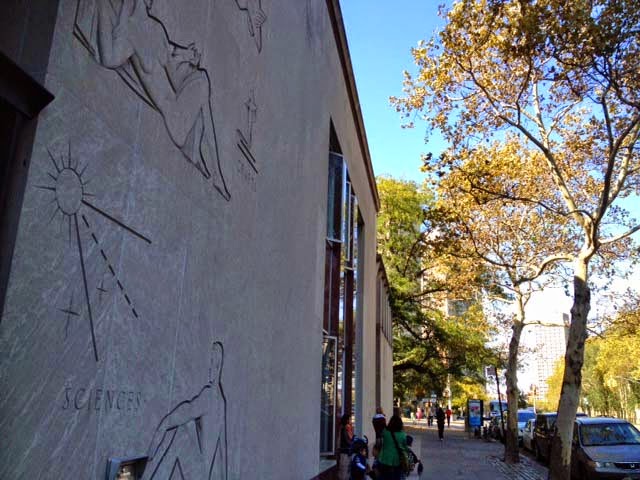
Truth Park at the north end of the library where an admonition about TRUTH and TREASURE appear
On the north face of the Brooklyn Heights Library (facing the corner park- We like to call it “Truth Park”) we find inscribed this admonition to come to the library to pursue TRUTH not TREASURE:
 “All that come here to seek treasure will not take away gold but the seeker after truth and instruction will find that which will enrich the mind and heart”
At the last (5/18) BPL design “Charette”/Charade to sell and shrink the library none of the multitude of architects or BPL representatives at the tables knew of this admonition, or even knew how many feet of book shelf space was at the library for before and after comparisons.

Special Advisory To The Press:   We were notified that just in time for this first ever library sell-off ULURP hearing, CB2 is imposing new strictures on the press and media coverage of its meetings (not posted on the internet) that will make it harder for public not attending the meetings to get coverage of what happened.

The City Council makes special provision to enable the press to cover their proceedings, giving them special close-up seats and an elevated platform of honor and special vantage. . .  And they don't prohibit the regular audience from photographing and sharing what's happening in the proceedings.  But the notice we got?: That's not exactly what CB2 seems to be setting up.

The press should know that Robert Freeman head of the Committee, advises us that any recording that is "not disruptive or obtrusive is permitted."  He said that as Justice Brandeis said: "Sunlight is the best disinfectant."  He said that unless and until any recording becomes obtrusive they can't request that it has to be done in another way. 

Friday, May 15, 2015

Our Message For the May 15, 2015 City Hall Rally to Respond to de Blasio's Budget Underfunding the Libraries

Here is our message for the May 15, 2015 City Hall rally to Respond to de Blasio's currently proposed budget underfunding our New York City libraries.

What’s wrong with this picture?

A “progressive” mayor who didn’t restore or make up for the Bloomberg cuts is cutting funding to NYC libraries yet again!  This after everyone said a phony “budget dance” that needed to end was over?  Adding to this injury, de Blasio is projecting future capital fund expenditures on libraries at an insultingly low level for the next ten years!

That’s the same mayor who says that “income inequality . .growing, rampant income inequality” is the “crisis of our times” because we have “an economy that is basically supporting the 1%.”

Libraries, the tiniest fraction of the city’s budget (less than 1%), cost little to fund in the overall scheme of things, particularly given their benefit.. .

 . . . Yet de Blasio’s underfunding follows one of the best ever, most publicized campaigns to restore funding with the New York Times opining that NYC’s “utterly essential libraries” need money and the cuts restored, noting that in de Blasio’s New York, while libraries were starved, money flowed copiously to the “seldom neglected . . . corporate and entertainment infrastructure.”

The only problem with this campaign for funding?: It never mentioned that failure to replenish these gutted funds will be cited as a reason to sell off and shrink libraries like the Tillary Clinton Library in Brooklyn Heights, the 34th Street Science, Industry and Business Library, the Red Hook Library, the Pacific Branch and others.  Remember Donnell!

Bear in mind: Cuts in funding to the libraries commenced when plans were originated to cite such underfunding as a rationale to sell and shrink libraries throughout New York.

And as Mr. de Balsio said when he was running for mayor (July 12, 2013):
    “It’s public land and public facilities and public land under threat. . . and once again we see, lurking right behind the curtain, real estate developers who are very anxious to get their hands on these valuable properties”
Sign our petition on the web: Citizens Defending Libraries

Thursday, April 23, 2015

Resolutions About Library Sell-offs and the Future of the Brooklyn Public Library’s Brooklyn Heights Branch & Business Library adopted by Central Brooklyn Independent Democrats on April 23, 2015

On April 23, 2015, Central Brooklyn Independent Democrats adopted resolutions opposing the sale of New York City libraries.  Central Brooklyn Independent Democrats previously signed on to Citizens Defending Libraries Letter of Support- Support and Sign-On Letter: Full and Adequate Library Funding, A Growing System, Transparency, Books and Librarians.

Central Brooklyn Independent Democrats adopted a resolution that generally opposed all the pending sales of New York City libraries (the text will be put up here soon) and planned further future action.

Central Brooklyn Independent Democrats also adopted the following specifically respecting the Brooklyn Heights (Tillary Clinton) Library that tracks a similar resolution adopted April 16, 2015 by Independent Neighborhood Democrats.

* * * *

Central Brooklyn Independent Democrats

Resolution on the Future of the Brooklyn Public
Library’s Brooklyn Heights Branch & Business Library

Adopted by the CBID General Membership at the April 23, 2015 meeting.

Whereas, Central Brooklyn Independent Democrats (“CBID”) recognizes the critical and expanding role that Brooklyn’s public library system plays, especially the branch libraries, in the lives of New York City’s residents, providing them with books, information, communications and other technology, meeting spaces, and other resources and activities they rely upon to improve and enhance their intellectual, social and economic well being, and

Whereas, the increasing number of people who live, go to school and work near the Brooklyn Heights Branch places a growing strain on the Library’s resources and ability to meet the needs of its diverse community of patrons, and

Whereas, the Brooklyn Public Library must develop a plan to ensure performance of necessary maintenance and improvements such as infrastructure repairs, additional space, new services, enhanced technology and partnerships with other community resources at the Brooklyn Heights branch, and

Whereas, the Brooklyn Public Library has raised several proposals impacting the Brooklyn Heights branch including the business library, the centerpiece of which calls for selling the space that currently houses the Brooklyn Heights branch to private real estate developers, and

Whereas, any sale of a publicly-held asset raises very serious concerns regarding whether the sale will serve the interests of the community, therefore be it 

Resolved, that the Central Brooklyn Independent Democrats opposes any proposed sale of an important public asset to private developers with little or no transparency, long-term planning, and oversight, and

Resolved that the Central Brooklyn Independent Democrats Neighborhood opposes diminution of public areas or services in the Brooklyn Heights branch, and be it further

Resolved, that the Central Brooklyn Independent Democrats calls upon all our elected officials to reject piecemeal proposals put forth by the Brooklyn Public Library, including the entire idea of locating any affordable housing off-site, for the Brooklyn Heights Branch, and be it further

Resolved, that the Central Brooklyn Independent Democrats will work with elected officials, other organizations and campaigns to provide a forum for exploring flexible, responsible, transparent and fiscally sound ways to renovate, upgrade and enhance the existing facility over the coming years, and be it finally

Resolved that the Central Brooklyn Independent Democrats will work with others to fight for increased funding for the borough’s public libraries so that they can continue to meet the many needs of their growing number of patrons and remain a valuable resource to this city.

* * * *
See the resolution adopted by Independent Neighborhood Democrats: Resolution on Future of the Brooklyn Public Library's Brooklyn Heights Branch & Business Library Adopted by Independent Neighborhood Democrats on April 16, 2015.

See also the following about the forum on the future of the library Independent Neighborhood Democrats held on January 22, 2015: Open Letter To Brooklyn Public Library Trustee Peter Aschkenasy Re Commitment to Provide Information About Library Sale.

Additionally, here is another resolution IND adopted earlier: Resolution Respecting Neighborhood Libraries adopted by Independent Neighborhood Democrats on June 20, 2013

All Three Candidates For New York 's 11th Congressional District, Donovan, Gentile and Lane (Republican, Democrat and Green), Sign Our Letter of Support- Election Day Is May 5th

All three candidates for New York 's 11th Congressional District, Donovan, Gentile and Lane, above have joined in signing our Citizens Defending Libraries Letter of Support
There is an important election that will be held May 5th.  The election, for New York 's 11th Congressional District, is to fill the seat vacated by former Congressman Michael Grimm (R) who resigned in January after he pleaded guilty to a federal tax evasion charge.

We are pleased to report that all three candidates for the seat, Republican, Democrat and Green, have joined to sign our Citizens Defending Libraries Letter of Support: Support and Sign-On Letter: Full and Adequate Library Funding, A Growing System, Transparency, Books and Librarians.

This universal support for our cause pretty much precludes Citizens Defending Libraries from endorsing one candidate versus another based on their position respecting libraries and their funding, sale, shrinkage, elimination of books or librarians.  Nevertheless, this is an important election and we suggest that you study the candidates positions in all respects.  Here, taking the candidates in alphabetical order, is more information relevant to libraries.  We also encourage  those wishing to participate to supply comments to this page.

Republican Daniel M. Donovan, Jr., is currently the District Attorney for Richmond County (Staten Island).  As someone in charge of an investigative and prosecutorial office we are particularly pleased to have his support.  We have, of course, been urging more scrutiny and investigation with respect to the library sales past like the NYPL’s sale of Donnell and proposed like the NYPL’s proposed sale of the Science, Industry and Business Library (flowing out of the discredited Central Library Plan that also included the sale of Mid-Manhattan and destruction of the main research library stacks), and sales/shrinkages the Brooklyn Public Library is proposing like that of Brooklyn Heights (Tillary Clinton) Library, Red Hook and Williamsburg.

Democrat Vincent J. Gentile, a New York City Councilman, is currently the City Council Chair of Committee on Oversight and Investigations.  It is also especially meaningful to have Mr. Gentile joining in signing our letter of support in that Mr. Gentile is the former Chair of the City Council’s Library Committee, holding that position until relatively recently when it was taken over by City Councilman Costa Constantinides.  We have been busy testifying before the City Council about our objections to the sale and shrinkages of libraries, the elimination of books and librarians and asking that the City Council delve more deeply into these issues.

Candidate Gentile supplied us with the following statement for use in forwarding word of his sign on to support us.  We offered all the candidates the opportunity to supply such an accompanying statement:
The definition of what a library should be in the digital age is constantly changing but our libraries are adapting and rising to meet these new challenges. And because of this, I know our libraries will survive. Whether it's new Americans seeking foreign-language classes or teenagers looking to socialize and be stimulated after school, our libraries are there. Whether it's the unemployed who come to be coached by library staff on résumé-writing or seniors who come to learn how to set up an email account, our libraries are there. That is why today libraries are seen more as public community spaces and centers for opportunity and less as storage spaces for bound volumes of information. During tough economic times, people turn to libraries more than ever.  And it's because of this that libraries must survive. Free and equal access to information is not just a major draw for libraries but one of the hallmarks of a great civilization. Free and equal - no matter who you are, where you live or where you come from, no matter your age, gender, race or economic standing - all have free and equal access to all that our libraries have to offer. Our libraries are "tabernacles" of personal freedom.
Green Candidate James Lane, is not a career politician. He is a lifelong resident of New York City is married and has a young child in our city’s public school system.  When Mr. Lane was previously running for Public Advocate he participated in our Public Advocate’s Forum.  He complected a Citizens Defending Libraries questionnaire in connection with that previous race from which the below is excerpted:
I am strongly opposed of the sale, shrinkage and consolidation of our public libraries and their assets and the reduction of their space. I feel that if the public was made more aware of this issue that we would be having massive protests in the streets. . .
. .  There are no benefits to the community and selling off, shrinking down and consolidating to a so-called Central Library plan. In fact, these plans would only result in a financial profit to wealthy real estate developers that are just trying to obtain these properties at bargain basement prices without providing the public any benefits for the spaces they will have taken away from the people.. .

. . . I believe this practice of selling off and shrinking our public libraries need to be thoroughly investigated.
All of Mr. James’ response together with the questions Mr. James was responding to are available here: Response of Public Advocate Candidate James Lane to Citizens Defending Libraries Questions For Candidates For New York City Offices.

Thursday, April 16, 2015

Resolution on Future of the Brooklyn Public Library’s Brooklyn Heights Branch & Business Library Adopted by Independent Neighborhood Democrats on April 16, 2015

The following is the resolution respecting the Brooklyn Heights (Tillary Clinton) Library that Independent Neighborhood Democrats adopted April 16, 2015 after a forum where the Brooklyn Public Library defended its plans.

* * * *

Independent Neighborhood Democrats

Resolution on the Future of the Brooklyn Public
Library’s Brooklyn Heights Branch & Business Library
Adopted by the IND General Membership at the April 16, 2015 meeting.

Whereas, Independent Neighborhood Democrats (“IND”) recognizes the critical and expanding role that Brooklyn’s public library system plays, especially the branch libraries, in the lives of New York City’s residents, providing them with books, information, communications and other technology, meeting spaces, and other resources and activities they rely upon to improve and enhance their intellectual, social and economic well being, and

Whereas, the increasing number of people who live, go to school and work near the Brooklyn Heights Branch places a growing strain on the Library’s resources and ability to meet the needs of its diverse community of patrons, and

Whereas, the Brooklyn Public Library must develop a plan to ensure performance of necessary maintenance and improvements such as infrastructure repairs, additional space, new services, enhanced technology and partnerships with other community resources at the Brooklyn Heights branch, and

Whereas, the Brooklyn Public Library has raised several proposals impacting the Brooklyn Heights branch including the business library, the centerpiece of which calls for selling the space that currently houses the Brooklyn Heights branch to private real estate developers, and

Whereas, any sale of a publicly-held asset raises very serious concerns regarding whether the sale will serve the interests of the community, therefore be it 

Resolved, that the Independent Neighborhood Democrats opposes any proposed sale of an important public asset to private developers with little or no transparency, long-term planning, and oversight, and

Resolved that the Independent Neighborhood opposes diminution of public areas or services in the Brooklyn Heights branch, and be it further

Resolved, that the Independent Neighborhood Democrats calls upon all our elected officials to reject piecemeal proposals put forth by the Brooklyn Public Library, including the entire idea of locating any affordable housing off-site, for the Brooklyn Heights Branch, and be it further

Resolved, that the Independent Neighborhood Democrats will work with elected officials, other organizations and campaigns to provide a forum for exploring flexible, responsible, transparent and fiscally sound ways to renovate, upgrade and enhance the existing facility over the coming years, and be it finally

Resolved that the Independent Neighborhood Democrats will work with others to fight for increased funding for the borough’s public libraries so that they can continue to meet the many needs of their growing number of patrons and remain a valuable resource to this city.

* * * *
See also the following about the forum on the future of the library Independent Neighborhood Democrats held on January 22, 2015: Open Letter To Brooklyn Public Library Trustee Peter Aschkenasy Re Commitment to Provide Information About Library Sale.

Additionally, here is another resolution IND adopted earlier: Resolution Respecting Neighborhood Libraries adopted by Independent Neighborhood Democrats on June 20, 2013

Tuesday, March 10, 2015

Floor Plans of the Brooklyn Heights Library Considered In Light of the Library’s Proposed Sale and Shrinkage

This is NOT a graph- Just a visual to catch you attention with the information that we have some interesting calculations for you below!
59%, approximately 37,703 square feet, of the Brooklyn Heights Library is above ground, and,. . . .   according to the BPL’s own calculations, 21,571 square feet (at least) of the above-ground space should be allocated to the existing “branch” functions. . .. . . PLUS added to that there should also a lot of additional underground space!- . .

. . . But shouldn’t ALL, or MOST of, the tax-payer-owned-and-paid-for space including the space the BPL deems "Business and Career Library" function space, be kept for public use, not sold off and shrunk way down to benefit the private developer of a luxury condominium tower and Saint Ann’s a private school which now may be getting 18,000 to 20,000 square feet for a new school theater, pretty much the same amount of space as proposed for a shrunken replacement library (proposed to have only 15,000 square feet above ground)?
FOR MORE CALCULATIONS KEEP READING. . .

How big is the current Brooklyn Heights Library?
The current library is 63,000 square feet.  We are going with this particular stated size, because this is the stated size that has been used the longest and was used by the architects that the Brooklyn Heights Library hired to calculate an inflated estimate of repairing the library’s air conditioning.  The BPL’s previous statements of the libraries size have usually stated the size of the library to be very close to this number and over 62,000 square feet.  On Monday, March 9, 2015, the library announced for the first time that it was hiring Marvel, the real estate developer’s architect, and simultaneously released for the first time floor plans in response to one Citizens Defending Libraries long-standing requests.  At that time the developer’s architect presented for the first time a somewhat  reduced statement of the library’s current size stating it to be 59,146 square feet.  In order to avoid any aggregation of rounding errors and what is know in the trade as “net to gross” calculation shifts and in order to facilitate a continuity of dialogue we will continue to use the 63,000 square feet that has been used for the last couple of years.  That is 1.06516x the smaller revised statement of size recently adopted by the developer's architect.
How big is it proposed that a smaller library to replace the existing library would be?
The developer was appointed as developer, awarded the RFP (Request For Proposals), based on its representation that it would build:
    •    a 21,000 square foot library,
    •    of which just 15,000 square feet would be above ground.
On Monday, March 9, 2015, the developer’s architect for the first time referred to the developer’s still incomplete plans (no current design existing) as providing a library with a few additional square feet, “21,500 square feet."  We think that statement of a slightly increased size is a reaction to the fact that the new Sunset Park Library is currently proposed to be 20,600 square feet, almost the same size as the it is proposed to shrink the Brooklyn Heights Library down to.  Also, on that March 9, 2015 evening the developer disclosed that Saint Ann’s, a neighboring private school is likely to get an 18,000 to 20,000 square foot auditorium because of the redevelopment.   There is friction in the neighborhood because it is understood that the benefits that Saint Ann’s school is getting is helping drive the deal to sell and shrink the taxpayer-paid-for library.  We are not now restating the size of the proposed replacement library to include an extra 500 square feet because there is no known obligation on the part of the developer to provide it and we do not see evidence that the BPL is trying to negotiate any improvement of this very bad deal for the public. 
How much of the Existing Brooklyn Heights Library is above ground?

Above, showing in bar graph form the amount of space in the existing Brooklyn Heights Library (left) both above and underground and (right) in the proposed replacement library that would go at the bottom of  tower built for luxury condominiums
Based on the figures and floor plans (below- click to enlarge) the BPL just released the current library has approximately 37,703 square feet of above ground space.  The library consists of four floors and 59% of its space is in the two most important floors that are above ground.  There is more space in another two stories below ground, where currently 17,527 square feet or (28% of the total 63,000 square feet) is used for books and materials (similar to the research stacks of the NYPL's 42nd Street Central Reference Library that make books readily accessible upon request).

Is anything else being given up in addition to the space inside the library? 

Yes, a great deal.  There is all the space outside the library, including a park and landscaped areasThere is all the light and air that the neighborhood will sacrifice.  There is an extra burden of infrastructure like public schools. . . even as this move diminishes that supporting infrastructure.  There is an enormous amount of cost and disruption that needs to be taken into account and hasn't been yet.  There is the fact that for years yet to be determined, the neighborhood will only have a very small temporary library, a mere 7,000 square feet.  That's not only a poor, make-shift substitute while children are growing up, one also needs to remember that as BPL president Linda Johnson told her trustees at the last BPL trustees meeting, when you take library resources away there is an extended period after you bring those resources back before patrons return to their habits of using them again returning to previous levels of patronage. 

The Existing Brooklyn Heights Library integrates both "branch" and the "Business and Career Library" functions serving Downtown Brooklyn: What amount of space is proportionally devoted to each?

Between the Branch Library and the Business and Career Library functions, the library assigned 57% of the space to the Branch Library functions (blue) and 43% to the Business and Career Library functions (green).

Allocating the entire library’s space proportionately that would mean that approximately 21,571 square feet of the above-ground space should be allocated to the Branch Library.  Allocating the below ground space the same way would assign another 14,419 to the Branch Library for a total of 35,990 square feet.  In that case, 27,010 square feet of the Brooklyn Heights Library’s functions would wind up being moved to the Grand Army Plaza Library deemed by the BPL to be Business and Career Library functions that don’t need to stay in Downtown Brooklyn.  There will be no additional space for those functions in the Grand Army Plaza Library, but Linda Johnson and the BPL administration officials have acknowledged that there will be costs they are not disclosing to reconfigure the Grand Army Plaza Library and shrink other function there to cram in the functions transferred of of Brooklyn Heights Library and away from the Downtown area.

The BPL is arguing that the amount of space devoted to Brooklyn Heights Library functions that should be shifted, reconfigured and crammed into Grand Army Plaza for reconfiguration and replacement/shrinkage of other function there should be should be greater than the 27,010 square feet allocation above.
How much space should be retained for an adequately-sized replacement Brooklyn Heights Library if the Business and Career Library functions are moved to Grand Army Plaza?
The answer to this question must flow from the functions the public would like to see retained at the Brooklyn Heights Library. . . . and also what the public would not want to see crowded out of the Grand Army Plaza Library.  The answer should also defer to, and take appropriately into account, the fact that the Brooklyn Heights Branch and the Business and Career Library functions in the library have always operating on an integrated, synergistic basis with economies of scale flowing out of their joint operations.

Accordingly, even if the Business And Career functions are shifted out of the library, one must think twice or more about whether the Branch Library would want to give up the following:
    •    The full scale auditorium that is used for events, films, functions and gatherings, and as a place to do things like vote.  Such space that can be made readily available to the public in the Downtown area is very rare and becoming increasingly in more demand as density rapidly increases.
    •    The public conference room, for the same reason as above.  (There is also a possibility for more of these conference rooms to be created if you read on.)
    •    The electrically equipped computer room that is now technically designated by the BPL as a Business and Career Library space, but which is definitely used by many, many of the Branch Library patrons.
    •    The restrooms.  There is currently a men’s restroom, a women’s restroom (so frequently in many facilities complained about as not being large enough), a separate children’s bathroom and a ground floor bathroom next to the front entry.  The ground floor bathroom is designed to serve the handicapped, and because of the way that Downtown Brooklyn figures as a major transit hub, it regularly serves the bus drivers of a number of Boroughs’ key bus lines.
If you want the library to keep all of these spaces, which is probably a good idea, then the calculation of the percentage of what should be retained for the branch of the above-ground space becomes a 74% for the branch vs. 26% for the Business and Career library functions proposition.  In that case, one would want the library that remains to have about 27,900 square feet of space above ground (vs. the current 37,703 square feet) plus a certain amount of additional support space below ground.  If the percentage for the underground space were the same percentage (which the library would probably argue against) the additional underground space would be 18,719 square feet.

The BPL’s mantra is that all space in libraries should be the same space flexibly used for everything, an excuse to shrink libraries that creates logistic and noise problems while communicating to the public that it isn’t valued enough to deserve gracious public spaces devoted to its needs. 
Should the Brooklyn Heights Library retain all the Business and Career Library functions?
Yes.  We think the simple answer is obviously yes.  The decision to "move" it dates back to plans initiated in 2007 to sell and shrink libraries around the city and the plan to "move" it is, in our opinion, just a pretext to shrink library space in something of a shell game maneuver.

We think the Business and Career library should be kept in Downtown Brooklyn where they are most centrally and conveniently located to the residents of the borough and to other New Yorkers.
What about enlarging some of Brooklyn Heights Library’s Library functions irrespective of whether Business and Career Library functions are formally being viewed as retained at the library?
This could be a very good idea.  At other libraries like the NYPL’s 34th Street Science, Industry and Business Library and The Grand Army Plaza Library the concept has been introduced to have libraries provide more spaces  for people to meet and convene and work on projects, sometimes providing patrons with such things as digital editing and production equipment.  With the reuse of the former Jehovah's Witness Buildings the neighborhood is becoming even more a tech center that the library could work hard to support.  What could be done to serve the public with facilities centrally located in the borough’s downtown gets into the realm of imagination. .  but  you don't need to challenge your imagination much to realize the building's potential extra uses.

Thoughts include:
    •    A second and/or a larger auditorium
    •    Use of any unused or perhaps less well used staff space, as conference and meeting rooms.
    •    Configuration of library uses to better align with and support educational service support school students, especially those in the overburdened public school system.  This could include rooms for use by visiting classes on study trips. 
Do the floor plans released on Monday March 9, 2015 disclose anything else of interest?
Yes.  They indicate that restoring the air conditioning system in the building to working order could easily be be a much simpler and less expensive proposition than the BPL has acknowledged.   
When one considers the possibilities, it is probably foolish not to think in terms of more wisely using this asset to benefit the public as always intended, not figuring schemes to benefit a private developer or the private Saint Ann’s School instead.

There is also the question of the importance of books (yes physical books) and having them readily accessible, more than one copy in the system, particularly in central libraries when it comes to the harder to find volumes. . .you know, the reason we created libraries to store and share our books to begin with.