Why Is New York City Planning to Sell and Shrink Its Libraries?

Defend our libraries, don't defund them. . . . . fund 'em, don't plunder 'em

Mayor Bloomberg defunded New York libraries at a time of increasing public use, population growth and increased city wealth, shrinking our library system to create real estate deals for wealthy real estate developers at a time of cutbacks in education and escalating disparities in opportunity. It’s an unjust and shortsighted plan that will ultimately hurt New York City’s economy and competitiveness.

It should NOT be adopted by those we have now elected to pursue better policies.

Wednesday, May 22, 2019

As The Brooklyn Public Library Holds Gala At The Barclays Arena Honoring Nets And Barclay’s Arena, Citizens Defending Libraries Is There With A Message: End Faux Philanthropy; Take Less And Don’t Sell Our libraries!

The date, May 22nd, finally came and the Brooklyn Brooklyn Public Library held it’s 2019 annual gala at the Barclays basketball arena, of all places, honoring the nets basketball team and the Barclay’s arena itself.

. . .   “Of all places” has several implications.  A weird place to hold the gala?  Yes, but weirder if you know that BPL president Linda Johnson has shacked up (in a Brooklyn Bridge Park apartment) with real estate developer and mega-subsidy collector Bruce Ratner who created the arena as part of the ill-famed Atlantic Yards eminent domain project.   And that weirdness grows more ominous when you realize all the connections that exist between the real estate industry, Mr. Ratner’s Forest City Ratner development company in particular, and the sale and shrinkage of libraries, the elimination of books and the deprofessionalization of librarians.

That weird ominousness continues when you consider how the BPL now likes to focus on “partnering” its public, supposedly democratic commons with private corporate interests such as the Nets and the Prokhorov/Ratner arena.  That, in fact was something that the BPL’s press release made a point about.

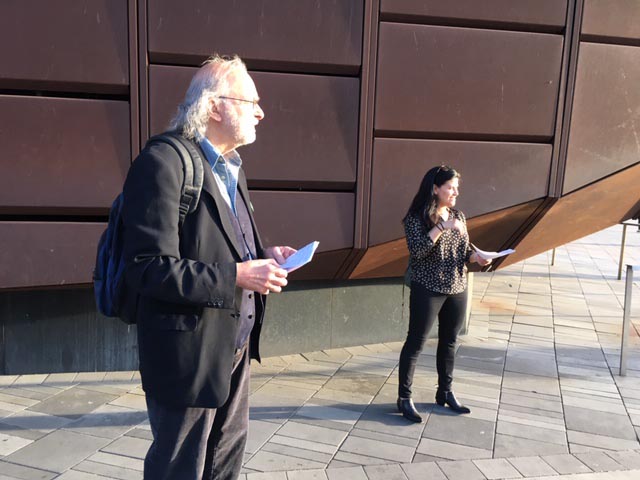
Sometimes you just gotta be there- Citizens Defending Libraries was outside the gala leafleting with a message as gala attendees arrived.

Our message which we chanted was “Put a stake in faux philanthropy: Take less and don’t sell our libraries!”   We also sang our library don't sell our libraries song written for us by Judy Gorman.  We displayed this visual:
Admittedly, our chant about eliminating “faux philanthropy” and “taking less” instead of selling libraries was borrowing from the spirit of Anand Giridharadas, author of  “The Elite Charade of Changing the World” (we've written about him before), who has said that “giving has become the wingman of taking. Generosity has become the wingman of injustice. Changing the world has become the wingman of rigging the system.”

Upon hearing our chant one of the developers entering the arena came over to joke with us: “How about if I want to buy a library?”  David Kramer, whose Hudson Companies is replacing the downtown Heights central destination library with a luxury tower in a shrink-and-sink real estate deal, was one of the attendees. Although often quipful himself, Kramer was not the fellow who offered this clever quip.

This is the flyer we handed out to those entering plus to some passersby:
Here is the text.
Spending Public Library Money To Partner and Party With Private Real Estate Interests Destroying Our Libraries?
 NYC Public Libraries Are Mostly Public Tax Dollar Funded– And The BPL Is Partnering & Partying With Private Interests, Honoring Real Estates Interests Dismantling Libraries?
Our libraries should be a civic commons for public discourse and learning.  Instead, the mantra afoot with our library officials is to “partner” with, advertise, and undeservedly burnish commercial corporate brands and the reputations of companies unraveling our democracy, companies involved in privatizing our public assets and turning our libraries into real estate deals that eliminate the  books, librarians and libraries the public has invested in.   

NY Times columnist Jim Dwyer wrote that NYC libraries “have more users than major professional sports, performing arts, museums, gardens and zoos - combined,” but the city diverted its funds instead into subsidies for the very controversial private Ratner/Prokhorov “Barclays” arena with:
at least $464 million to build new baseball stadiums . .  and $156 million for the Barclays Center. That's $620 million for just those three sports arenas - a sum more than one-third greater than the $453 million that the city committed for capital improvements to the its 206 branch libraries and four research centers, which serve roughly seven times as many people a year as attend baseball games. ( . . the teams are getting an additional $680 million in subsidies spread over 40 years.)
Our presidential-candidate mayor underfunds libraries as an excuse to sell them while the BPL holds a gala to honor the Barclays Center and the Brooklyn Nets, brought to us by subsidy-collection meister Bruce Ratner?  It’s insane and absurd: BPL president Linda Johnson said turning libraries into real estate deals was her biggest priority. Topping the list: Two libraries next to Ratner property, including Brooklyn’s second biggest library.  Ms. Johnson is now literally shacked up with Bruce Ratner.  The dots to be connected are myriad.  See:
The (Ugh) Upshot After Brooklyn Public Library President Linda Johnson Shacks Up With Bruce Ratner?: The BPL Will Hold Gala On May 22nd Honoring The Ratner Barclays Center And Nets!

It Gets Personal, But This Gossip Is, In Fact, Real News About The Business of Selling Libraries- Two From That Constellation of Library-Selling Stars Hook Up As A Couple: Bruce Ratner and Brooklyn Library President Linda Johnson– Guess Where?
Sign our petition on the web: Citizens Defending Libraries
* * *

Note that the two Citizens Defending Libraries posts above contain a ton of information about the almost unbelievable number of dots that connect when it some to library real estate sales, Linda Johnson, her shackmate Bruce Ratner, Forest City Ratner and the Brooklyn Bridge Park Corporation board similarly pushing for development there.   

The BPL issued a press release that day:  Brooklyn Public Library Honors Brooklyn Nets and Barclays Center ..  [plus a few more]

This is some of what it said (emphasis supplied):
Nearly 500 supporters gathered at Barclays Center last night to raise funds for Brooklyn Public Library (BPL) and to recognize Brooklyn’s leaders in business, sports and literature.

“In addition to raising funds for our collections and services, the gala provides Brooklyn Public Library the opportunity to recognize organizations and individuals emblematic of Brooklyn’s innovative and creative spirit,” said Linda E. Johnson, Brooklyn Public Library President and CEO.

“The Barclays Center and Brooklyn Nets have inspired the borough with the power of sports, and in the process supported the Library and local community-based organizations. We are delighted to honor all of their accomplishments.”

* * * *

BSE CEO Brett Yormark—who oversees the business enterprise that manages and controls the Brooklyn Nets, Barclays Center and other sports and entertainment venues—accepted the award on behalf of the Barclays Center. In his remarks, he announced a special initiative to provide two free tickets to a Barclays Center event to every child who completes Brooklyn Public Library’s summer reading challenge.

“We are honored to be recognized by the Brooklyn Public Library, one of our borough’s pre-eminent cultural institutions,” said Yormark. “Hosting the Gala aligns perfectly with Barclays Center’s mission of bolstering other key Brooklyn organizations and we are proud to continue that support by partnering on the summer reading challenge.”

Opened in 2012, Barclays Center hosts an extensive variety of events, including the Brooklyn Nets, premier concerts, major professional boxing cards, top college basketball, family shows and the New York Islanders. The Nets relocated from New Jersey upon the opening of the arena, and have reached the postseason four times since moving to the borough. In all of its community efforts, BSE Global aims to inspire lives through the spirit and the power of sports and entertainment.

* * *

Furthermore, the Brooklyn Nets and Barclays Center have partnered with Brooklyn Public Library on a number of literacy initiatives including Team Up To Read, a program to support children ages 5 to 9 as they work to become strong readers.

* * * *

Special guests included Brooklyn Borough President Eric L. Adams . . .

* * * *
Baratunde Thurston, a trustee of Brooklyn Public Library and Emmy-nominated futurist comedian, writer and cultural critic, served as host for the evening. Thurston helped re-launch The Daily Show with Trevor Noah. . .
(An aside: Does it seem that the Daily Show has gotten increasing flat and corporate in its messages recently?)

As for the "nearly 500 supporters," that's also what the BPL told the police, but our own count was far below that.  We had an idea of the number based on the number of flyers we handed out to those who arrived plus a good sense of the high proportion of people taking them.  Maybe nearly "nearly 500" is the number of people for whom tickets had been bought, rather than people who actually showed up?

It was amazing how many of the people who showed up didn't know about the library sales or dismantlement.   One of the attendees walked over to specifically thank us for handing out the flyer.  At least of the police officers on duty for the even was also very thankful to learn about much that he said he didn't know.

There seems to have been virtually no coverage of the gala.  The BPL, itself, put up pictures here:
Join the crowd?
On the right it's Bruce Ratner
Ratner girlfriend BPL president Linda Johnson, glad to have her arms around two local politicians who want to become mayor, City Councilman Corey Johnson on left, and Brooklyn Borough President Eric Adams on right.  Borough President Adams has been a regular attending BPL galas.
Early September 2015: Borough President Adams ponders over 2000+ signed and individualized petitions opposing the sale of the second biggest library in Brooklyn that were collected by Citizens Defending Libraries in August.  The petitions impressed him, and he surprised the real estate industry by refusing to approve the deal selling the library that had been brought to him.  After the City Planning Commission and the City Council ignored his opposition, Borough President Adams eventually fell in line behind everyone else giving a last approval of the shrink-and-sink sale that converted the library site to a luxury tower project. 
Here is a link to must read from National Notice how on issue after major issue, a robust system of NYC libraries being an excellent example, elected officials, succumbing to the influence of money  are not giving the public what it wants and could easily have (plus how the corporate press is complicit):
Everybody’s Realizing It Now: The Political Establishment Is Not Willing To Give The Public The Things The Vast Majority Of Americans Want And That We Could Easily Have, May 11, 2019.
Outside the gala we took some of our own photos.

A guest of honor, Bruce Ratner, the BPL president's Brooklyn Bridge Park development shackmate, arrives.

David Giles who now works for the BPL after writing to endorse library sales working at the Center for an Urban Future
Library trustee and Brooklyn Bridge Park Corporation board member Hank Gutman.
In addition to our own posts, there was pre-coverage of the event by Norman Oder of Atlantic Yards/Pacific Park Report:   Ball for Brooklyn: Barclays Center site of Brooklyn library gala, where arena is honored; Bruce Ratner and BPL's Linda Johnson buy a Pierhouse condo, May 03, 2019.

Here is some of what Mr. Oder wrote:
It's unsurprising that the library, like the Brooklyn Academy of Music and the Brooklyn Museum and the Brooklyn Children's Museum [which itself is involved with a BPL library real estate deal] and the Brooklyn Historical Society, would enmesh itself with a major company. Still, it remains unfortunate that such nonprofit institutions, which are supposed to act in the public interest, ally themselves with big-money sponsors whose interests are not necessarily in sync.

* * *

I don't think--I don't like to think--that the need to keep warm relations with potential sponsors affects Brooklyn Public Library programming decisions or materials selection.

Let's see. The library, during the height of the project controversy (and before Johnson's time), faced charges of censorship for culling certain politically charged pieces of art when re-mounting an art exhibit called Footprints. (It was unwise caution, but I thought other omissions were even more meaningful.)
About library real estate deals (which have been in the works since about 2004 or earlier, at first mostly in secret) Mr. Oder said:
The devil is in the deal, and the details: clearly the New York Public Library's Donnell Library deal in Manhattan was a disaster. I'm reserving judgment on the Brooklyn Public Library's Brooklyn Heights Branch.
As comments to Mr. Oder’s article Citizens Defending Libraries co-founder Michael D. D. White wrote:
One might reserve judgement about the sale of the central downtown Heights library, a central destination library that was the second biggest in Brooklyn and hope that it will be a good deal for library patrons in the end, but that hope must factor in what we know now:

It will no longer be a Business Library.
It will no longer be a Career Library.
It will no longer be an Education Library.
It will no longer be a federal depository library.
It was all of these things until recently.
It will be approximately 40% the previous size.
The proportion of space the public visits will be pushed underground: Previously there was almost 38,000 square feet of space above ground (plus two underground stories kept books at the ready). The new library will have just 15,000 square feet above ground. [More of the comment at the site.]
And:
For those interested in the Curriculum Vitae for BPL president and Ratner apartment mate Linda Johnson, her work as an environmental lawyer (on the wrong side) and her “rise” via her father’s company, we have it posted here:

Brooklyn Public Library Trustees- Identified + Biographical and Other Information Supplied.
A few days after the gala, BPL trustee (also Brooklyn Bridge Park Corporation board member) Hank Gutman, dressed for tennis out side the Brooklyn Casino on Montague Street, ran into CDL co-founder Michael D. D. White.  Gutman attended the gala, while White was outside with other leafleting library defenders.  Gutman told White that White should have come to gala and `why not contribute to the library to do so.'  He asked White why White wasn't busy donating to the library--  But that sort of missed the basic point of the flyer that was handed out that evening, that we the taxpayers do pay for our libraries, that "NYC Public Libraries Are Mostly Public Tax Dollar Funded," and that when taxpayer money is diverted into huge subsidies for projects like the private Barclays arena and then the BPL is induced to use our publicly funded libraries to advertise that private arena, it's not charity, and our public tax dollars are being stolen to support private interests.

There is now available a brand new Project Censored Radio Show radio interview with CDL co-founder Michael D. D. White that provides, in one-half hour, a superb up-to-date comprehensive overview about what is going on with respect to the dismantlement of NYC libraries and issues related thereto.
(PS: To catch up with several other recent commentaries about the thereat to the public commons and democracy posed by "philanthropic" wealth that puts this event in a larger context see: A Flourish of Stories About So-Called Philanthropy Being Used As A Guise For Diminishing The Public Commons– That Includes Libraries.)

Latest Project Censored Radio Show Features Interview With CDL Co-Founder Michael D. D. White On Dismantlement of Libraries- (And Another Interview With Investigative Reporter Dave Lindorff)

Here’s something we don’t think you’ll want to pass by–   The latest Project Censored Radio Show Features Interview With CDL Co-Found Michael D. D. White (And Another With Investigative Reporter Dave Lindorff).  See:
Latest Project Censored Show:- Dave Lindorff and Michael D. D. White, May 21, 2019
The weekly Project Censored Radio Show, just part of the work Project Censored produces (also including an annual book and annual identification of top-censored stories), is a Pacifica network public radio show, a quintessential Pacifica network show fulfilling the mission of Pacifica by pointing out on a weekly basis the huge doughnut hole of major news and issues that are going unreported by corporate media.  Paying attention to how and why such information is being buried and ignored usually makes clear the other hugely important part of the picture: The power structures in place that would such matters steered in certain ways and therefore have a vested interest in an uninformed, misinformed or misled public.

The half hour interview with Michael D. D. White covers a lot of ground.  It is probably at this moment the best up-to-date half hour to get an overview hearing about why New York City libraries (and potentially other libraries similarly around the country and the world) are being attacked and shifted away from pursuit of their traditional functions.

The following are links you may want to us to delve deeper into some of things you’ll hear discussed in the interview:

Main Citizens Defending Libraries page
Of course, our our current main Citizens Defending Libraries page, which, with lots of links, takes you in any direction you would like to research more about the dismantling of NYC libraries.  In all, it provides a very good overview, fairly parallel to the interview, but with even more information, of what we are up against broken down by topics.

It's Not Just The Real Estate Industry Threatening Libraries: Examining The Panoply of Other Threats

Our CDL page on Digital vs. Physical books:  Physical Books vs. Digital Books.

Articles About Library Privacy and Surveillance In Libraries
Interesting to Think That it All Began With BOOKS? Except That Amazon and World’s Wealthiest Man (As We Know Jeff Bezos Today) Didn’t Exactly Begin That Way. . .

Amazon Headquarters Lands In Long Island City: What Happens When Our Elected Officials Hand The Task of Governing Over To A Private Sector Corporation

Citizens Defending Libraries has covered suppressed books, including here:
Books As Catalysts In A World Where Information And Points of View Are Often Suppressed

Biography of Washington Post publisher Katherine Graham, one example of a suppressed book.
As for Pacifica stations getting more content out and the possibility of HD radio (and you can think about the parallels between why it's important to preserve traditional libraries and why terrestrial radio is similarly important, there's a bit written about HD radio here:

Feeling Constrained By Your Digital `Liberation’? Speaking Personally, I Am

Interestingly, what that article mentions about our doorbells no longer being zones of privacy became a NY Times op-ed subject (Time To Panic About Privacy) in the special Sunday Review privacy project (but the way the Times has it set up on line is creepy and may turn your brain off).

Michael White reported a little bit of Esprit de l'escalier (spirit of the staircase) after his Project censored interview-  He said that when co-host Chase Palmieri asked about implication of Amazon Prime's reach (and he couldn't answer that exactly), he should have one-upped the conversation respecting such concerns with a jump to mentioning Alexa.  And when it comes to Alexa, our YouTube channel has a short Alexa video that's funny in a creepy, black humor sort of way.  See:

We think you will enjoy this video: Alexa Explains Surveillance Valley (+ Siri on Alexa)
The video:
Alexa Explains Surveillance Valley (+ Siri on Alexa)


The Alexa video is also embedded in a CDL post about Yasha Levine's book (Levine could be a good Project Censored guest):

Reading on the Internet vs. Reading a Book You Picked Up Browsing In Your Library: Yasha Levine’s “Surveillance Valley- The Secret Military History of the Internet”

There is another immediate followup Citizens Defending Libraries post to the above Yasha Levine book post (below), but the implications of it are very layered, nuanced and frightening, offering an uncomfortably challenging perspective.  It would have been, a real "rabbit hole," to get into-- It's basically another angle on where Levine gets around to for the end of his book.  Levin was even interviewed about it on WNYC's "On The Media":

Self Proclaimed As Fighting Surveillance, Library Freedom Project Is Tied to Tor Service With Its Deep Ongoing Connections, Including Financing, To The U.S. Government

The article mentioned by Michael White at the end about the interview about the non-representation of super-majorities of the public on major issue after major issue  (including not giving us the libraries we can afford):

Everybody’s Realizing It Now: The Political Establishment Is Not Willing To Give The Public The Things The Vast Majority Of Americans Want And That We Could Easily Have

Signing our petition lets people get email updates.

Monday, March 11, 2019

Defending Libraries Testimony To City Council Regarding NYC Library Budget, The Sale of Libraries, Privatization of Libraries, Short Library Hours, And The Elimination of Books

Matthew Zadrożny and Michael D. D. White testifying at City Hall about the destruction and privatization of the libraries
On March 11, 2019 Michael D. D. White of Citizens Defending Libraries and Matthew Zadrożny of the Committee to Save the New York Public Library testified at a New York City Council budget hearing before the council’s library committee presided over by councilman Jimmy Van Bramer.

Mr. Zadrożny’s testimony focused on objections to very shortened hours that the 42nd Street Central Reference Library is now open to researchers and the public (there is a petition), and the relationship of those short hours to the privatizing of that library as it is increasingly used for private gala events of the wealthy.

Mr. White’s testimony focused on the elimination of books and sale and shrinkage of libraries in the system overall. . . . even as designer Karl Lagerfeld had just died with a private library of physical books for his personal use rivaling in size the number of book collections down to which some of the biggest public libraries in New York City are now shrinking.

Councilman Van Bramer said that he was unaware of some of what he was being told in the testimony presented. 

Video of the testimony and Councilman Van Bramer’s reaction is available below.


City Council Hearing March 11 2019- Testimony of Library Defenders (click through to YouTube for best viewing)

Here is an example (a Gotham Gazette article about the hearing) of how such incisive testimony as this doesn’t get covered and the public likely gets a very different message about what is happening from the reporting that is furnished:
Library Presidents Seek Additional Funds at City Council Budget Hearing, March 12, 2019, by Ben Brachfeld.
Here is the text version of the testimony of Michael D. D. White:

March 12, 2019

Councilman Jimmy Van Bramer
Committee on Cultural Affairs,
   Libraries and International Intergroup Relations
Council Chambers
City Hall, New York

Re: March 11, 2019 Testimony respecting Preliminary Budget Hearing - Cultural Affairs, Libraries and International Intergroup Relations-  New York City Council Budget and Oversight Hearings on Fiscal Year 2020 Preliminary Budget, The Preliminary Capital- Plan for Fiscal Years 2020-2023, The Preliminary Ten-Year Capital Strategy for Fiscal Years 2020-2029 and The Fiscal 2019 Preliminary Mayor’s Management Report.
   
Dear City Council Members and Committee on Cultural Affairs, Libraries and International Intergroup Relations:

This letter provides the written version of our Citizens Defending Libraries oral testimony delivered yesterday.

As the New York Times covered in its recent obituary for Karl Lagerfeld,  (Karl Lagerfeld, Designer Who Defined Luxury Fashion, Is Dead), Mr. Lagerfeld had an estimated 300,000 volumes in his personal, private library.  We presented pictures at the hearing that we have up at Citizens Defending Libraries.  Those 300,000 volumes are only a few books shy in number from the number that is being talked about as the number that will be in the reduced Mid-Manhattan Library.
See: Through The Windows of Privilege (Like Karl Lagerfeld’s) The Enduring Value Of Physical Books And Libraries With Big Collections Can Readily Be Discerned               
That’s not the way it should be.  The mid-Manhattan Library was designed to hold 700,000 books.  And now we are talking about it’s being consolidated with SIBL (the 34th Street Science, Industry and Business Library), from which over one million books are missing.  And then it is also supposed to be absorbing all of the hundreds of thousands of books that disappeared from the Donnell Library that was shrunk and sunk to be replaced by a luxury tower.

Mr. Lagerfeld was something of a polymath, but these 300,000 books represent his personal interests, those of just one single man.   The Mid-Manhattan Library, the main circulating library for New York City, should provide books representing the interests of all New Yorkers.

We also presented pictures at the hearing that we have up at Citizens Defending Libraries of the empty shelves at the Flatbush Library.  The pictures were taken the evening that the Brooklyn Public Library trustees held a trustees meeting above these empty shelves, quite oblivious to them and their emptiness, while they held a sort of goofy meeting about how to rearrange furniture in shrunken libraries so that library users wouldn’t notice that the libraries didn’t have enough space.
See:   Atop Empty Bookshelves of The Flatbush Library, Brooklyn Public Library Trustees Meet Displaying Holiday Spirit As They Fuss Over Expensively Tiny Library Space
Earlier at the hearing we heard Brooklyn Public Library president Linda Johnson testify about how the replacement for the Brooklyn Heights Library is going to be a bigger, better configured library.  That’s not true; it’s going to be smaller, 40% of the previous library’s size; it will not be an “Education Library,” not a “Business Library,” not a “Career Library,” not a federal depository library (it was all these things before); it won’t have lots of books like before; and, in terms of configuration, it will be configured as an afterthought (an awkward horseshoe shape) to what the developer wanted for his luxury project.   

Similarly, NYPL COO Iris Weinshall said that the reason to sell the Inwood Library was because of its poor configuration, but when they assembled the developers to bid on the property the library administration officials and city development officials told those developers that configuration of the replacement library didn’t matter.
See: The Voice of an Inwood Library Defender- Jeffrey Wollock Provides an Overview: Libraries as Real Estate -How NYC's Libraries are Being Stolen
So what you are told is not true, and we are eliminating books and living in a world where people like Karl Lagerfeld, who have the privilege to own what is valuable, own more books than we are furnishing the citizens of New York City in our public libraries.

Please not as well that Citizens Defending Libraries endorses and supports the testimony of Matthew Zadrozny of the Committee to Save The New York Public Library objecting to the NYPL’s very contracted for the 42nd Street Central Referenced Library and how keeping those shortened hours in order to hold private gala events at the library represents a highly inappropriate privatization of that public asset intended to serve the public.

For more about the disappearance of books from our New York City public libraries see the section of information about it on our Citizens Defending Libraries main page:
How Many Books Are Disappearing From New York City Libraries?     
Sincerely,
       
Michael D. D. White
Citizens Defending Libraries   

Mr. White presented these visuals during his testimony of the many books in Karl Lagerfeld's library and of the empty shelves ignored by the oblivious BPL trustees visiting the Flatbush Library:


Here is the text version of the testimony of Matthew Zadrożny:
   
Committee on Cultural Affairs, Libraries and International Intergroup Relations

City Council of New York City

March 11, 2019

Chairman Van Bramer, Councilmember Borelli, Councilmember Cumbo, Councilmember Koslowitz, Councilmember Moya, thank you for holding this hearing.

My name is Matthew Zadrozny. I am a data scientist and a member of the Committee to Save the New York Public Library, also known as, SaveNYPL.org. I've used the NYPL for 25 years, as a student, freelancer, and recently to research NYC history. I donate money to NYPL through its Young Lions program and attend board meetings as a member of the public.

Earlier today you heard Tony Marx, NYPL's president, request additional funds for longer hours. I support this. But there's more to the story.

The leadership of NYPL wants longer hours for the branch libraries. However, they have resisted longer hours at NYPL's Central Research Library at 42nd & 5th Avenue. For sixty years after its founding, the main library was open around 87 hours per week. Now it is open only 56 hours. Most days, today included, the main library closes at 6pm — before working New Yorkers can get there. On Sundays, the library is only open for four hours. And last summer it was closed on Sundays.

Historically, longer, later hours allowed New Yorkers to come after work and stay till 9 or 10 in the evening, researching, studying, and bettering their lives. NYPL reduced hours in the 70s due to a budget crisis. Now the library's endowment is at a record high of more than $1 billion. The obstacle is not money but leadership's addiction to corporate events and weddings.

SaveNYPL has been protesting this. We want NYPL to give priority to the public and readers, not parties and rentals. We have collected some 2,000 signatures from New Yorkers who need the main library to be open late. These include high school kids, college students, researchers, writers, and freelancers — people who are the engine of NYC's economy and culture.

Over the library entrance are the words: "The City of New York has erected this building for the free use of all the people." The 42nd street building is owned by the City of New York and it belongs to all New Yorkers. It is the greatest publicly accessible research library in the world. Closing the library for private events during prime time is de facto privatization and unbecoming of a great city.

What is more important: Cocktail parties for the connected? Or a quiet space for students, scholars, startup founders, and job seekers?

The City Council should tell NYPL's leadership that the best way to help the public is not through expensive and unnecessary capital projects. Instead, keep the central library, and all libraries, open longer. Serve readers, not cocktails!

Friday, March 8, 2019

Through The Windows of Privilege (Like Karl Lagerfeld’s) The Enduring Value Of Physical Books And Libraries With Big Collections Can Readily Be Discerned

Lagerfeld loved to pose and have pictures taken of his library that appeared in many, many, many, many, many, many  promotional stories.  Take a peek: Can you spot the two-volume set related to a semi-obscure poet who lived in the south of France?
After renowned and prolific fashion designer Karl Lagerfeld died in Paris, Tuesday, February 19th there was so much written about him, and there were commemorative full page tributes paid for in the New York Times by Chanel one of the fashion houses he most famously deigned for.  For us, one of the most fascinating descriptions about the man published was in the New York Times obituary (Karl Lagerfeld, Designer Who Defined Luxury Fashion, Is Dead), which commented that “he estimated his library at 300,000 volumes.”

Confirming that Lagerfeld loved and valued his books, we can relate that three of the volumes in Lagerfeld’s collection were given to him by the mother of Citizens Defending Libraries co-founder Michael D. D. White who worked for Chanel when Lagerfeld was designing for that fashion house.  Two of those books were a two-volume set that Lagerfeld wanted (and couldn’t find) because of his interest in a semi-obscure poet who lived in the south of France.  Lagerfeld took the time to personally extend his thanks when the book was given to him.

Lagerfeld “estimated his library at 300,000 volumes”!   That library of volumes personally collected by just one privileged individual is almost equal in size to the 400,000 volumes that the  NYPL sometimes talks about the new downsized version of its Mid-Manhattan Library holding. Mid-Manhattan (now to be rechristened “SNFL,” the “Stavros Niarchos Foundation Library”) was designed to hold far more books than that, 700,000 books.  That downsized 400,000 number at the NYPL’s largest circulating library in New York City is what is supposed to represent, after a consolidating shrinkage, all the volumes that were also in SIBL, the Science, Industry and Business Library from which more than a million books have gone missing, and another 175,000 books from just one of Donnell’s collection when that central destination library was shut down.  Moreover, the NYPL’s architects for the shrunken Mid-Manhattan Library have represented repeatedly, including assurances to the NYPL trustees that the shelves meant to hold the 400,000 books can always be removed is the collection is shrunk still further.

This shrinkage of physical books in the NYPL’s libraries is occurring when circulation, mostly physical books is way up, nearly 70%, and the public still prefers physical books rather than the (more expensive) digital books that library administration officials are pushing at them.

We have supplied information about how with huge and overwhelming percentages of our countries population agreeing quite sensibly about what they want (and could and ought to be able to have), elected officials representing corporate and monied interests are not delivering those things.  Tim Wu wrote an op-ed that appeared the New York Times Wednesday offering up the same stark observation about the thwarting of democracy (See: The Oppression of the Supermajority-  The defining political fact of our time is not polarization. It’s the thwarting of a largely unified public.)

What’s happening in New York with the real estate deals dismantling libraries and the elimination of books is another prime example of the way the public is not getting what is a top priority for a huge majority of citizens even though what the public wants is entirely affordable and makes sense, especially as a public commons . . .

. . . The other side to this is to see, via the expression of of privileges of wealth and rank in our society, how those in a position to make their own personal choices (like Lagerfeld) value books and their own private libraries.  So, for instance, the NYPK sold the Donnell Library in a book-eliminating shrink-and-sink deal that netted the NYPL perhaps less than $23 million for the for the drastic shrinkage of what was once a beloved five-story, 97,000 square foot central destination library . . . The double page color advertisements in the New York Times advertising the luxury condos featured the penthouse apartment on the market for $60 million.  In the color advertisement you looked through the windows of the penthouse condo to be allured by the private library therein. 

Adding to the embarrassing contrast, that penthouse apartment devotes a far, far higher percentage of its floor space to luxury owner’s private library as a amenity than New York City devotes in its budget to public libraries as a shared resource serving all New Yorkers.  See- What’s Wrong With These Numbers?: The Baccarat Tower’s $60M Penthouse and NYC’s Library Budget, April 29, 2014.
Real Estate News: Even While Sacrificing NYC PUBLIC Libraries To Create Real Estate Transactions, Developers Use The Creation of PRIVATE Libraries To Promote Their Projects.
Similarly, we have written about how developers apparently are adding private libraries to their their developments as selling points to market them better.  See: Real Estate News: Even While Sacrificing NYC PUBLIC Libraries To Create Real Estate Transactions, Developers Use The Creation of PRIVATE Libraries To Promote Their Projects.

The Brooklyn Heights Association, which once fought for a bigger and better Business, Career and Education central library in Brooklyn Heights reversed course to side with the development community coming out in favor of selling that library in a development deal that generated a windfall for the Private Saint Ann’s School.  Until just recently the Brooklyn Heights Association raised money with neighborhood house tours that afforded the public tantalizing views of the select interiors of many of the magnificent homes in the neighborhood. One of the most spectacular hits on the BHA house tour the year before the BHA started promoting the sale and shrinkage of the local public library was a was a townhouse equipped with its own two-story private library customized with magnificently detailed yellow-green wood bookshelves . . .  (In retrospect we can only wonder whether it was the home of a Saint Ann’s school family.)

The architect hired by the developer and Brooklyn Public Library for designs respecting the shrink-and-sink deal selling of that Brooklyn Heights Library in downtown Brooklyn Marvel Architects headed by Jonathan Marvel.  The firm refused to produce numbers describing the number fo books being eliminated from the libraries by its redesigns.  However, when the firm needed some good PR to counter the negative news about its involvement with the library sell-off and the shady calculations that resulted in the oversized Pierhouse impairing the view from the Brooklyn Heights Promenade, the New York Times obliged with a Matt Chaban authored puff piece that generated some of its warm and fuzzies plus gave the architect’s cred by posing Jonathan Marvel and his father in front the shelves holding their library of architectures books. . . many of those books are likely to be hard, if not impossible to find, in a New York Public library.  See: It’s Marvelous To Have Books!- Indeed, But Architect Jonathan Marvel Designs a Library Seemingly Oblivious To The Tradition of Finding Books In The Library.

It endears Karl Lagerfeld to us that he so loved books.  No doubt his easily accessible library contributed heartily to his wide ranging productiveness.  We’d love to love everyone who loves books, and when you peer through the windows afforded when the privileged make the choices that they are free to make, it is clear that there are many who love and value their books.  It’s just that we’d like it if all those who have such privilege to have their own libraries would also love for the rest of us to have books in our public libraries of New York.  Please.  Please.

Some other tidbits about Mr. Lagerfeld and books.  To accommodate his growing library, Lagerfeld planned a facility underneath the tennis court at his house in Biarritz the centerpiece of which was a 10,000-square-foot, 20-foot high library space.  And Mr. Lagerfeld ran "his own bookstore, 7L, on the Rue Lille in Paris."

One last surprise, while New York library officials take pot shots at "dusty" physical books (calling them "analogue books" and "artifactual originals," while they speak dismissively about “old time" versions of libraries that are not "twenty-first century" "Libraries of the future"), Mr. Lagerfeld perceived the world differently– Rumors came true, and Mr. Lagerfeld, who one must think of as quite intimately linked to the renowned fragrances of Chanel, helped produce a new perfume based on a loving evocation of the scent of books.  It was named  “Paper Passion.”

Saturday, March 2, 2019

The (Ugh) Upshot After Brooklyn Public Library President Linda Johnson Shacks Up With Bruce Ratner?: The BPL Will Hold Gala On May 22nd Honoring The Ratner Barclays Center And Nets!


Do we think, under the circumstances of a certain `coupling,' that the BPL's "Ball For Brooklyn" Gala site where the library honors Bruce Ratner's arena is just a little cartoonish in its absurdity?  We took a try at making it more so.

Ugh, Ugh and double-ugh!  It’s ugly indeed! . . .

No, you can’t make this stuff up!: It’s really just days, barely a few weeks since we reported about how Bruce Ratner and Brooklyn Public Library President Linda Johnson were shacking up (See: It Gets Personal, But This Gossip Is, In Fact, Real News About The Business of Selling Libraries- Two From That Constellation of Library-Selling Stars Hook Up As A Couple: Bruce Ratner and Brooklyn Library President Linda Johnson– Guess Where?).

When we passed on the news from the real estate industry reporting website The Real Deal we noted that the shacking-up shack was the view-impairing Pierhouse development in Brooklyn Bridge Park at 130 Furman Street. . .  

And that then let us go on to explicate with an extensive eight (count ‘em, eight) bullet points connecting all sorts of dots with respect to how the nesting together of these two real estate minded adversaries of our libraries related in so many ways to the selling off of our libraries and the abuse of our library system and public assets. . .

. . . It’s a real estate story, a library selling story, and it’s an Atlantic Yards (Pacific Park) story, and . . .

. . .  OMG, it didn’t take long, but we’ll now have to lengthen our dot-connecting bullet point list item with another significant connection!  Consider for yourself if this one is just too embarrassing to be believed?. . .

At Tuesday’s February 26th Brooklyn Public Library Trustees meeting as BPL president Linda Johnson smiled at her board, NYPL trustee Michael Liburd* told his assembled fellows that on Wednesday, May 22nd the BPL would hold its annual fund-raising gala at the Bruce Ratner developed Barclays Center and that “one of the reasons” for locating the gala at the Barclays Center “is that we are honoring the Barclays Center and the Brooklyn Nets.”  Liburd’s mention of the gala being held at the Barclays Center was greeted with some outbursts of delighted laughter.   Then someone at the table jumped in to call attention to the cleverness of how this library fundraiser was named the “Ball for Brooklyn” with the emphasis on the “Ball.” . . . Yes, indeed that’s exactly how the gala is being promoted–  Top of the list before and mention of cocktails or dinner is “Honoring: Barclays Center & Brooklyn Nets.”

Isn't that a nice gift for BPL prez Linda Johnson to be giving her boyfriend Bruce?
(* Liburd has pushed real estate development as head of Community Board 9's Land Use Committee.)
Joining the club to attend the “Gala” is apt to cause nose bleeds: With “limited Availability” the BPL is posting some pricey positions for attendees to opt into: “Lead Sponsorship” at $100,000, “Principal Sponsorship” at $500,000, “Visionary Sponsorship” at $25,000, “Contributor Sponsorship” at $10,000.  Liburd said that working with the CEO of the Barclays Center there was motivation for the Ratner/Prokhorov Center to make the event “even more financially successful than previously.”  And do contributors get special consideration if afterwards they want to “bid” on libraries that go up for sale?

Liburd waived a page of names distributed to the trustees asking them to hit up a bunch of monied so-and-sos for gala contributions.  The list included thirteen designated individuals targeted from the “Blackstone Charitable Foundation.”  Of course when it comes to libraries and turning them into real estate deals the name of Stephen A. Schwarzman’s “Blackstone” is already exceedingly familiar.    
Conferring Awards to Rewrite History -or- Rewriting History to Confer Awards– How Taking Over Certain Organizations Factors In (And Affect The Course of Future Events)

This is not the first BPL “partnering” to promote the Forest City Ratner brand, including the Nets and Barclays.  Our previously provided bullet point list already mentioned the BPL veering into such promotions for Ratner–  it was, in fact, one of the first things thought of when the BPL and Linda Johnson were thinking about as examples of the kind of private “partnering” the BPL could do.  The library, as the BPL trustees are aware, has a strong brand that somewhat automatically enlists public approval.  With partnering some of that approval can be expected to `rub off’. . . in both senses of that phrase.

As for “awards” and “honoring,” this is also not the first time that what should be a public commons asset like the library has been commandeered to lend the Ratner organization a faux burnishing of its reputation that it does not deserve.

In April of 2008, a problematically comprised and compromised Brooklyn Museum board of trustees taking Ratner money led straight to, as reported in Norman Oder’s Atlantic Yards Report:
A protest organized by Develop Don't Destroy Brooklyn in response to the Brooklyn Museum's honoring of Bruce Ratner draws an angry (and creative) crowd, with chants of "Shame on you" and signs like "Dung Deal." Borough President Marty Markowitz's wife Jamie takes a few too many pieces of swag. Deputy Mayor Patricia Harris [who was also in change of the launch of the Bloomberg’s initiation of efforts to turn libraries into rel estate], a key advisor to Mayor Mike Bloomberg on charitable issues, is also present, a sign--as became clearer during the mayor's effort to override term limits--of the intertwining of charity and politics.
The Brooklyn Museum board acted to “honor” Ratner just as essential city approvals hung in the balance for Ratner’s huge Atlantic Yards mega-monopoly project of which the Barclays Center was a conspicuous part.  No doubt it was hoped that the “honoring” would help push the mega-project through over community objection (and even get it more taxpayer subsidy) despite what was then the increasingly bad reputation of the mega-project.   

One for instance of how badly regarded the Ratner megadevelopment was as it lumbered toward its eventual first groundbreaking was Kent Barwick, president of the Municipal Arts Society, calling the development “the poster child for what goes wrong when process is ignored. . . a poorly designed project that has polarized the community and that squanders both opportunity and public trust.”
But criticism like that can be naturalized if you commandeer the criticizer.

As Citizens Defending Libraries co-founder Michael D. D. White wrote in Noticing New York
The Municipal Art Society was once thought of as representing the public and standing up to developers in the face of abusive development.  . . .   Not so long ago, MAS had scores of forums about development in the city invoking the name and principles of Jane Jacobs in which, while the moderators kept civil order, the Atlantic Yards mega-monopoly was excoriated by expert panelists and attending public alike, for a zillion villainous transgressions against the public interest.
  
More recently, after an orchestrated reconstituting of the board, essentially, as it was disclosed to me, happening as something of a coup, MAS has reversed itself to the extent that many no longer regard it as representing the public.  This new version of MAS has given not one, but two, awards the to the Atlantic Yards mega-development, essentially praising Forest City Ratner for the kind of neighborhood destruction that was previously decried, an absurdity that’s siren for satire, essentially an award for “preserving a swath of Prospect Heights by tearing it down to build the Ratner Prokhorov Barclays arena while letting the rest of the destroyed neighborhood acreage lie fallow for a few decades.”   (See: Monday, June 16, 2014, Ratner, Gilmartin & the MAS Onassis Medal: selective memory, glitzy gala, and enduring dismay.)
(See: Is Forest City Ratner, As Victor, Writing Our History?- WNYC's Press Release on Appointing Forest City Ratner's MaryAnne Gilmartin to Its Board of Trustees, November 16, 2014,)

White, wrote there about how MAS events now reportedly can degenerate to “almost unbelievably depressing pro-development spectacle.”  Indeed, more recently, in another Noticing New York article, White wrote about MAS gathering unsuspecting listeners to hear Linda Johnson extol her vision of turning libraries into real estate deals in a supportive, noncritical environment.  See:  Municipal Art Society, Once Venerable, Becomes Platform For Disseminating Misinformation Promoting Development, In this Case Backing Library Sales and Shrinkage, June 15, 2015.
   
Norman Oder, who has written voluminously and extensively focusing on Atlantic Yards (renamed Pacific Park as a probable ruse to escape its history of criticism) has, after assiduous study, boiled things down to a synthesis that Atlantic Yards has always relied upon a “culture of cheating.”   One of the supreme cheats the cheater can employ is to rewrite history. 

At the 2008 demonstration outside the Brooklyn Museum when the Museum was “honoring” Bruce Ratner, protesters were sharing and Michael D. D. White was reading “quotes through the ages about `honor’” such as Thomas Jefferson’s “Nobody can acquire honor by doing what is wrong.”  Real “honor” certainly cannot be acquired that way, but the wind that blows against that quote are the many variations of quotes about how “history is written by the victors,” which means that the verisimilitude of honor can be acquired that way, or to use a quote often attributed to Napoleon, “history is a pack of lies agreed upon” that can confer such verisimilitude.
  
Winston Churchill (“Winnie” to a Brit we know who remembers him from living through the WWII era), albeit, definitely had his commendable achievements. However, Churchill said that “history will be kind to me because I intend to write it.”  Indeed, because he actually did write it (with very appreciable help from the British taxpayers), and in the process his ruthless past apparently got quite forgotten.

When White was writing about the about face of the Atlantic Yards critique that occurred when the MAS board was taken over partly for that purpose, he was also writing about how radio station WNYC issued a history-falsifying press release when appointing Forest City Ratner  Chief Executive Officer MaryAnne Gilmartin to its board of trustees.  It was an inappropriate thing for WNYC to do. WNYC is another public commons and public trust that should be serving the public.

The Brooklyn Museum, The Municipal Art Society, The WNYC Public Radio Station, The Brooklyn Public Library: These are all organizations that are supposed to be serving the public with the goal of being a conduit of information free of their own manufactured bias.  We think of our libraries of repositories where we safely entrust with all our history.  Whatever the reason, personal relationship between BPL president Linda Johnson and Bruce Ratner, or not, it is frightening when the library is an organization enlisted to rewrite history.  Furthermore, the BPL’s obsession with being in the thrall of huge private contributions from those with conflicts of interest is likewise scary in a compounding way.

The effect of rewriting history?  “Whoever controls the past controls the future,” wrote George Orwell in “1984.”  It’s similar to another quote that’s various attributed to ancient the ancient and wise: “Those who tell the stories also rule the society.”  Or, if we adapt the words of George Santayana: Those who are able to rewrite history so that we forget the past can condemn us to suffer the repetition of their misdeeds.

As for those who would like a crack at repeating their misdeeds, the urgency of seizing the pen to rewrite history is directly related to how unflattering a truthful telling of history is.  As the BPL seeks to confer its `honors,’ there is, another story, a very different narrative to be related.  The so-called `success’ of the Barclays Center is highly disputable as far the arena itself is concerned, and Atlantic Yards (aka “Pacific Park”) of which that arena is an integral part is also a continuing embarrassment in multiple ways.

Intimately familiar with its myriad details, journalist Neil deMause has, with reasons he lays out, called the arena “an epic train wreck.”  The bonds issued to finance the Barclays Center (even after a refinancing to reduce financial stress) are not doing well becoming “nearly junk”: The rating agencies have been threatening to lower their ratings (“just barely within `investment grade’ and above junk, but with a negative outlook, indicating that the rating was unstable.)  The original overall project presentations touted a ten-year course to completion in 2003, but quite recently it’s been admitted that it may take till 2035 to complete it even while questions are being deflected about whether it will take even longer than that.  In 2009 and Marisa Lago, then head of the state’s ESDC agency overseeing the project indicated it could take “decades” or 40 years to complete.

Meanwhile, the mega-monopoly mega-project has suffered extremely embarrassing and delaying cost overruns getting it into litigation.  The promise of the so-called affordable units has turned out to be deceptive and those units will be extra long in coming.  Another of the highly touted reasons for giving the project to Ratner was to close the gash and knit the neighborhood streets back together by building over the open pit rail yards at that location– But addressing that goal, which should have been a priority, will now be postponed until the tail end to be done only when the project is finally reaching its finish line.  For this mess of pottage other recently developed buildings and what was more truly affordable existing housing (not over the rail yard) were torn down and developers competing with Ratner were chased away and shut out. 

Simultaneously At The NYPL “Billionaire Graffiti.”

While the BPL is lending its we-are-a-library halo to supply a good reputation to Linda Johnson’s boyfriend’s project, the NYPL is similarly willing to invert things and put its own we-are-a-library halo to work to improve the reputation of two of the main people, trustees on its board, Stephen A. Shwarzman and Marshall Rose, associated with the library-shrinking, library-selling, book-eliminating Central Library Plan.   The NYPL had to officially abandon the reviled plan, but the latest set of alterations at the 42nd Street Central Reference Library involve putting the name of Stephen A. Schwarzman, the piratical plutocrat on the library building in yet one more place.  This is the man who, aside from driving library plundering plans ahead has said the poor should pay more taxes and the loopholes that allow him to pay especially low taxes compared to the rest of us need to be protected.  Along with this, an outdoor plaza will suffer an ostentatious bedecking with the name of real estate mogul Marshall Rose.  People are calling it “Billionaire Graffiti.”

Entrusting Our History And Narratives To The Current Library Administration Officials And Boards

Other things happened at the BPL trustees meeting.  It was announced that rather than just be repository of books and content, the BPL is going into content production; it will start creating its own podcasts (“Borrowed”).   What stories will ultimately be told as the content is generated by administrators and trustees eager to “honor” Mr. Ratner?  At a recent NYPL meeting the NYPL trustees were told that they too would be going into content production by partnering with HBO.
               
Ms. Johnson made it a point to mention and promote to the trustees Eric Klinenberg’s recent book “Palaces for the People,” which according to the acknowledgments in Mr. Klinenberg was created by him after he was approached by the Revson Foundation which has funded all sorts of initiatives in connection with promoting the sale of libraries.  And the Revson Foundation works closely with those at the library like Ms. Johnson so one could think of this as another example of the BPL getting involved with content production. Ms. Johnson advised the trustees that the first chapter of Klinenberg’s book was about the New Lots Avenue Library (665 New Lots Ave. at Barbey St), which she advised them was being targeted for a `complete branch renovation’ because it is in the “worst shape” of any library in the system needing one.  We will have to be alert for what is in store for the library.

The BPL trustees are also, it turns out, working at their level on directing people about what they should read.  Coming back to our collection of connect-the-dots bullet points when we first found out that Linda Johnson and Bruce Ratner were shacking up together, BPL trustee Hank Gutman was at the meeting.  Gutman, like Johnson and Ratner also (under somewhat scandalous circumstances) also has an apartment in the view-impairing Pierhouse development in Brooklyn Bridge Park at 130 Furman Street.  Gutman is the head of the BPL’s new “Digital Strategy Committee.”  (It includes members besides the trustees.)  Gutman said that one of the things the committee was working on in terms of new digital technology was to refer library users to books “they should be reading” (including “books they are perhaps unaware of”), but he said it would be done in by “privacy respecting, non-intrusive means.”  Gutman said that almost the entirety of the committee’s last meeting was spent talking about “the nudge” project, which he said was directed to encouraging people in a more friendly way to return books to the library.

Do we want a man like Gutman working on digital technology that steers what gets read when people come into their libraries?  Part of the connect-the-dots the dots bullet points is that Gutman not only lives in the same Brooklyn Bridge Park building as Ratner and Johnson, but that he is also on the board of the Brooklyn Bridge Park Corporation and that there is a weird amount of overlap between the BPL board and the Brooklyn Bridge Park Corporation board.  Thus Gutman winds up pushing development by selling off libraries by being on the BPL board as well as pushing development in Brooklyn Bridge Park by being on that board.

Tuesday morning, the day of trustees meeting, was also the day of a ribbon cutting for one of the housing developments in Brooklyn Bridge Park.  Before the meeting Gutman, with a certain amount of haughty disdain, carefully explained to one of the BPL employees why the community should not have been opposing development in the park.  He said that his Brooklyn Heights neighbors were opposing the development in Brooklyn Bridge Park because it involved “low income” units and that his neighbors didn’t want to live with such people of a different class.  It was probably true that, if you searched, you might have been able to find some upper class Brooklyn Heights residents who didn’t want to see lower income subsidized units in the neighborhood, but Gutman’s was hardly, we believe, an accurate overall representation of why more development in the park has been widely opposed by the community.  Gutman’s tended explanation is probably better thought of as another eager try at rewriting of history.  Should we trust Mr. Gutman to steer library users to the books they “should read”?

Gutman favored the sale of the BPL’s Business, Career and Education Library, a central destination and federal depository library in Brooklyn’s downtown center that was the BPL’s second biggest library, newly renovated, expanded and completely upgraded.  It was a shrink-and-sink deal, jettisoning books and eliminating most of the library’s previous functions.  The luxury tower at the site replacing the library is now taller than all the neighboring buildings.  (It’s tall enough to be seen now from the Grand Army Plaza central library where the trustees were meeting.) Linda Johnson told her board of the trustees that they were still working on* the design for the much smaller, more underground, much more bookless library that is to be in the luxury tower.  She said that as they did so they also wanted to please those who had an “old time version” of what a library should be.

 A new, very big investment for the BPL, a $650,000 media buy to “change the way that people think about BPL.” _picture we took of the presentation at the meeting,
More about how people should think of libraries?–  also big news from the meeting: In a new initiative, the BPL will be launching a $650,000 high profile media buy to sell the BPL brand with the number one purpose to “change the way that people think about BPL.”
(* The question has always been how much of an afterthought to the developer’s plans the “replacement” library will be.  The library space is already configured as an awkward horseshoe shape around space the developer is preemptively devoting to the luxury tower’s use. Another library space in a luxury tower that is turning out to be very much an afterthought about what is supposed to go into a luxury tower is the library space along with “arts space” that is supposed to go into the Walentas, Two Trees development Ashland Place tower “Southside project” near the Brooklyn Academy of Music where the space is not being delivered because the city– and the library– don’t know what the deal is that they cut with the building’s developer when it acquired the land and the developer got special exemptions and approvals to build bigger based on providing library and cultural space within the building.  The whole thing was already a scandal because the developer when “bidding” was actually supposed to be getting from the Bloomberg administration the ability to build a parking garage, not a luxury tower.  That changed and then, further along the way a deal was altered again for a bigger building with more luxury apartments if 15,000 square feet was provided for libraries. More recently, BPL spokesperson David Walloch said there was only going to be 1,500 square feet of library space.  What is not stalled?: The Whole Foods and the Apple Store have already opened in the building.

At the trustees meeting the problems with the non-delivery of space were mentioned and the trustees were told that the BPL would “just wait around till that gets resolved.”  BPL trustee Jordan Barowitz from the Durst Development organization who heads the capital projects committee in charge of the BPL’s real estate development said the project was “on hold” while the city and the developer “resolved their differences.”  He said he didn’t know “exactly what the differences were,” but “it was not surprising” there was a difference between the city and developer.  Any guesses whether the Walentases will come to the May 22nd the "Brooklyn Ball" gala honoring the Ratner arena?)
(Addendum: What to know what the previous BPL Trustees meeting in December was like?– It too taunted ironic response in a spectacular way.  See: Atop Empty Bookshelves of The Flatbush Library, Brooklyn Public Library Trustees Meet Displaying Holiday Spirit As They Fuss Over Expensively Tiny Library Space.)