Mayor Bloomberg defunded New York libraries at a time of increasing public use, population growth and increased city wealth, shrinking our library system to create real estate deals for wealthy real estate developers at a time of cutbacks in education and escalating disparitiesin opportunity. It’s an unjust and shortsighted plan that will ultimately hurt New York City’s economy and competitiveness.
It should NOT be adopted by those we have now elected to pursue better policies.
David Eisenbach wearing save our library, don't sell our libraries buttons as he campaigned outside the Inwood Library to be elected to the office of NYC Public Advocate
What do library defenders need to know about the candidates running to be the Democratic candidate for New York City Public Advocate? David Eisenbach is running against incumbent Tish James.
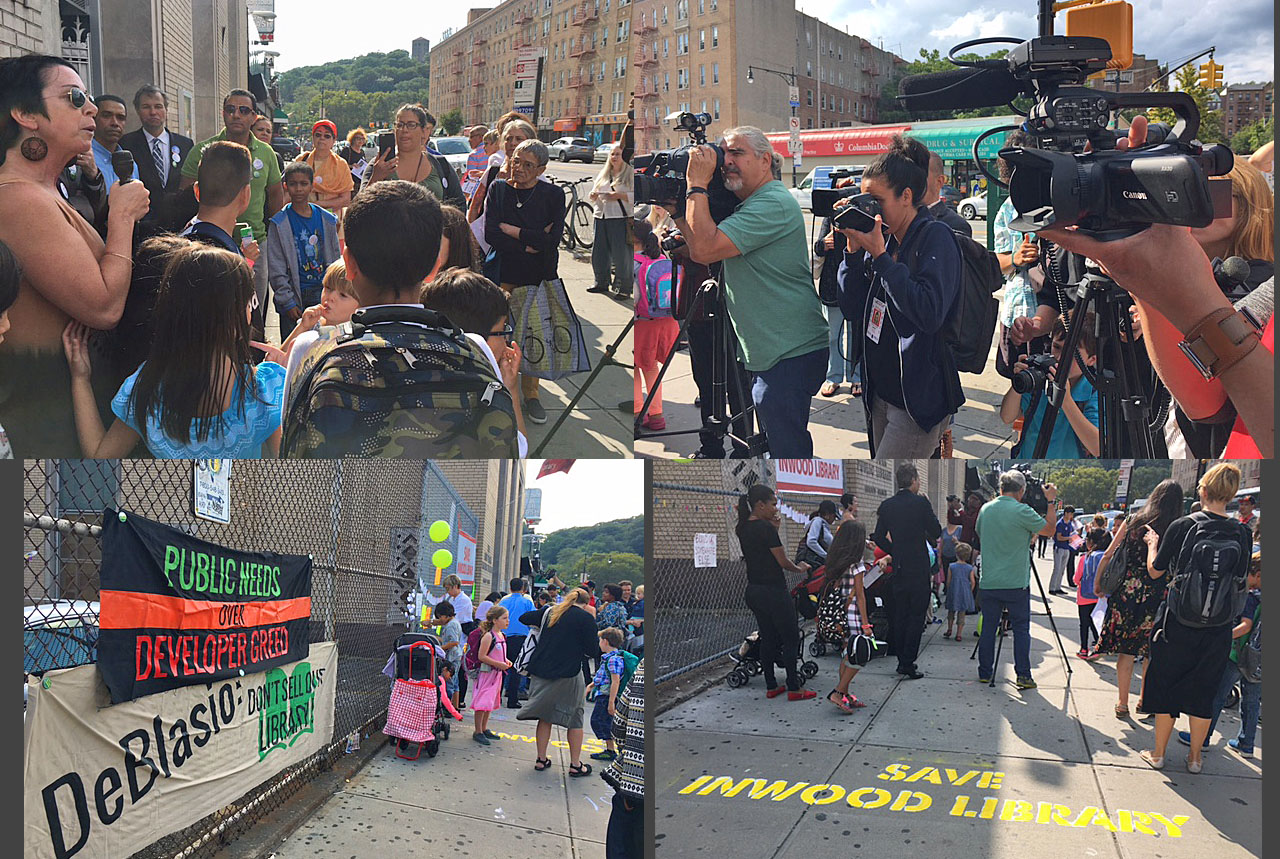
Thursday of this week, David Eisenbach was up in the neighborhood of Inwood standing with a large crowd outside the Inwood Library calling for that library to be saved from sale for development by Mayor Bill de Blasio and his administration.
Save the Inwood Library press conference Thursday
Public Advocate Tish James was not there. In her now nearly four years in office as Public Advocate Tish James has done little to oppose the sale of New York City libraries.
After the current NYC Comptroller, Scott Stringer wrote a strong letter critical of the BPL's sale and shrinkage of its second biggest biggest library in Brooklyn with the current Tish James followed suit to write similarly, and as a candidate for office candidate James campaigned against such shrinkages.
Accordingly, Citizens Defending Libraries endorsed her when she ran for her office. And Ms. James mentioned protecting libraries in both speeches she gave after her two primary wins four years ago. She again mentioned the importance of protecting libraries and our public assets in her inaugural address.
Nevertheless, Ms. James is one of the list of public officials who have not done enough to exercise their formidable powers to protect the libraries from the significant abuses involved in their sales.
Where does David Eisenbach stand on the subject of NYC library sales?
Letter from David Eisenbach, candidate for Public Advocate, decrying library sales.
David Eisenbach has also furnished Citizens Defending Libraries with a letter further expressing his thoughts about stopping these sales and the role of the Public Advocate in that regard.
It reads:
To Supporters of Citizens Defending Libraries,
My name is David Eisenbach. I teach history at Columbia University and I'm running in the September 12th Democratic Primary for Public Advocate because I'm tired of New York City's Democratic establishment selling off our libraries, parks, and hospitals to Big Real Estate. I'm absolutely furious about the city's plan to demolish the Inwood library and sell the property to a developer. Libraries have played an essential role in my life. As a child my local library hosted storytelling and film programs that enkindled a joy for learning and planted the seeds for my career as a writer and History Channel host and producer. My first book was almost entirely researched in NYPL. I think the Inwood Library sellout is symbolic of the sick, distorted priorities of our current society that values money over knowledge. Now more than ever we need to build and expand libraries not tear them down for the highest bidder.
I know 4 years ago Bill de Blasio and Tish James made a lot of promises to Citizens Defending Libraries -- promises that went unfulfilled. It would be very reasonable for you to be suspicious of yet another politician promising to be THE ONE to defend the libraries. All I can say is I don't accept big real estate money. I'm not a career politician looking to use the Public Advocate's office to become mayor - I only want to be Public Advocate. I've dedicated my career to spreading knowledge and sparking a passion for learning in my students. I promise I'll be a Real Public Advocate who will defend Inwood library and all others. So remember to vote this Tuesday.
Sal Albanese, candidate for NYC Mayor, speaking Thursday to Save the Inwood Library crowd
What do Library defenders need to know about the candidates running to be the Democratic candidate for New York City mayor? Sal Albanese and Bill de Blasio are running.
Thursday of this week, Sal Albanese was up in the neighborhood of Inwood standing with a large crowd outside the Inwood Library calling for that library to be saved from sale for development by Mayor Bill de Blasio and his administration.
The Inwood Press Conference Thursday
The news of Bill de Blasio is far more disconcerting, really quite damning. Four years ago the de Blasio campaign called up Citizens Defending Libraries and asked that we stand en mass before another library, the 42nd Street Central Reference Library, so that Mr. de Blasio could trumpet his call to halt the sale and plunder of New York City libraries. He said:
It’s public land and public facilities and public value under threat. . . and once again we see, lurking right behind the curtain, real estate developers who are very anxious to get their hands on these valuable properties
As mayor, de Blasio would go on to pursue the sale of SIBL: That means an elimination of the city’s biggest science library, that will also result in a concomitant shrinkage of the Mid-Manhattan Library, the central library in Manhattan that is the city’s biggest circulating library from which so many books will then disappear. Mayor de Blasio also plans to sell the Inwood Library in another redevelopment scheme just like he is selling the Sunset Park Library.
Four years ago, when de Blasio, Citizens Defending Libraries called up to ask us to produce a crowd while he proclaimed that he was against selling New York City Libraries including the Brooklyn Heights Library, he was trying to catch up with the other candidates for mayor running against him like Sal Albanese (John Liu and others) who were saying these library sales were as wrong as the public absolutely knows them to be. (Previously, candidate de Blasio had blown Citizens Defending Libraries off saying he couldn’t be bothered with the issue of libraries.)
Do want to know what Sal Albanese says about library sales?
Want to hear more about what Mr. Albanese has to say about the library sales?: Tune in the Monday, September 11th to WBAI Radio's Morning Show where he will be interviewed. The topic of libraries is certain to come up.
Sal Albanese at forum by Mike Delia
Here is some of what Sal Albanese said at our Mayoral forum:
“These
libraries are essential to the city’s future and we are watching the
erosion of it. The real estate industry is running amuck, basically, in
this city. That’s what’s happening. I’ve drawn a very, very clear line
when it comes to contributions. I am not accepting a dime from real
estate developers in this city or the lobbyists who represent them.
Look,
real estate developers are business people. They want to maximize
their profits. They see these huge building, these great buildings,
these landmarked buildings like the libraries in Manhattan and Brooklyn
Height and they see dollar signs, but the bottom line is that government
officials should be making decisions on the merits.
They
shouldn’t be working with the real esate industry behind the scenes to
sell these libraries off. We saw what happened with the Donnell
Library, it was sold off in 2007. There was no public input at all.
Where was the City Council? It’s easy to blame Bloomberg, but we do
have a City Council. We have a Public Advocate. We have a
Comptroller. These things don’t happen by accident. They’re not
happening in isolation. I mean where was the public hearing on these
issues that are so important to the city? The City Council does have a
library committee, I think.
* * *
The political system
is really broken and has really been co-opted by big money. The New
York Times has a great editorial today about the real estate industry is
now piling on to get involved in City Council races. They’re spending
millions of dollars. Look, they’re in business. This is what they do.
It’s legal. But elected officials have the obligation to represent the
public, not folks who are trying to maximize their profits.. . .
* * *
Here we do things in an opaque way. It’s not transparent.
* * *
Listen
carefully to what all the candidates say. I’ve said this before:
They're outraged . . They’re furious. . . They’re shocked. You’d think
they were block association presidents. One is the Comptroller, one is
the Public Advocate, one is the Council Speaker! I mean I can’t
believe the incredible nerve of some of these people, because they
should be held accountable for some of the things that have happened in
this city on their watch.
* * *
The City
Council should have held major hearings. It was a major issue and no
one seems to know where $100 million in capital money or how it got to
that point without any real hearing or public input. That’s the crux of
our problem. It’s a broken political system.
* * *
It’s
just wrong and it’s bad public policy. I mean, William Rudin from the
real estate industry was front and center in terms of the proposals to
sell off the libraries [in the Central Library Plan], and they
see tremendous opportunities for huge profits like the sale of Saint
Vincent’s Hospital so I think it’s bad pubic policy. . . .”
Save The Library press conference in Inwood Thursday
We hope that library defenders registered as Democratic in New York City will be voting this Tuesday (September 12, 2017), in the primary. Much of what you as a voter might want to know you were likely to find out if, this Thursday, you were with the crowd up in the neighborhood of Inwood standing outside the Inwood Library calling for that library to be saved from sale from development by Mayor Bill de Blasio and his administration.
You also need to know that a lot of the people who are causing trouble for the communities they are supposed to represent are city councilmen helping to push through sale of the libraries. In the neighborhood of Inwood, Josue Perez is running against the local library-selling city councilman Ydanis Rodriguez and therefore has gotten “support of several Uptown groups, including Save the Inwood Library.” Josue Perez spoke at Thursday’s Save The Inwood Library Press conference.
Josue Perez, running for city council against library-selling Ydanis Rodriguez
Other city council members high on the list NOT to vote for because they favor and push through library sales: Brad Lander, Steve Levin (sales are shrinking two libraries in his district the Brooklyn Heights Library and Williamsburg Library), Carlos Menchaca (selling the Sunset park Library), and Laurie Cumbo.
Ede Fox is running against Ms. Cumbo and her real estate money.
Go digital with your library, submit a selfie and win a prize from Amazon
New Yorkers love their physical library books. . . circulation is way up at the city’s libraries and the bulk of that circulation increase is physical books. . . And NYC library officials are doing their utmost to promote digital books instead of what they derisively refer to in their board meetings as old-fashioned, archaic “analogue books.”
The library officials' effort to steer patron into digital books includes an expensive new campaign you’ll surely be seeing if you ride the subways in the next few weeks. Library officials have been proclaiming how they want to follow a new business model of looking for partnerships with the private sector and to garner attention the new campaign offers the public prizes from Amazon.
Amazon “controls 74 percent of e-book sales” and in multiple other ways is one of the world’s hugest monopolies astoundingly unfettered by anti-trust regulation, its proposed acquisition of Whole Foods and its more than 400 stores just another accretion of its formidable market dominance. See New York Times Op-Ed- Amazon Bites Off Even More Monopoly Power, by Lina M. Khan, June 21, 2017.
We are no down to just five men owning as much wealth as half the world’s population, and since money is power, that’s five men having as much power as half the world’s population. One of those men is Jeff Bezos, founder, chairman, and chief executive officer of Amazon.
Among other things, Jeff Bezos owns the Washington Post which reports on the elected representatives in Washington who decide whether Amazon should be reined in and regulated, the antitrust laws applied to it.
All three of the city’s three library systems, The New York Public Library, Brooklyn Public Library, and Queens Public Library have joined together in this promotion, which offers free e-book downloads in subway stations, although reportedly the Subway Library site was developed by the NYPL. The MTA, another public entity, is also engaging in the promotion along with Transit Wireless, the entity that has a 27 year contract to provide wireless in the subways (itself partnering with AT&T, Sprint, T-Mobile and Verizon).
It took a long time to get cell phone and wireless service in the subways. The delay (about five years after technology could have been implemented) was once justified by the explanation of terrorism fears: It was though that the possibility that terrorists would use communications effectively for their purposes if those communications they because available underground, ought to outweigh the advantages and safety enhancements for the public (including a public under attack). As for being safe, the addition of security cameras were planned at the same time with who knows what else.
Subway placard advertising and ubiquitous posters on subway station walls
The campaign is being promoted by posters throughout subway system
stations, advertising placards on the trains, and postings on the
digital subway kiosks that now give subway information if you interrupt
their other advertising. The campaign also involves decorating a subway
train to look like the "Rose Reading Room," in the NYPL's
central reference library. What makes the decoration an identifiable
attempt to to look like the Rose Reading Room is the inclusion of the
ceiling painted to resemble the the Rose Reading Room ceiling that keeps gettingproblematically injured.
There is a video available of the Rose Reading Room train. Then there is the sweepstakes contest a
competition that encourages riders to take selfie photos next to a
literary-themed subway car and share it via social media. Those who use
the hashtag #SubwayLibrary and tag @TWWiFi have the chance to win an
Amazon Kindle Voyage or prizes from the NYPL. Perhaps not so coincidentally the same subway kiosks advertising the selfie photos contest also advertise Pokemon Go. . .
. . . NYPL President Tony Marx said the program for straphangers was "encouraging reading, learning,
and curiosity."
Earlier this week
when a Tuesday night presentation by Marvel Architects about their
designs for a vastly shrunken Brooklyn Heights Library was poorly
received with the public attendees complaining and asking for details
about the loss of books, one of the apparent shills for the plan (sitting
with library-sale-and-shrinkage promoter Deborah Hallen and hobnobbing with the
development types) tried to defend the loss of physical books that
resulted from the shrinking of the library by brightly asking: “How many
more digital books will be available” in the shrunken library?
Each of the library heads got one quote in the press program release. Queens
Library President and CEO Dennis M. Walcott said "Subway Reads aligns
perfectly with this objective, and will lead even more people to Queens
Library's extensive collection of e-books, audio books, music and
digital magazines."
Here is other coverage of the Subway Library promotion. Although some of the pictures are nice, you'll save time if you read the press release that actually tells you more.
Mr. Reynold Levy on Charlie Rose, and left, his board member bio on the Revson Foundation website
Back in 2015, Noticing New York, in an article that tracked Sharon Greenberger and some of the other people involved in selling off libraries and public assets, took a look at the library-selling activities of the Revson Foundation and the consequently interesting composition of the Revson Foundation’s board. See: Where Are They Now?: Sharon Greenberger, Evercore and the Revson Foundation- Selling And Shrinking NYC Libraries (Saturday, June 6, 2015).
Currently "chair" of the Revson Foundation?
Missed at the time, and who without precognition could know its relevance then, was Reynold Levy. Reynold Levy, another board member of the library-selling Revson Foundation. What makes this particularly interesting is that (appointed September 2015*) Mr. Levy stepped in to the role of president of the Robin Hood Foundation, which in January emerged as a prominent entity trying to bring about the sale for development of the Inwood Library. Although the assertion does not match what is currently on the Revson
Foundation website, Mr. Levy's bio on his own website says he is
currently the "chair" of
the Revson Foundation. (On the other hand, the Revson Foundation's bio for
Mr. Levy appears to be out of date in other key respects.)
(* Quite recently, belying its original press release appointing him and associated publicity, the New York Times reported that the appointment was “on a transitional basis.” See: Robin Hood, Favorite Charity on Wall Street, Gets New Leader, by Elizabeth A. Harris, April 25, 2017. Perhaps he was not the right image for a foundation promoting privatizing charter schools.- The Executive Director now newly heading Robin Hood is black.)
The Inwood community is not pleased that Robin Hood, the "favorite charity on Wall Street," wants to sell its library. In fact, there aren't any communities that are pleased about the way these real estate plans backed by the Revson Foundation and Robin Hood Foundation please developers and not communities. . .
. . . Is it maddening or just ironic to an ugly fault that one of Mr. Levy's claims to fame is that he authored a book whose short title is: “They Told Me Not To Take That Job”?
Placard we carried at the April 29th Climate March
This post will be updated.
Saturday, April 29, Citizens Defending Libraries had representatives in Washington D.C. to spread the word, handing out thousands of flyers, that the shrinking and elimination of our libraries also threatens us with the loss of the information we need to know about climate change and how to deal with it. For instance, the biggest science library in New York City, SIBL, the Science, Industry and Business Library, definitely one place you would hope to go to study climate change, is now being closed down, totally eliminated, the collection of science books it is supposed to house is biting the dust.
NYPL officials provided the New York City Council December 14th with an extremely dubious excuse for elimination of the Science library and its books: that it had abandoned collection of science books, expecting that people can resort to "the internet" to learn about science instead.
Really? . . .
. . . The headlines in days before the Climate March were helping us make the case how specious this reasoning was.
• Two days before the Climate MarchFCC Chair Ajit Pai unveiled a plan to end net neutrality, essentially privatize the internet meaning that private financial interests will will control the rights deciding the availability of information on the internet and how accessible it is:
In Washington, D.C., the chair of the Federal Communications Commission on Wednesday outlined a sweeping plan to dismantle net neutrality rules, which seek to keep the internet open and prevent corporate service providers from blocking access to websites, slowing down content or providing paid fast lanes for internet service.
• The day before the Climate March the Trump administration removed the Evironmental Protections Agency's pages relating to climate change, climate science, the impacts of climate change and what readers can do about climate change, all gone from the site replaced with a banner headline saying "this page is being updated." See: EPA removes climate change page from website,by Devin Henry, April 28, 2017.
Citizens Defending Libraries co-founder Carolyn McIntyre at the Climate March
Citizens Defending Libraries co-founders Carolyn McIntyre and Michael D. D. White at the Climate March
Here are the flyers we distributed thousands of at the March-
Small Flyer distributed at Washington D.C. April 29 Climate March.
Small Flyer distributed at Washington D.C. April 29 Climate March.
Sign our petition on the web: Citizens Defending Libraries
Take action and inform yourself via
our web pages, Facebook, Twitter & Youtube
Flyer distributed at Washington D.C. April 29 Climate March.
Flyer distributed at Washington D.C. April 29 Climate March.
Eliminating Books, Selling and Shrinking Libraries- is an attack on Democracy, equal access and opportunity. . .. . and our chance for all of us to know about climate change and participate in its solutions?
DID YOU KNOW?:
• Canada's government has destroyed irreplaceable climate change data in Canadian libraries, collected at taxpayer expense and gathered over more than a hundred years. Canada has the world's longest coastline, traveling up into the Arctic where some of the fastest, most critical climate change is taking place.
• Records once available respecting New York climate history are no longer to be found at the NYPL's 42nd Street Central Reference Library. Banishing books, the NYPL is also totally eliminating the 34th Street Science Library because science can be fund “on the internet,” but the Trump administration is purging internet climate change information and wants to dispense with “net neutrality” access to information.
• The reckless bulk destruction of rare and valuable books and information at the San Francisco Public Library meant that books with information about global warming were trashed and sent to landfills as the library bankrupted itself, shrinking into a technologically focused `library of the future'.
• In the empty shelves of Brooklyn Public Libraries you can’t find Jane Jacobs’ writings suggesting that the answers for humanity’s survival will be developed ground up and that our relationships with nature need to be symbiotic.
Are libraries being purged of information with the Orwellian objective of preventing the public from knowing what it needs to know and creating more manageable, easier to control, top-down narratives in sync with the latest Koch brothers press releases?
Will our future news and information have to come from the likes of fracking endorser former NYC Mayor Michael Bloomberg, appointed as United Nations `Climate Change Envoy'?
Sign our petition on the web: Citizens Defending Libraries
Take action and inform yourself via
our web pages, Facebook, Twitter & Youtube
(You can also sign petitions against the elimination of net neutrality like the one from Mozilla.)
First Unitarian Congregational Society of Brooklyn's Weaving the Fabric of Diversity & Citizens Defending Libraries present the fourth Forum on Selling Off Public Assets
Saturday April 8, 2017, 2:30 - 5:00 PM,
116 Pierrepont St, Brooklyn, NY 11201
Panel Discussion Speakers:
Lynn Ellsworth founded the Tribeca Trust, a civic organization, and is a co-founder of the Alliance for a Human-scale City, a network of over 100 community and civic groups from all five boroughs. Lynn founded the Friends of Duane Park and created the Inside Tribeca Loft tour in 1994. Lynn is most proud of orchestrating the restoration of a public park that had been paved over by Robert Moses. She is working on a book about the political economy of historic districts and humanscale urbanism, with a working title: In the Shadow of the Skyscraper. Lynn Ellsworth is a Mom and dog-owner who lives in Tribeca.
Alicia Boyd is a community activist in the Crown Heights/Flatbush and Prospect Lefferts Garden community. Alicia has been very effective in challenging local politicians and focusing on the empowerment of the community through the Community Board. She is the co-founder of MTOPP - The Movement To Protect People, Empire Study Group and FLAC - Flower Lovers Against Corruption. Alicia is most proud of stopping a major up zoning planned in her community. Alicia Conducted one of the largest Brooklyn Anti-gentrification and Displacement forums at the Brooklyn Museum. Alicia's organization has filed 6 lawsuits against the Community Board, Borough President Eric Adams and the Office of Budget and Management. She can be reached at www.mtopp.org or (718) 703-3086.
Tom Angotti is Professor of Urban Policy & Planning at Hunter College and the Graduate Center/CUNY. He recently coedited Zoned Out! Race, Displacement and City Planning in New York City and previously authored New York For Sale: Community Planning Confronts Global Real Estate.
Michael D. D. White is a co-founder Citizens Defending Libraries, a lawyer and an urban planner who worked for NYC and the NYS public finance agencies for over a quarter century. He writes Noticing New York about development in NYC and associated politics and National Notice about national economic and policy issues.
Carolyn McIntyre is another of the co-founders of Citizens Defending Libraries, a social worker and therapist practicing in New York. She is married to Mr. White.
1. The “spectacles” through which public assets are viewed for potential privatizing- Monetizable, Quantifiable, Potential operation of exclusion principle
a. Private owner decision making vs. decision in the commons
b. Corporate mentality (what this means for absence of ethics)
c. Conglomerate thinking (i.e. top–down and ever increasing consolidation of wealth thinking, invisibility of people as people)
d. Wealth inequality (and the vicious cycles in play)
e. Realms in addition to public commons under attack (family, private, and spiritual life)
f. Flip side argument- The “tragedy of the commons”, Wikipedia, Twitter, Overfishing of the ocean, Safari parks and wildlife preserves in Africa, Oscar Newman’s “Defensible Space” vs. Jane Jacobs’ “Eyes on the Street.”
2. Examples of public assets under attack: Libraries, parks, playgrounds and memorials, schools & colleges, hospitals, public housing and buildings built on city-owned land, fire houses, police stations and post offices, prisons, light and air (zoning) and public ownership of the streets, the environment, the public airwaves, the internet, knowledge and information, culture.
3. Methods of takeover: The shock and awe tactics of defunding etc.
4. “Private Public Partnerships” - Jane Jacobs’ “monestrous hybrids” and "if you ride with the devil, sooner or later he’s gonna drive." Withheld public benefits used as lures to permit private profit. (20 minutes)
5. One way to take over public assets?: Usurpation of ownership/control of those who own and protect the public assets:
a. Taking over elected officials, political parties, elections and government
b. Community Boards and property-owner-controlled “Business Improvement Districts.”
c. 501(c)(3)s and charitable organizations, library boards, museums, public broadcasting, etc.
d. AstroTruf Groups:
i. Those groups formed for the purpose of being AstroTurf, capturing and co-opting expected and logical opposition.
ii. Takeover of sometimes venerable legacy groups with proven past records of protecting and representing the public.
6. Who’s to thank? Some recurring characters and political operatives
7. Ways to protect the public. Who are our allies? Raising awareness. Peoples Puppet Theater.
Our Public Assets Under Attack- A Calamity of the Commons Unfolding That We Must Act Collectively Against- How best To Express It?
But how to express it? With multiple forums we have been working on that.
A Sign-On Letter of Support: We Stand Collectively Against The Sale of Public Assets- For Your Consideration
We sign this letter urging the protection of our public assets hoping that you as our elected officials will take our message to heart recognizing us as the public constituency to which you are properly accountable.
Our public assets, our public properties are under attack. We believe the situation is increasingly dire. That which endows the public realm and the public commons with its value and essential meaning is in jeopardy. In deals that skew toward private profit at public expense, greed is exceeding itself as never before to push the envelope of what is conceivable everywhere we look.
Public parks and public buildings built on city-owned land. . schools, colleges, libraries, fire houses, playgrounds, police stations, hospitals, housing, memorials . . these public assets are part of our New York heritage, civic architecture and crucial infrastructure and resources that belong to everyone. If city services are relocated, cut back or curtailed when city buildings are privatized, everyone loses, except the privileged few who arrive on the scene purporting to be our new "private partners."
To acquaint yourself more fully with the spectrum of assets under attack look at the names of the groups signing this letter and consider the assets those groups were formed to protect. Their statements about why they are signing this letter elucidate this crisis further.
Built by our forefathers with public funds and resources, assembled over decades, some more than a century ago, the basic amenities of the public realm that are at stake are increasingly irreplaceable. The same rapidly escalating land values underlying these properties and the prime locations that put them squarely in the sights of the real estate industry virtually assures the impossibility of the public's reacquiring such treasures ever again. Similarly, the master craftsmanship and natural materials of the traditional architecture these assets feature will be increasingly costly and hard to obtain, or in anyway replicate.
Part of the problem is that we are in an era of increasing income and wealth inequality with the most affluent in our society lowering the taxes they pay. Some may assert that a significant diminishment and elimination of the public realm must therefore be accepted as inevitable even as the city and its wealth continue to grow. We, however, choose to view this new imbalance as temporary and subject to correction.
More insidious is how the growing political inequality and the power that flows from mounting economic disparities is being abused. We witness the interests of money repeatedly prioritized over the rights of the voting electorate as potent influence is exercised to lay siege to our public properties.
We cannot let a privileged few with special access show up on the steps of government with plans to sell and privatize our assets, plundering their value. Because these losses are so tragically permanent and long-term we must think in terms of the future, banding together to face the current assault and draw the line, doing everything we can to ensure our public assets are protected immediately.
Although the reasons for alarm should be obvious, we are concerned that the public servants we must look to as guardians too frequently are not alert or responsive. Outcry is essential when reorganizations under the rubric of "partnerships" convey responsibility for the provision of basic government functions, like public schools, parks and public libraries to those focused on private profit. In these situations we find the public baited into accepting Faustian bargains premised on notions that the unacceptable be accepted.
Brutally inverted propositions perplex the public:
• Your city can't keep pace with the rampant development in your vicinity to provide the public school expansion now needed? A developer will provide the public school if it can do whatever it wants with a historic district, turned over to it as ransom.
• The city refuses libraries their traditional and appropriate level of funding? You may be told that you can have a better library if the community consents to upzoning because libraries are openly discussed as nice "placating" gestures, tactics, to push through developers' schemes.
In all these situations the private offerors' incentive is to minimize public benefit while maximizing private profit. Our new private gatekeepers benefit from withholding public benefit, particularly since dribbling benefits out in the smallest possible increments will allow them to return more often with new proposed "bargains." Even worse, the private sector is given an incentive to foment public crisis for private exploitation.
When the job of managing our public properties is captured by private interests with altered agendas, we see a dismaying shift of balance in the way these so-called "partners" manage things and the outcomes that result. We get, for instance, the spectacle of hospitals expertly administered by top-talent professionals who skillfully deliver premium real estate deals while entrusted community health care facilities are steered into bankruptcy.
Over and over again we see a lack of transparency with the adoption of unnecessarily complicated governance structures and funding mechanisms, set-ups that seem best contrived to deflect accountability.
Reflect and you will probably recognize these aspects of commonly recurring modus operandi by those raiding public treasures:
• Withhold funds claiming there's no money for public assets or that what we publicly own can only be funded with self-cannibalizing sell-offs.
• Manufacture crisis conditions and present false choices, seeking to promote "TINA" narratives ("There Is No Alternative"). This can include overestimating and inflating repair and maintenance costs while so-called "solutions" are rushed forward.
• Underestimate the value of what the public owns. This way assets (e.g. Donnell Library) can be disposed of at far less than true value benefitting developers and escaping accountability to the public.
• Do top-down designed deals that the public will be the last to know about, part of a general effort to eliminate the public from discussions to the maximum extent possible.
• Stack decision-making boards with people who are unsympathetic to those served by the targeted assets.
• Do deals calibrated to be benefit .01% while frequently, opportunistically, taking advantage of income inequality to target assets that have more value to the less politically powerful and less advantaged.
• Dismiss alternatives to protect and preserve the assets. (Includes obfuscating and ignoring facts).
The way in which we see our public assets attacked are obvious symptoms of another major necessary conversation that looms in the background. When assets the public clearly cherishes and would chose to pay for are targeted for transfers catering to private objectives we know that we must recognize the root causes for this neglect of the public will. Money in politics, election and campaign finance reform must be addressed. Still, it is essential that our public assets be protected now without these more encompassing, albeit related, battles having to be won first. In fact, we cannot let these conversions of public capital into even more private gain additionally fuel the imbalance and inequity being fought.
We believe that it is important to view all these many attacks on our public assets as being all of a whole. All of these lop-sided deals should receive collective scrutiny. The often common and repeated stratagems employed against the public should be looked at on an integrated basis, which includes noting that there is a high frequency of overlap among the players and political operatives that present them to us.
We request your support and your statements of allegiance. Most of all we request that you take action that is observable as effective. Not only are we reaching out, we will also be watching.
All who represent us and are charged with protecting our interests need to roundly and soundly agree that this era of putting the public's property on the auction block is an era who's time has passed. It was never sustainable in the first place. Whenever deals like these present themselves we must recognize them for the cheats and swindles that they are, greet them as dead on arrival and pack them off with the quick funerals they deserve.
"That's the standard technique of privatization: defund, make sure things don't work, people get angry, you hand it over to private capital."
"Privatization does not mean you take a public institution and give it to some nice person, it means you take a public institution and give it to an unaccountable tyranny."
• Canada’s National Union of Public and General Employees (NUPGE) VIDEO: The Privatization Zombie, September 19, 2013